Charlotte Court House in Charlotte County, Virginia — The American South (Mid-Atlantic)
Central High School
Charlotte Court House, Virginia
| — | Charlotte County | — |
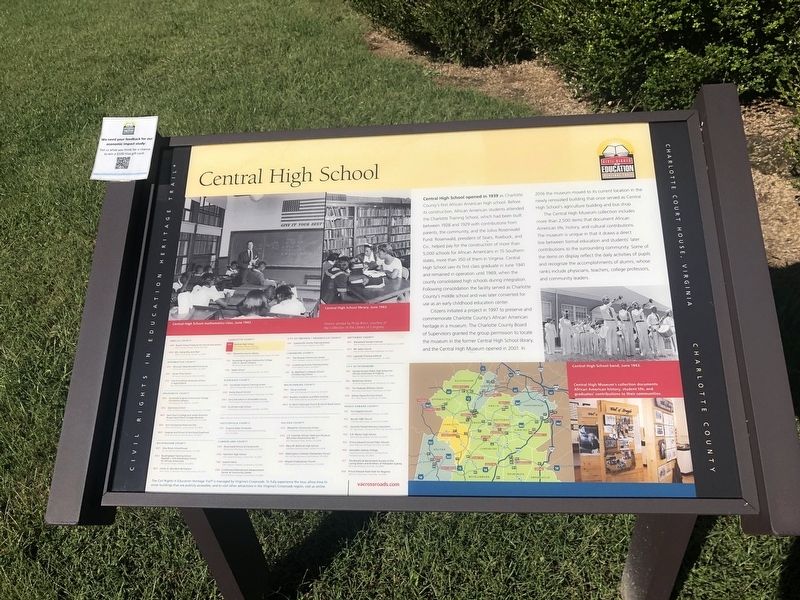
Central High School opened in 1939 as Charlotte County's first African American high school. Before its construction, African American students attended the Charlotte Training School, which had been built between 1928 and 1929 with contributions from parents, the community, and the Julius Rosenwald Fund. Rosenwald, president of Sears, Roebuck, and Co., helped pay for the construction of more than 5,000 schools for African Americans in 15 Southern states, more than 350 of them in Virginia. Central High School saw its first class graduate in June 1941 and remained in operation until 1969, when the county consolidated high schools during integration. Following consolidation, the facility served as Charlotte County's middle school and was later converted for use as an early childhood center.
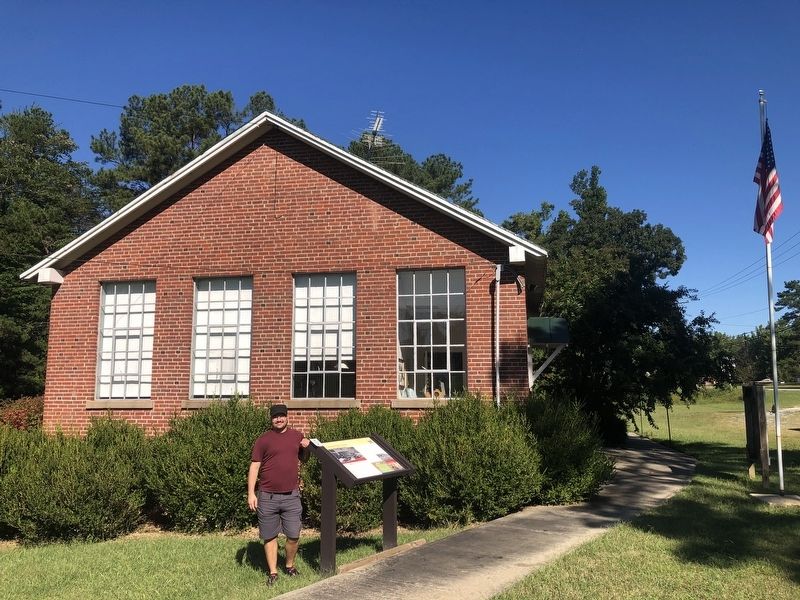
Citizens initiated a project in 1997 to preserve and commemorate Charlotte County's African American heritage in a museum. The Charlotte County Board of Supervisors granted the group permission to locate the museum in the former Central High School library, and the Central High Museum opened in 2001. In 2016 the museum moved to its
this page online
The Central High Museum collection includes more than 2,500 items that document African American life, history, and cultural contributions. The museum is unique in that it draws a direct line between formal education and students' later contributions to the surrounding community. Some of the items on display reflect the daily activities of pupils and recognize the accomplishments of alumni, whose ranks include physicians, teachers, college professors, and community leaders.
Erected by Civil Rights in Education Heritage Trail. (Marker Number CR1.)
Topics and series. This historical marker is listed in these topic lists: African Americans • Charity & Public Work • Civil Rights • Education. In addition, it is included in the Civil Rights in Education Heritage Trail, and the Rosenwald Schools series lists. A significant historical month for this entry is June 1941.
Location. 37° 3.943′ N, 78° 38.023′ W. Marker is in Charlotte Court House, Virginia, in Charlotte County. It is on Thomas Jefferson Highway

Regionally, this marker is in the Piedmont, in Southside Virginia, and specifically in Central Virginia. It is also in the American South and specifically in the Upper South. Globally, it is in North America, the Western Hemisphere, the Western World, and the Anglosphere. Historically, it finds itself in what was once the territory of the Mississippian Culture, one of the original Thirteen Colonies, one of the Confederate States of America, and the Antebellum South.
Other nearby markers. At least 8 other markers are within walking distance of this marker: Charlotte Court House (approx. 0.7 miles away); Joseph R. Holmes (approx. 0.7 miles away); Veterans Memorial (approx. 0.7 miles away); Confederate Monument Interpretation (approx. 0.7 miles away); Charlotte County Confederate Monument (approx. 0.7 miles away); Henry and Randolph (approx. 0.7 miles away); Constitutional Oak (approx. 0.7 miles away); Charlotte County Library (approx. 0.7 miles away). Touch for a list and map of all markers in Charlotte Court House.
Other markers no longer nearby. Charlotte Court House (was approx. 0.7 miles away but has been replaced with another marker now near it); Henry and Randolph's Debate (was approx. 0.7 miles away but has been replaced with another marker now near it).
Credits. This page was last revised on September 25, 2021. It was originally submitted on September 25, 2021, by Devry Becker Jones of Washington, District of Columbia. This page has been viewed 1,015 times since then and 86 times this year. Photos: 1, 2. submitted on September 25, 2021, by Devry Becker Jones of Washington, District of Columbia.
