San Bruno in San Mateo County, California — The American West (Pacific Coastal)
First Shipboard Landing
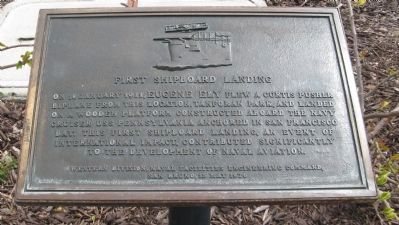
Photographed by Syd Whittle, April 24, 2009
1. First Shipboard Landing Marker
Erected 1976 by Western Division Naval Facilities Engineering Command, San Bruno, 15 May 1976.
Topics. This historical marker is listed in these topic lists: Air & Space • Waterways & Vessels. A significant historical date for this entry is January 18, 1911.
Location. 37° 38.175′ N, 122° 25.151′ W. Marker is in San Bruno, California, in San Mateo County. It can be reached from El Camino Real. Touch for map. Marker is at or near this postal address: 1150 El Camino Real, San Bruno CA 94066, United States of America. Touch for directions.

Regionally, this marker is in the San Francisco Bay Area and on the Coast Ranges. It is also on the American Pacific Coast. Globally, it is in North America, on the Ring of Fire, on the Pacific Rim, in the Western Hemisphere, in the Western World,
this page online
Other nearby markers. At least 8 other markers are within 2 miles of this marker, measured as the crow flies: Tanforan Racetrack Japanese Assembly Center (here, next to this marker); Seabiscuit (about 300 feet away, measured in a direct line); Tanforan Assembly Center Commemorative Garden (about 300 feet away); Transportation Evolution (approx. 0.7 miles away); Development of Industry in the Area (approx. 0.7 miles away); Cut Stone Bridge (approx. 0.7 miles away); State Theater/State Room (approx. 1.3 miles away); Martin Building (approx. 1.4 miles away). Touch for a list and map of all markers in San Bruno.
More about this marker. Marker is located at the entrance to the Tanforan Shopping Center.
Also see . . .
1. Eugene Burton Ely. Shortly before 11 AM on the morning of 18 January 1911, after the usual weather-driven delays, Ely took off from Tanforan racetrack. Pennsylvania was anchored off the San Francisco waterfront, in full view of thousands of spectators ashore, on ships at the city piers,
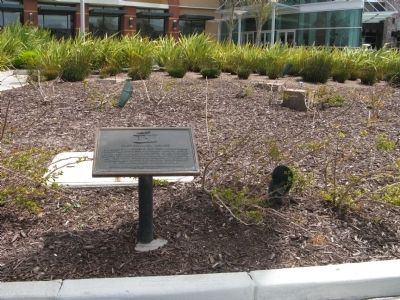
Photographed by Syd Whittle, April 24, 2009
2. First Shipboard Landing Marker
Wikipedia replacement for this broken link. (Submitted on April 28, 2009.)
2. California National Guard's First (Naval) Aviator Eugene Burton Ely, by Mark J. Denger. "In February 1910, shortly following America's First International Air Meet in Los Angeles, E. Henry Wemme purchased one of Curtiss' first 4-cylinder Biplanes and took the agency for them in the Northwest. However, having never flown, nor having any actual knowledge of aircraft, Wemme found himself unable to fly it. Eugene Ely offered to try to fly the little 4-cylinder plane, but
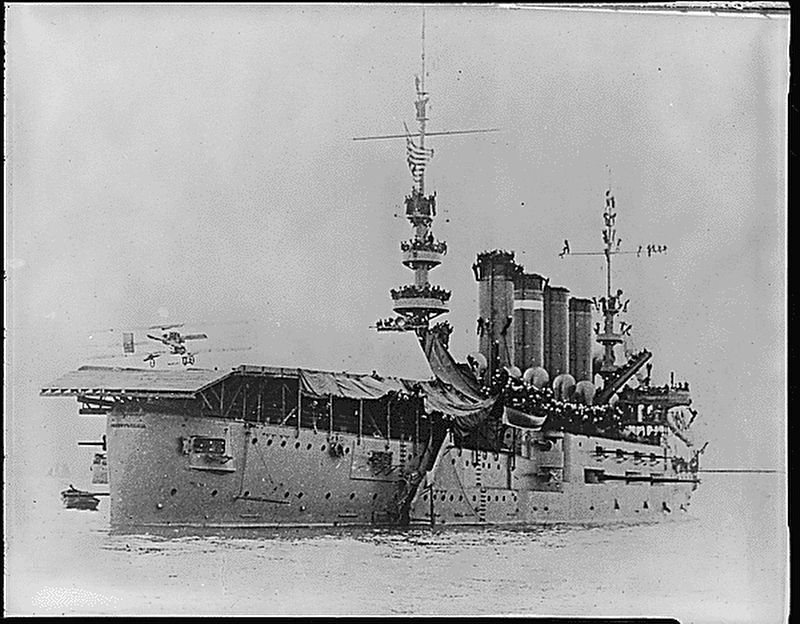
Photographed by Unknown Photographer, January 18, 1911
3. World’s First Nautical Landing
“Pennsylvania (Armored Cruiser 4), starboard stern quarter with Eugene P. Ely landing plane on flight deck.” From the National Archives Catalog, General Records of the Department of the Navy. The airplane had a rear-facing propeller.
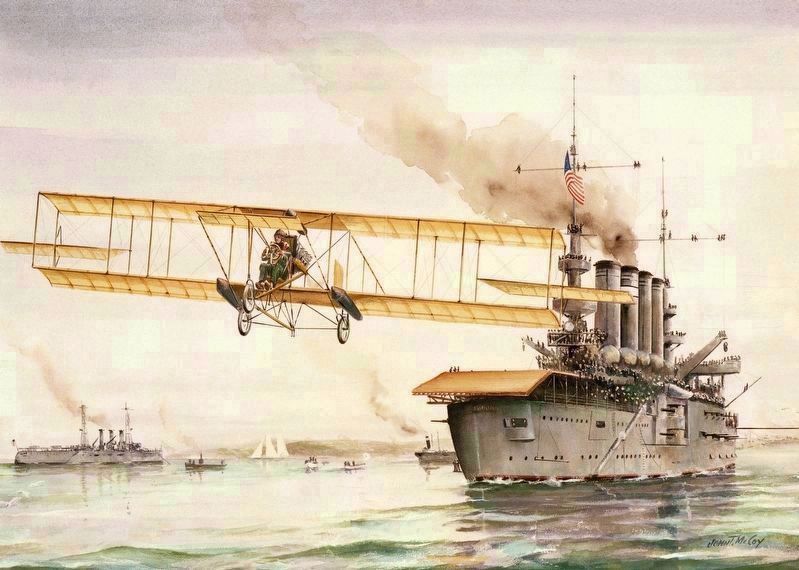
Artwork by John McCoy, 1984
4. World’s Second Nautical Takeoff*
“Eugene Ely Taking Off from the USS Pennsylvania, July 18, 1911.” He had landed earlier that day. From the National Archives Catalog, Records of the Office of the Secretary of Defense. *The first takeoff was also by Ely on November 14, 1910, off the USS Birmingham in Norfolk, Virginia. If you click on the image to expand it you can see the grappling hooks that snagged the arresting wires during landing.
Credits. This page was last revised on February 5, 2026. It was originally submitted on April 28, 2009, by Syd Whittle of Mesa, Arizona. This page has been viewed 7,921 times since then and 135 times this year. It was the Marker of the Week January 13, 2019. Photos: 1, 2. submitted on April 28, 2009, by Syd Whittle of Mesa, Arizona. 3, 4. submitted on January 12, 2019, by J. J. Prats of Powell, Ohio.
