Downtown in Sioux Falls in Minnehaha County, South Dakota — The American Midwest (Upper Plains)
Horse-Drawn Streetcars
October 23, 2021
1. Horse-Drawn Streetcars Marker
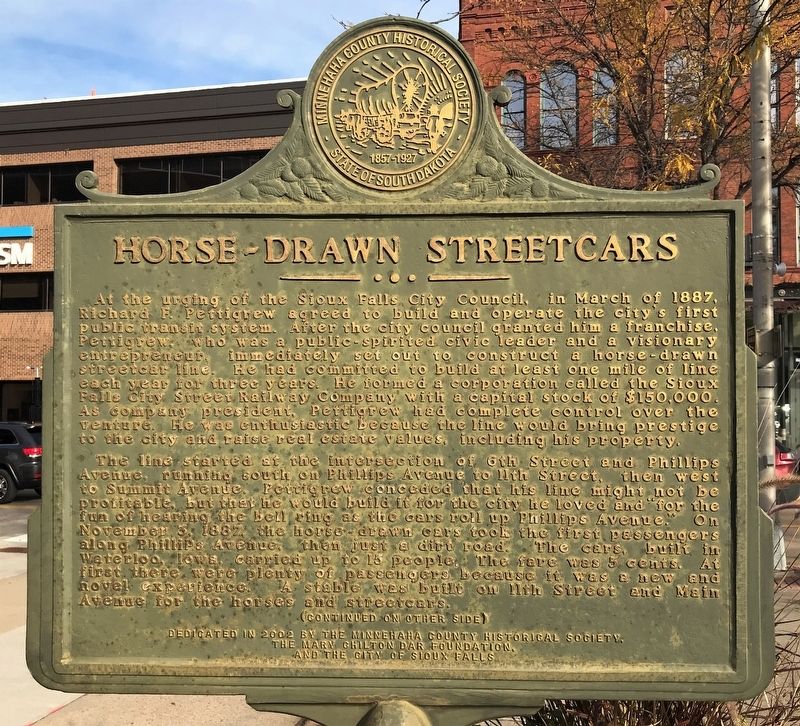
The line started at the intersection of 6th Street and Phillips Avenue, running south on Phillips Avenue to 11th Street, then west to Summit Avenue. Pettigrew conceded that his line might not be profitable, but that he would build it for the city he loved and "for the fun of hearing the bell ring as the cars roll up Phillips Avenue." On November 3, 1887, the horse-drawn cars took the first passengers along
this page online
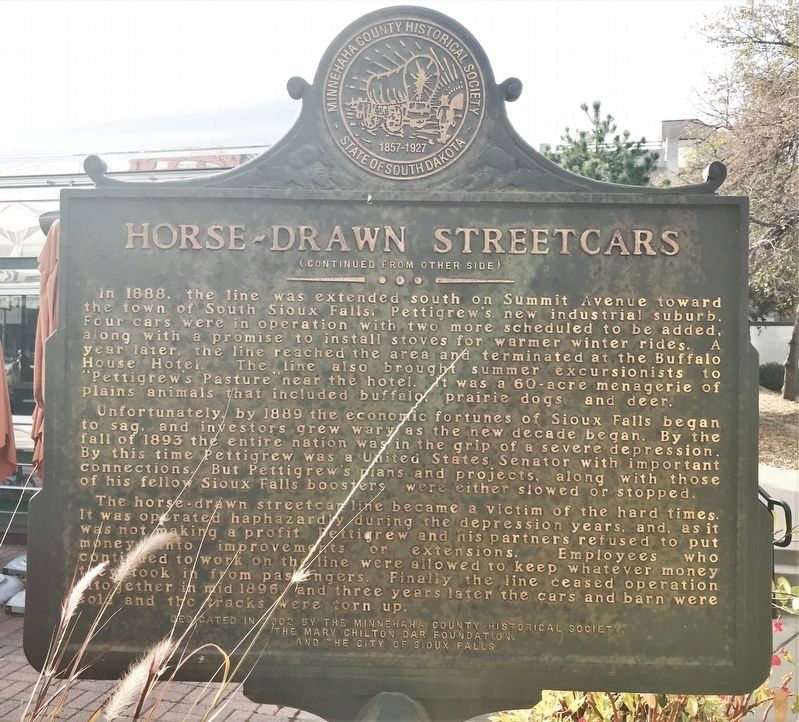
In 1888, the line was extended south on Summit Avenue toward the town of South Sioux Falls, Pettigrew's new industrial suburb. Four cars were in operation with two more scheduled to be added, along with a promise to install stoves for warmer winter rides. A year later, the line reached the area and terminated at the Buffalo House Hotel. The line also brought summer excursionists to "Pettigrew's Pasture" near the hotel. It was a 60-acre menagerie of plains animals that included buffalo, prairie dogs, and deer.
Unfortunately, by 1889 the economic fortunes of Sioux Falls began to sag, and investors grew wary as the new decade began. By the fall of 1893 the entire nation was in the grip of a severe depression. By this time Pettigrew was a United States Senator with important connections. But Pettigrew's plans and projects, along with those of his fellow
October 23, 2021
2. Horse-Drawn Streetcars Marker
The horse-drawn streetcar line became a victim of the hard times. It was operated haphazardly during the depression years, and, as it was not making a profit, Pettigrew and his partners refused to put money into improvements or extensions. Employees who continued to work on the line were allowed to keep whatever money they took in from passengers. Finally the line ceased operation altogether in mid 1896, and three years later the cars and barn were sold and the tracks were torn up.
Erected 2002 by Minnehaha County Historical Society, the Mary Chilton DAR Foundation, and the City of Sioux Falls.
Topics and series. This historical marker is listed in this topic list: Railroads & Streetcars. In addition, it is included in the Daughters of the American Revolution (DAR) series list. A significant historical month for this entry is March 1887.
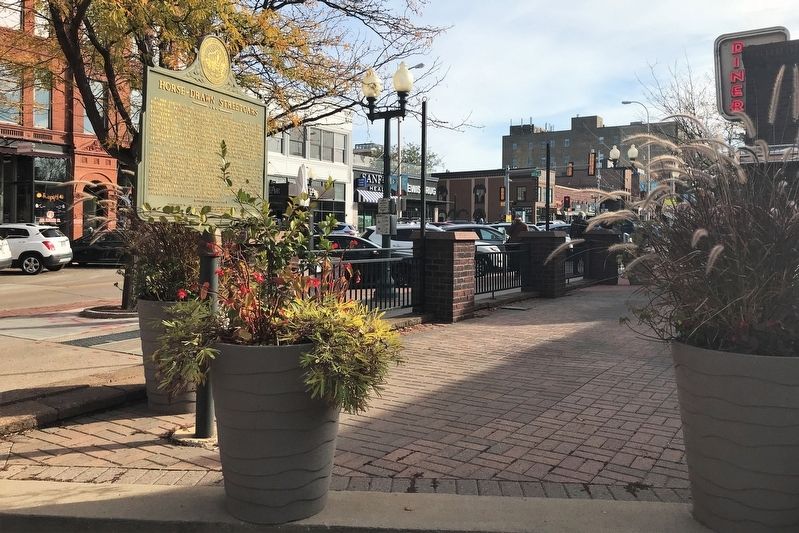
Location. 43° 32.793′ N, 96° 43.619′ W. Marker is in Sioux Falls, South Dakota, in Minnehaha County. It is in Downtown. It is on South Phillips Avenue south of 9th Street, on the right when traveling south. Touch for map. Marker is at or near this
October 23, 2021
3. Horse-Drawn Streetcars Marker, from the north

Regionally, this marker is in East River. It is also in the American Midwest, in the Lewis & Clark Corridor, in the Corn Belt, on the prairies, and on the Northern Plains. Globally, it is in North America, the Western Hemisphere, the Western World, and the Anglosphere. Historically, it finds itself in what was once Rupert’s Land and also the Louisiana Purchase.
Other nearby markers. At least 8 other markers are within walking distance of this marker: Phillips Avenue Plaza (a few steps from this marker); Tasunke-Ota (within shouting distance of this marker); Hattie C. Phillips (within shouting distance of this marker); The First National Bank in Sioux Falls (within shouting distance of this marker); Site of First Home (within shouting distance of this marker); The "Squatter" Government at Sioux Falls City (about 400 feet away, measured in a direct line); The Donahoe Clinic (about 400 feet away); Radio Station KSOO (about 400 feet away). Touch for a list and map of all markers in Sioux Falls.
Credits. This page was last revised on February 16, 2023. It was originally submitted on October 27, 2021. This page has been viewed 437 times since then and 46 times this year. Photos: 1, 2, 3. submitted on October 27, 2021. • J. Makali Bruton was the editor who published this page.
