
Riverfront in Wilmington in New Castle County, Delaware — The American Northeast (Mid-Atlantic)
The Great Railroad Boom
Riverfront Wilmington
"Passenger service to Philadelphia and New York. All aboard!"
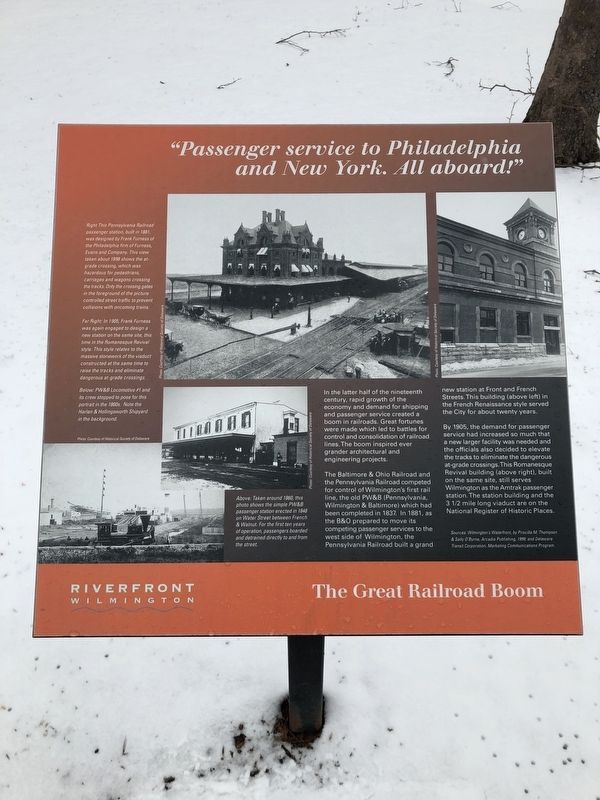
In the latter half of the nineteenth century, rapid growth of the economy and demand for shipping and passenger service created a boom in railroads. Great fortunes were made which led to battles for control and consolidation of railroad lines. The boom inspired ever grander architectural and engineering projects.
The Baltimore & Ohio Railroad and the Pennsylvania Railroad competed for control of Wilmington's first rail line, the old PW&B (Pennsylvania, Wilmington & Baltimore) which had been completed in 1837. In 1881, as the B&O prepared to move competing passenger services to the west side of Wilmington, the Pennsylvania Railroad built a grand new station at Front and French Streets. This building (above left) in the French Renaissance style served the City for about twenty years.
By 1905, the demand for passenger service had increased so much that a new larger facility was needed and the officials also decided to elevate the tracks to eliminate the dangerous at-grade crossings. This Romanesque Revival building (above right), built on the same site,
this page online
[Captions]
Right: This Pennsylvania Railroad passenger station, built in 1881, was designed by Frank Furness of the Philadelphia firm of Furness, Evans and Company. This view taken about 1898 shows the at-grade crossing, which was hazardous for pedestrians, carriages and wagons crossing the tracks. Only the crossing gates in the foreground of the picture controlled street traffic to prevent collisions with oncoming trains.
Far Right: In 1905, Frank Furness was again engaged to design a new station on the same site, this time in the Romanesque Revival style. This style relates to the massive stonework of the viaduct constructed at the same time to raise the tracks and eliminate dangerous at-grade crossings.
Below: PW&B Locomotive #1 and its crew stopped to pose for this portrait in the 1860s. Note the Harlan & Hollingsworth Shipyard in the background.
Above: Taken around 1860, this photo shows the simple PW&B passenger station erected in 1848 on Water Street between French & Walnut. For the first ten years of operation, passengers boarded and detrained directly to and from the street.
Erected by Riverfront
Topics and series. This historical marker is listed in these topic lists: Architecture • Railroads & Streetcars. In addition, it is included in the National Register of Historic Places (NRHP) series list. A significant historical year for this entry is 1837.
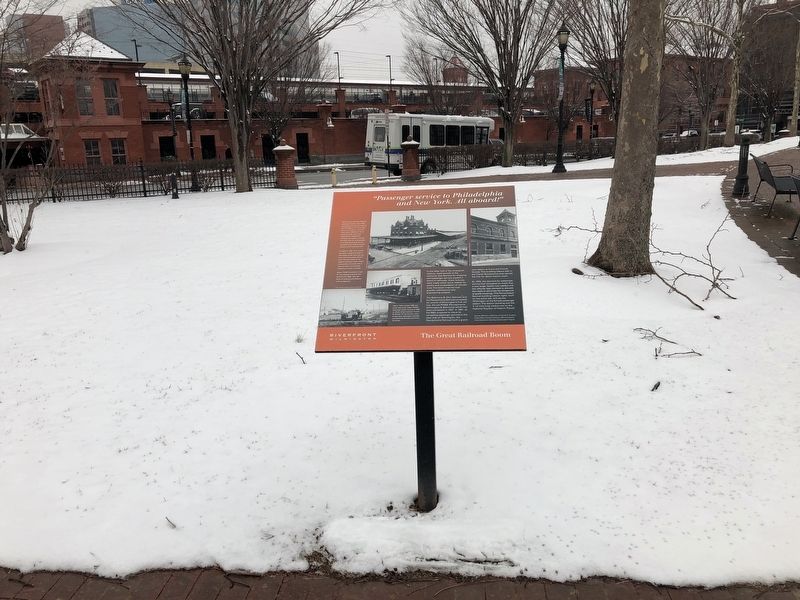
Location. 39° 44.204′ N, 75° 33.165′ W. Marker is in Wilmington, Delaware, in New Castle County. It is in Riverfront. It can be reached from Rosa Parks Drive east of South Market Street (Business U.S. 13), on the right when traveling east. Touch for map. Marker is at or near this postal address: 80 Rosa Parks Dr, Wilmington DE 19801, United States of America. Touch for directions.

Regionally, this marker is in Greater Philadelphia. It is also in the American Mid-Atlantic and on the Delmarva Peninsula. Globally, it is in the North Atlantic Region, North America, the Western Hemisphere, the Western World, and the Anglosphere. Historically, it finds itself in what was once New Netherland and also one of the original Thirteen Colonies.
Other nearby markers. At least 8 other markers are within walking distance of this marker: A different marker also named The Big Quarterly (here, next to this marker); Thomas Garrett (a few steps from this marker); Harriet Tubman (a few steps from this marker); The Underground Railroad (within shouting distance of this marker); The Tubman-Garrett Riverfront Park (within shouting distance of this marker); a different marker also named The Great Railroad Boom (about 300 feet away, measured in a direct line); South Market Street Bridge Dedicated in Honor of Senator John E. Reilly, Sr. (about 300 feet away); a different marker also named Freedom Lost (about 300 feet away). Touch for a list and map of all markers in Wilmington.
Other markers no longer nearby. The Big Quarterly (was here, next to this marker but has been replaced with another marker now near it); Freedom Lost (was about 300 feet away but has been replaced with another marker now near it).
Also see . . . Wilmington Amtrak Station - National Register of Historic Places Nomination Form.
The passenger station, main structure of the complex, was designed by Furness, Evans, and Company. The principal partner in this firm, Frank Furness (1839-1912), designed other stations in a similar style, which he popularized. Until recently, Furness has been best known for his influence on Louis Sullivan, his student. He has lately been widely recognized for such major works as the Pennsylvania Academy of Fine Arts, Broad Street Station, and the University of Pennsylvania library, in Philadelphia.(Submitted on April 23, 2025, by Pete Skillman of Townsend, Delaware.)
Wilmington was not only the headquarters of the Pennsylvania's Philadelphia, Wilmington, and Baltimore subsidiary; it was the terminal for many of the trains from the Delaware Railroad, later known as the Delmarva Division. Both lines had their operating headquarters in the office building, which stands vacant but intact to the south of the station. No major changes have occurred in the office building since it was occupied in the fall of 1905.
Credits. This page was last revised on April 23, 2025. It was originally submitted on March 1, 2019, by Devry Becker Jones of Washington, District of Columbia. This page has been viewed 797 times since then and 21 times this year. Last updated on October 30, 2021, by Carl Gordon Moore Jr. of North East, Maryland. Photos: 1, 2. submitted on March 1, 2019, by Devry Becker Jones of Washington, District of Columbia. • Mark Hilton was the editor who published this page.
