Thomas Jay Park in Tucson in Pima County, Arizona — The American Mountains (Southwest)
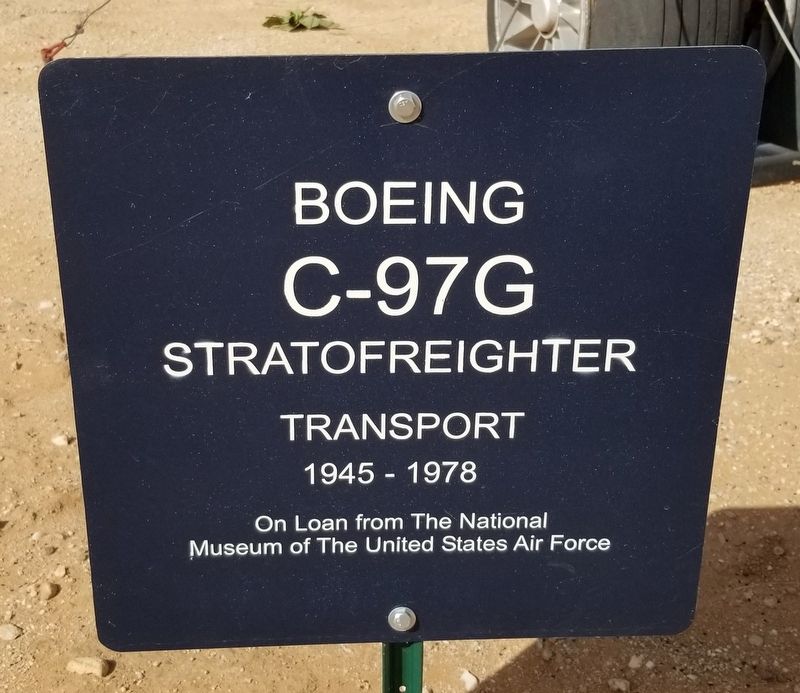
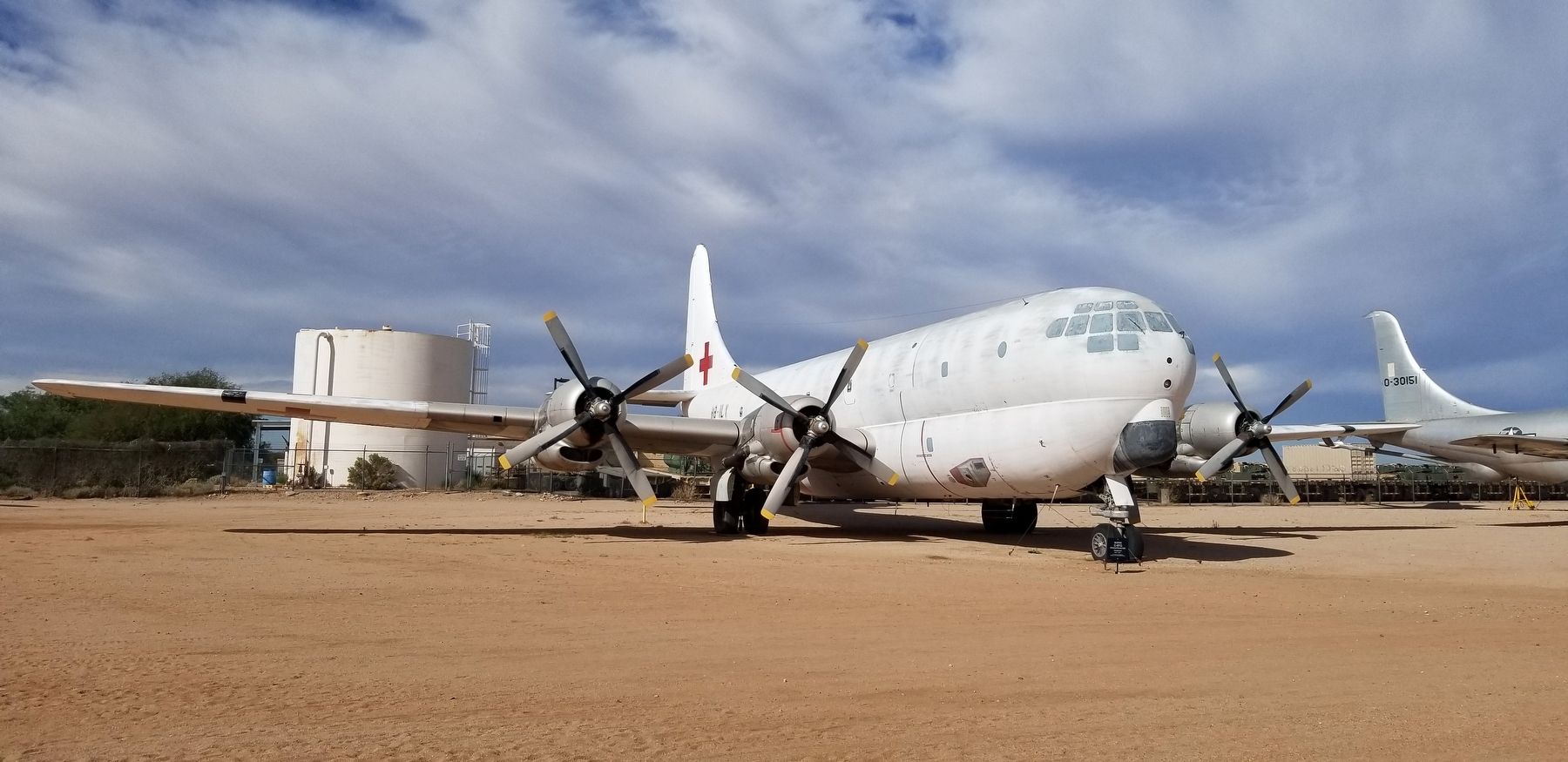
Boeing C-97G
Photographed by James Hulse, November 9, 2021
1. Boeing C-97G Marker
C-97G
Stratofreighter
Transport
1945 - 1978
On loan from the National
Museum of The United States Air Force
Erected by Pima Air & Space Museum.
Topics. This historical marker is listed in this topic list: Air & Space. A significant historical year for this entry is 1945.
Location. 32° 8.419′ N, 110° 52.284′ W. Marker is in Tucson, Arizona, in Pima County. It is in Thomas Jay Park. It can be reached from East Valencia Road 0.3 miles west of South Wilmot Road. The marker is located in the western section of the Pima Air & Space Museum. Touch for map. Marker is at or near this postal address: 6000 East Valencia Road, Tucson AZ 85756, United States of America. Touch for directions.

Regionally, this marker is in the Sky Islands, in the Sonoran Desert, and in the Phoenix Metropolitan Area. It is also in the American Borderlands and in the Southwest. Globally, it is in North America, the Western Hemisphere, the Western World, and the Anglosphere. Historically, it finds itself in what was once New Spain and also the Gadsden Purchase.
Other nearby markers. At least 8 other markers are within walking distance
this page online
More about this marker. The marker is located on the outside section of the Pima Air & Space Museum. There is an entry fee required to visit both the inside and outside sections of the museum.
Also see . . . Boeing C-97 Stratofreighter.
The Boeing C-97 Stratofreighter was a long-range heavy military cargo aircraft developed from the B-29 and B-50 bombers. Design work began in 1942, the first of three prototype XC-97s flew on 9 November 1944 (none saw combat), and the first of six service-test YC-97s flew on 11 March 1947. All nine were based on the 24ST alloy structure and Wright(Submitted on November 13, 2021, by James Hulse of Medina, Texas.)R-3350 engines of the B-29, but with a larger-diameter fuselage upper lobe (making a figure of eight or "double-bubble" section) and they had the B-29 vertical tail with the gunner's position blanked off. The first of three heavily revised YC-97A incorporating the re-engineered wing ( higher strength 75ST alloy), taller vertical tail and larger Pratt and Whitney R-4360 engines of the B-50 bomber, flew on 28 January 1948 and was the basis of the subsequent sole YC-97B, all production C-97s, KC-97s and civilian Stratocruiser aircraft. Between 1944 and 1958, 888 C-97s in several versions were built, 811 being KC-97 tankers. C-97s served in the Berlin Airlift, the Korean War, and the Vietnam War. Some aircraft served as flying command posts for the Strategic Air Command, while others were modified for use in Aerospace Rescue and Recovery Squadrons (ARRS). Source: WikipediaPhotographed by James Hulse, November 9, 20212. The Boeing C-97G and Marker

Photographed by James Hulse, November 9, 2021
3. The Boeing C-97G
Public Domain - US Air Force photo, 1940s
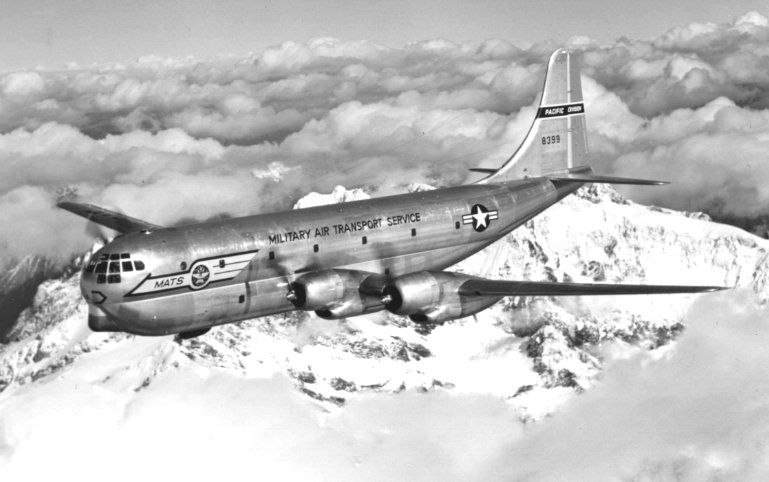
4. A Boeing C-97A Stratofreighter in flight
A Boeing C-97A Stratofreighter (s/n 48-399) in Military Air Transport Service markings.
Credits. This page was last revised on November 14, 2021. It was originally submitted on November 13, 2021, by James Hulse of Medina, Texas. This page has been viewed 365 times since then and 16 times this year. Photos: 1, 2, 3, 4. submitted on November 13, 2021, by James Hulse of Medina, Texas.
