South Portland in Cumberland County, Maine — The American Northeast (New England)
East Yard
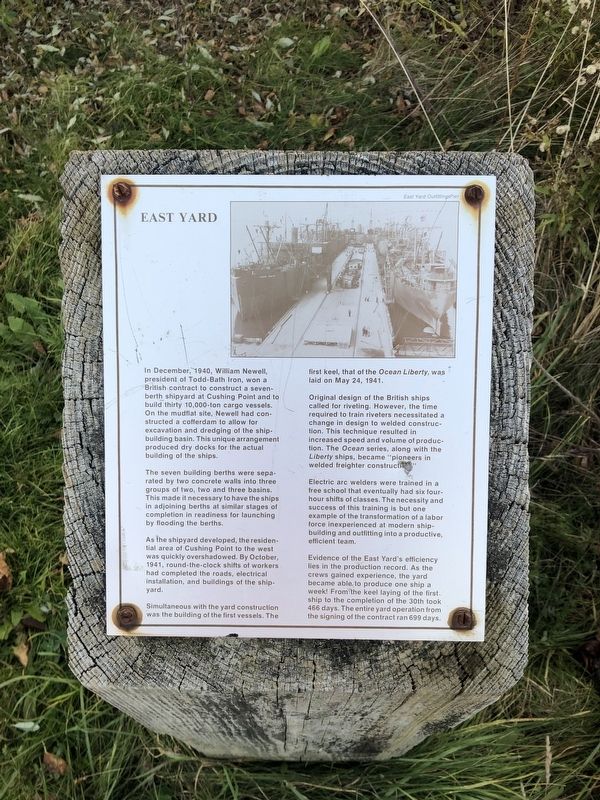
In December, 1940, William Newell, president of Todd-Bath Iron, won a British contract to construct a seven-berth shipyard at Cushing Point and to build thirty 10,000-ton cargo vessels. On the mudflat site, Newell had constructed a cofferdam to allow for excavation and dredging of the shipbuilding basin. This unique arrangement produced dry docks for the actual building of the ships.
The seven building berths were separated by two concrete walls into three groups of two, two and three basins. This made it necessary to have the ships in adjoining berths at similar stages of competition in readiness for launching by flooding the berths.
As the shipyard developed, the residential area of Cushing Point to the west was quickly overshadowed. By October 1941, round-the-clock shifts of workers had completed the roads, electrical installation, and buildings of the shipyard.
Simultaneous with the yard construction was the building of the first vessels. The first keel, that of the Ocean Liberty, was laid on May 24, 1941.
Original design of the British ships called for riveting. However, the time required to train riveters
this page online
Electric arc welders were trained in a free school that eventually had six four-hour shifts of classes. The necessity and success of this training is but one example of the transformation of a labor force inexperienced at modern shipbuilding and outfitting into a productive, efficient team.
Evidence of the East Yard's efficiency lies in the production record. As the crews gained experience, the yard became able to produce one ship a week! From the keel laying of the first ship to the completion of the 30th took 466 days. The entire yard operation from the signing of the contract ran 699 days.
Topics. This historical marker is listed in these topic lists: Education • Industry & Commerce • War, World II • Waterways & Vessels. A significant historical date for this entry is May 24, 1941.
Location. 43° 39.003′ N, 70° 13.769′ W. Marker is in South Portland, Maine, in Cumberland County. It is on Slocum Drive
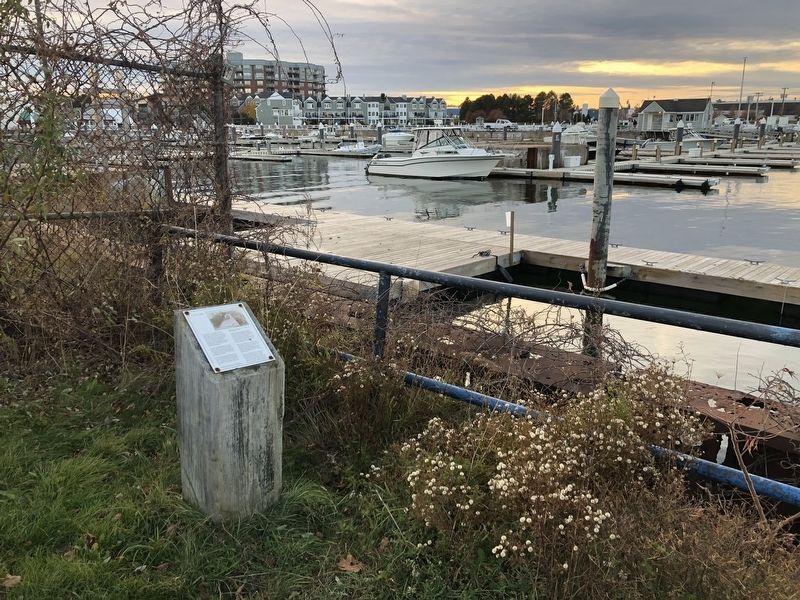

Regionally, this marker is on Southern Maine Coast. It is also in the American Northeast, in New England, and on the Eastern Seaboard. Globally, it is in the North Atlantic Region, North America, the Western Hemisphere, the Western World, and the Anglosphere.
Other nearby markers. At least 8 other markers are within walking distance of this marker: West Yard (a few steps from this marker); Shipbuilding (a few steps from this marker); Spring Point Ledge Light (about 500 feet away, measured in a direct line); First Congregational Church of South Portland (about 600 feet away); Coast Artillery Corps Memorial (about 600 feet away); Coast Artillery Corps at Fort Preble (about 700 feet away); Fort Gorges (approx. 0.2 miles away); Early Settlement (approx. 0.2 miles away). Touch for a list and map of all markers in South Portland.
Credits. This page was last revised on November 18, 2021. It was originally submitted on November 18, 2021, by Devry Becker Jones of Washington, District of Columbia. This page has been viewed 314 times since then and 17 times this year. Photos: 1, 2. submitted on November 18, 2021, by Devry Becker Jones of Washington, District of Columbia.
