Near South Side in Chicago in Cook County, Illinois — The American Midwest (Great Lakes)
White Castle #16
| — | Chicago Landmark | — |
Photographed by Andrew Ruppenstein, December 7, 2021
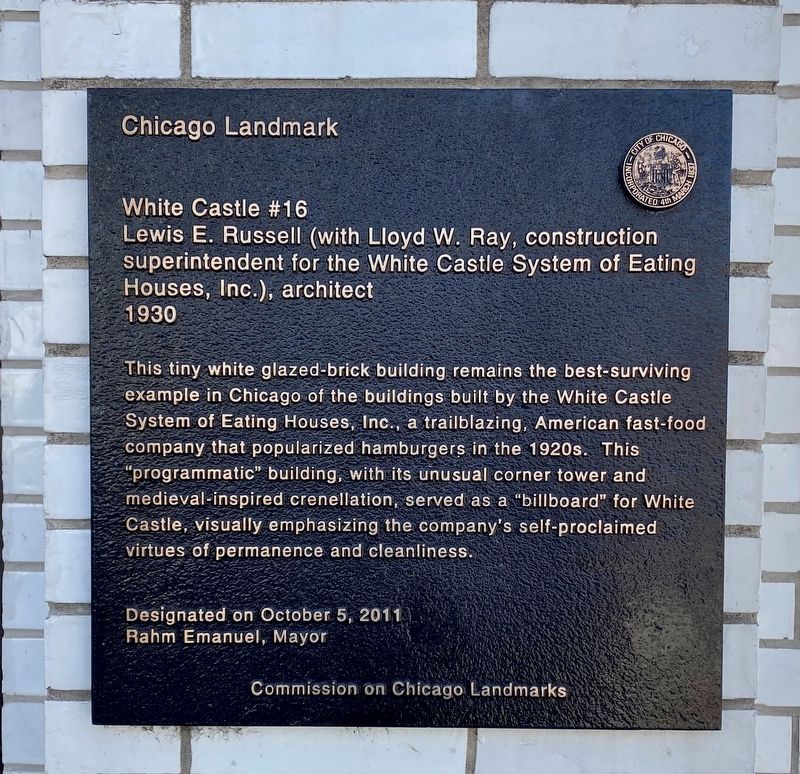
1. White Castle #16 Marker
White Castle #16
Lewis E. Russell (with Lloyd W. Ray, construction superintendent for White Castle System of Eating Houses, Inc.), architect
1930
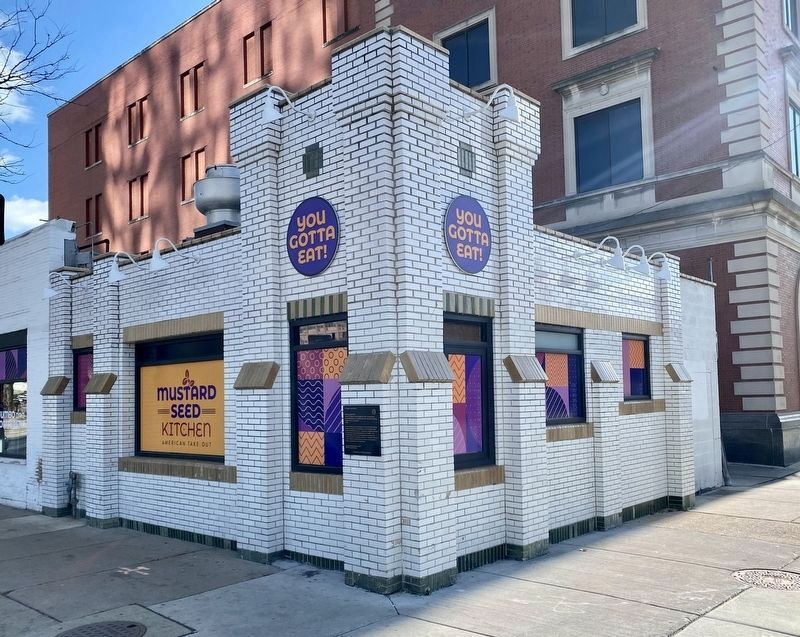
This tiny white glazed-brick building remains the best-surviving example in Chicago of the buildings built by the White Castle System of Eating Houses, Inc., a trailblazing American fast food company that popularized hamburgers in the 1920s. This “programmatic” building, with its unusual corner tower and medieval-inspired crenellation , served as a “billboard” for White Castle, visually emphasizing the company’s self-proclaimed virtues of permanence and cleanliness.
Designated on October 5, 2011
Rahm Emanuel, Mayor
Erected by Commission on Chicago Landmarks.
Topics and series. This historical marker is listed in this topic list: Industry & Commerce. In addition, it is included in the Illinois, Chicago Landmarks Commission series list. A significant historical date for this entry is October 5, 2011.
Location. 41° 51.161′ N, 87° 37.523′ W. Marker is in Chicago, Illinois, in Cook County. It is in the Near South Side. It is at the intersection of East Cermak Road and South Wabash
this page online

Regionally, this marker is in the American Midwest. Globally, it is in North America, on the Great Lakes, in the Western Hemisphere, in the Western World, and in the Anglosphere. Historically, it finds itself in what was once the Viceroyalty of New France, the territory of the Mississippian Culture, and the Northwest Territory.
Other nearby markers. At least 8 other markers are within walking distance of this marker: Chess Records Recording Studio (about 500 feet away, measured in a direct line); South Loop Market (about 500 feet away); South Michigan Avenue Motor Row (about 500 feet away); Chess Records Office and Studio (about 500 feet away); Hilliard Apartments (about 600 feet away); South Michigan Ave. Motor Row (approx. 0.2 miles away); Second Presbyterian Church of Chicago (approx. 0.2 miles away); a different marker also named Hilliard Apartments (approx. 0.2 miles away). Touch for a list and map of all markers
Photographed by Andrew Ruppenstein, December 7, 2021
2. White Castle #16 and Marker
The building is no longer a White Castle restaurant, but those seeking sliders can still find them at the much newer White Castle across the street, kitty-corner to this one.
Also see . . . Landmark Designation Report (Commission on Chicago Landmarks). Most landmark designation reports or similar documents for buildings focus heavily on the architecture, construction, ownership and use of said buildings. While this report does that, what makes it more interesting than usual is its provision of the cultural context. That is, the document is also a cultural history of eating, both in the US and locally.
Before there was McDonald's: "In general, however, American restaurants before World War I did not operate on the large scale that allowed for standardization of operations, nor did they advertise widely. However, industries such as the automobile industry, especially the Ford Motor Company under Henry Ford, were increasingly using consistent and standardized operating procedures to cut cost, increase efficiency and improve quality, making their products accessible to the burgeoning middle class. In addition, newspaper advertising was increasingly used to reach potential buyers for many consumer products. White Castle brought these modern industrial methods—large scale, standardized buildings and operations, media advertising, and the use of programmatic architecture as a marketing tool—to the sale of hamburgers in the 1920s."(Submitted on December 8, 2021.)
Credits. This page was last revised on January 30, 2023. It was originally submitted on December 7, 2021, by Andrew Ruppenstein of Lamorinda, California. This page has been viewed 946 times since then and 94 times this year. Photos: 1, 2. submitted on December 7, 2021, by Andrew Ruppenstein of Lamorinda, California.
