Ingomar in Rosebud County, Montana — The American West (Mountains)
Ingomar Public School
Photographed by Barry Swackhamer, July 17, 2021
1. Ingomar Public School Marker
Inscription.
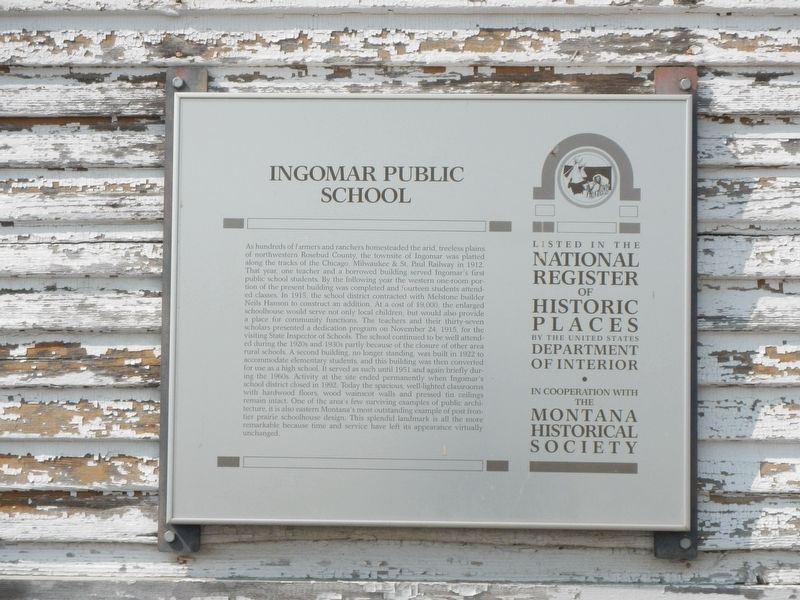
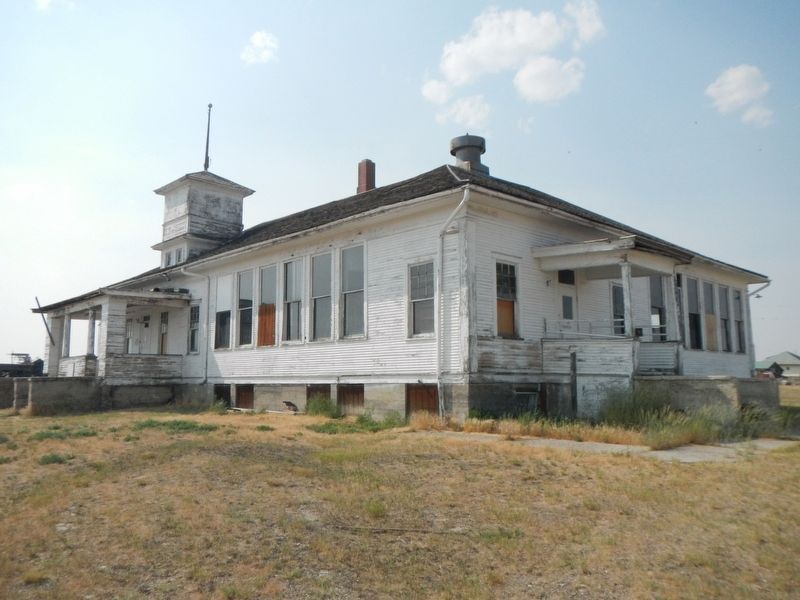
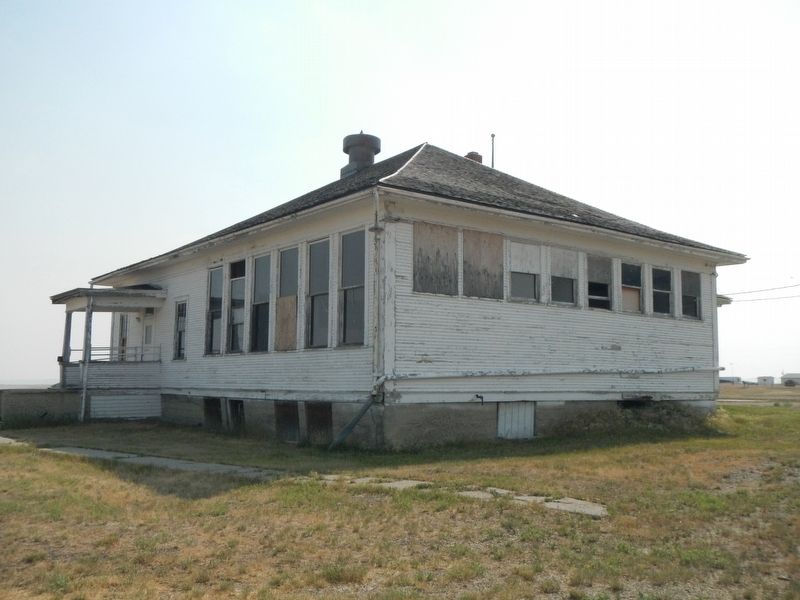
As hundreds of farmers and ranchers homesteaded the arid, treeless plains of northwestern Rosebud County, the townsite of Ingomar was platted along the tracks of the Chicago, Milwaukee & St. Paul Railway in 1912. That year, one teacher and a borrowed building served Ingomar’s first public school students. By the following year the western one-room portion of the present building was completed and fourteen students attended classes. In 1915, the school district contracted with Melstone builder Neils Hanson to construct an addition. At a cost of $9,000, the enlarged schoolhouse would serve not only local children, but would also provide a place for community functions. The teachers and their thirty-seven scholars presented a dedication program on November 24, 1915, for the visiting State Inspector of Schools. The school continued to be well attended during the 1920s and 1930s partly because of the closure of other area rural schools. A second building, no longer standing, was built in 1922 to accommodate elementary students, and this building was then converted for use as a high school. It served as such until 1951 and again
Click or scan to see this page online
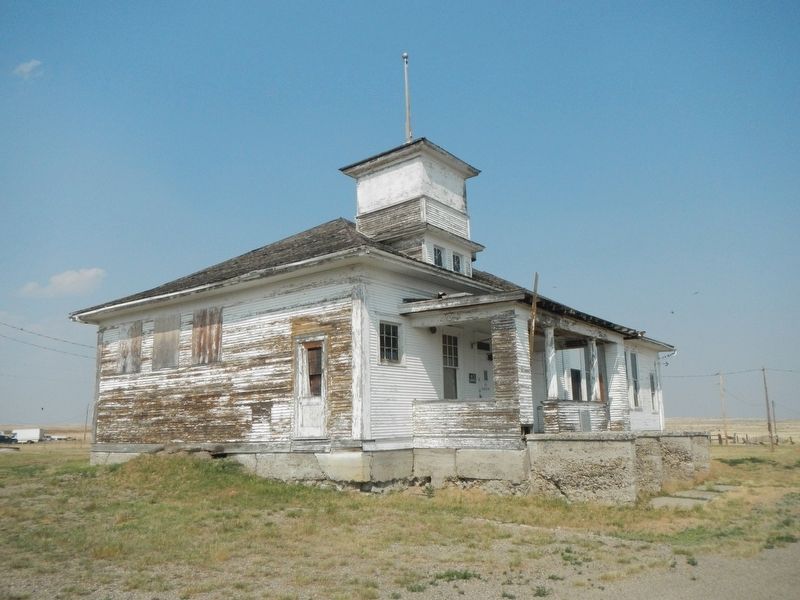
briefly during the 1960s. Activity at the site ended permanently when Ingomar’s school district closed in 1992. Today the spacious, well-lighted classrooms with hardwood floors, wood wainscot walls, and pressed tin ceilings remain intact. One of the area’s few surviving examples of public architecture, it is also eastern Montana’s most outstanding example of post-frontier prairie schoolhouse design. This splendid landmark is all the more remarkable because time and service have left its appearance virtually unchanged.
Location. 46° 34.615′ N, 107° 22.379′ W. Marker is in Ingomar, Montana, in Rosebud County. It can be reached from 2nd Avenue near 3rd Street, on the right when traveling west. Touch for map. Marker is at or near this postal address: 403 2nd Avenue, Ingomar MT 59039, United States of America. Touch for directions.
Regionally, this
Photographed by Barry Swackhamer, July 17, 2021
2. Ingomar Public School and Marker
The marker is near the front steps.
marker is in Southeast Montana, in Custer Country and in the Powder River Basin. It is also in the American Mountain West, in the Lewis & Clark Corridor, on the prairies, on the Great Plains, and specifically on the Northern Plains. Globally, it is in North America, the Western Hemisphere, the Western World, and the Anglosphere. Historically, it finds itself in what was once Rupert’s Land and also the Louisiana Purchase.
Other nearby markers. At least 4 other markers are within walking distance of this marker: Ingomar (within shouting distance of this marker); Wiley, Clark and Greening Bank (about 600 feet away, measured in a direct line); J.A. Bookman General Store (about 600 feet away); a different marker also named Ingomar (approx. 0.4 miles away).
Photographed by Barry Swackhamer, July 17, 2021
3. Ingomar Public School
Photographed by Barry Swackhamer, July 17, 2021
4. Ingomar Public School
Credits. This page was last revised on December 28, 2021. It was originally submitted on December 28, 2021, by Barry Swackhamer of Brentwood, California. This page has been viewed 231 times since then and 23 times this year. Photos:1, 2, 3, 4. submitted on December 28, 2021, by Barry Swackhamer of Brentwood, California.