South Los Angeles in Los Angeles County, California — The American West (Pacific Coastal)
USC after World War II
Photographed by Adam Margolis, January 14, 2017
1. USC after World War II Marker
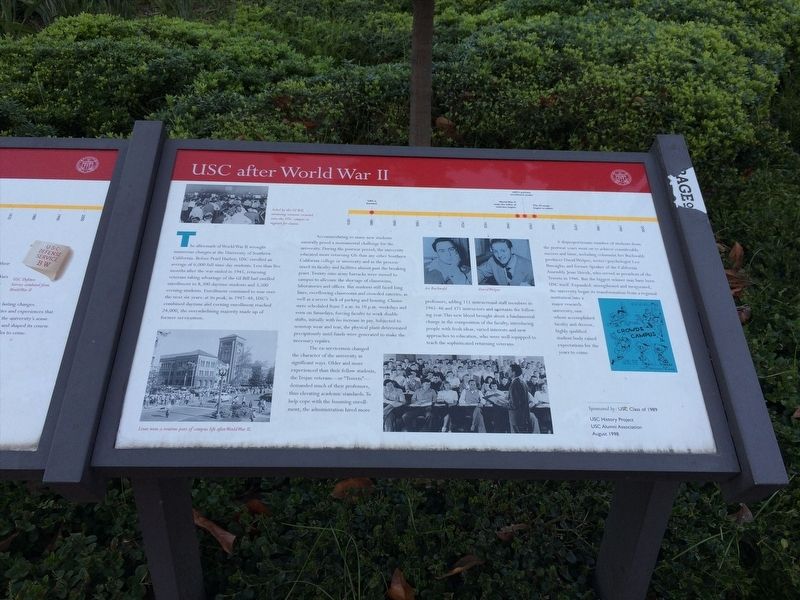
The aftermath of World War II wrought numerous changed at the University of Southern California. Before Pearl Harbor, USC enrolled an average of 6,000 full time day students. Less than five months later after the war ended in 1945, returning veterans taking advantage of the GI Bill had swelled enrollment to 8,300 daytime students and 3,500 evening students. Enrollment continued to soar over the next six years; at its peak in 1947-48, USC's combined daytime and evening enrollment reached 24,000, the overwhelming majority made up of former servicemen.
Accommodating so many new students naturally posed a monumental challenged for the university. During the postwar period, the university educated more returning GIs than any other Southern California college or university and in the processes taxed its faculty and facilities almost past the breaking point. Twenty nine army barracks were moved to campus to alleviated the shortage of classrooms, laboratories and offices. But students still faced long lines, overflowing classrooms and crowded arteries as well as a severe lack of parking and housing. Classes were scheduled from
this page online
The ex-servicemen changed the character of the university in significant ways. Older and more experienced than their fellow students, the Trojan veterans - or "Trovets" - demanded much of their professors, thus elevating academic standards. To help cope with the booming enrollment, the administration hired more professors, adding 111 instructional staff members in 1945-46 and 371 instructors and assistants the following year. This new blood brought about a fundamental change in composition to the faculty, introducing people with fresh ideas, varied interests and new approaches to education, who were well equipped to teach the sophisticated returning veterans.
A disproportionate number of students from the postwar years went on to achieve considerable success and fame, including columnist Art Buchwald, producer David Wolper, writer/physiologist Leo Buscaglia, and former
Photographed by Adam Margolis, January 14, 2017
2. USC after World War II Marker
Topics. This historical marker is listed in these topic lists: Education • War, World II. A significant historical year for this entry is 1945.
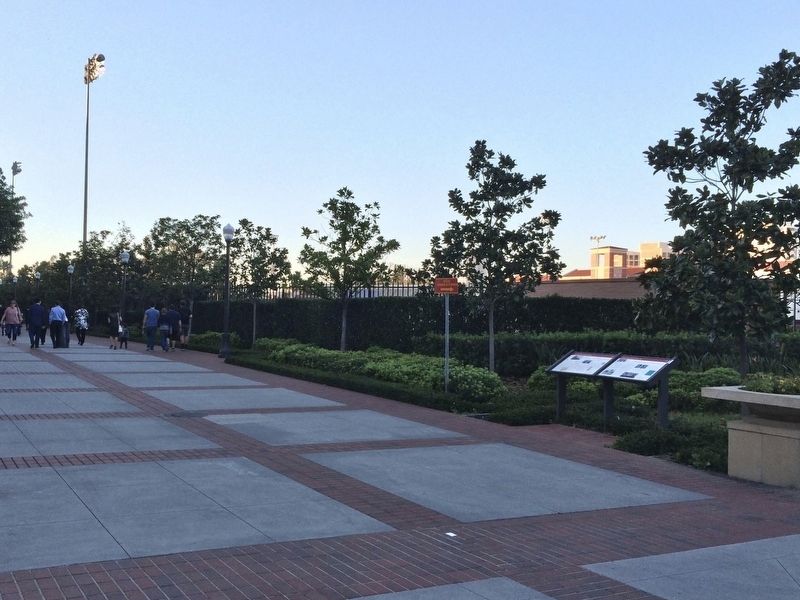
Location. 34° 1.277′ N, 118° 17.24′ W. Marker is in Los Angeles, California, in Los Angeles County. It is in South Los Angeles. It is at the intersection of West 36th Street and Watt Way, on the right when traveling west on West 36th Street. The marker is on the USC campus in a pedestrian area. Touch for map. Marker is in this post office area: Los Angeles CA 90089, United States of America. Touch for directions.

Regionally, this marker is in the Transverse Ranges. It is also on the American Pacific Coast. Globally, it is in North America, on the Ring of Fire, on the Pacific Rim, in the Western Hemisphere, in the Western World, and in the Anglosphere. Historically, it finds itself in what was once New Spain and also Mexico’s Alta California.
Other nearby markers. At least 8 other markers are within walking distance of this marker: USC and the World Wars (here, next to this marker); Physical Education Building (within shouting distance of this marker); Annenberg School for Communication (about 300 feet away, measured in a direct line); The USC Associates (about 400 feet away); Neil Armstrong (about 600 feet away); Student Musical Traditions (about 600 feet away); A Gathering Place (about 600 feet away); Cesar Estrada Chavez (about 600 feet away). Touch for a list and map of all markers in Los Angeles.
Credits. This page was last revised on December 11, 2025. It was originally submitted on January 7, 2022, by Adam Margolis of Mission Viejo, California. This page has been viewed 284 times since then and 43 times this year. Photos: 1, 2. submitted on January 7, 2022, by Adam Margolis of Mission Viejo, California. • J. Makali Bruton was the editor who published this page.
