Bearcreek in Carbon County, Montana — The American West (Mountains)
Black Gold
Photographed by Barry Swackhamer, July 21, 2021
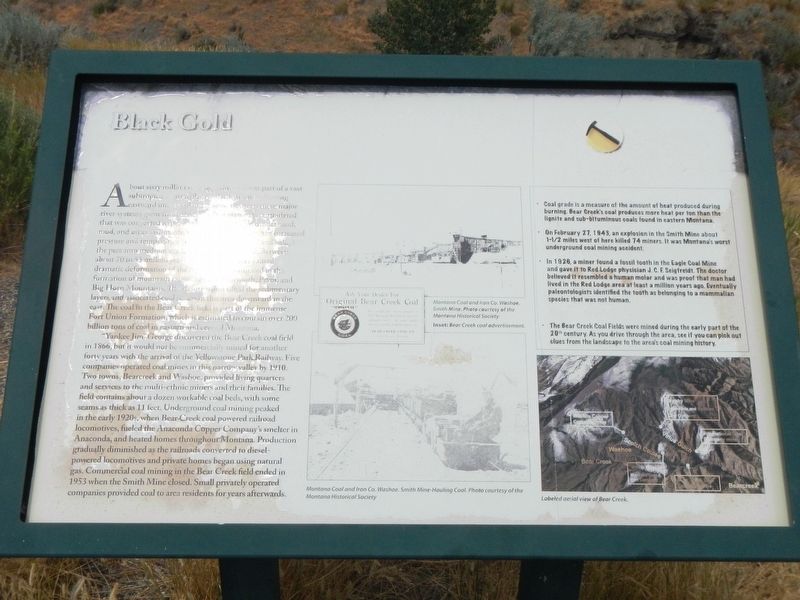
1. Black Gold Marker
Captions: (middle top) Montana Coal and Iron Co. Washoe.; (center) Bear Creek coal advertisement. (bottom center Montana Coal and Iron Co. Washoe. Smith Mine-Hauling Coal.; (bottom right) Labeled aerial view of Bear Creek.
Main Street @ 2nd Street
"Yankee Jim" George discovered the Bear Creek coal field in 1866, but it would not be commercially mined for another forty years with the arrival of the Yellowstone Park Railway. Five companies operated
this page online
GeoFacts:
• Coal grade is a measure of the amount of heat produced during burning. Bear Creek's coal produces more heat per ton than the lignite and sub-bituminous coals found in eastern Montana.
• On February 27, 1943, an explosion in the Smith Mine about 1-1/2 miles west of here killed 74 miners. It was Montana's worst underground coal mining accident.
• In 1926 a miner found

Photographed by Barry Swackhamer, July 21, 2021
2. Black Gold Marker on left
Geo-Activities:
• The Bear Creek Coal Fields were mined during the early part of the 20th Century. As you drive through the area, see if you can pick out clues from the landscape to the area's coal mining history.
Erected by Montana Department of Transportation.
Topics. This historical marker is listed in these topic lists: Industry & Commerce • Natural Resources. A significant historical date for this entry is February 27, 1943.
Location. 45° 9.506′ N, 109° 11.345′ W. Marker is in Bearcreek, Montana, in Carbon County. It is on State Highway 308 0.1 miles west of Scotch Coulee Road, on the right when traveling west. Touch for map. Marker is in this post office area: Bearcreek MT 59007, United States of America. Touch for directions.

Regionally, this marker is in Yellowstone Country. It is also in the American Mountain West and in the Lewis & Clark Corridor. Globally, it is in North America, the Rocky Mountains, the Western Hemisphere, the Western World, and the Anglosphere. Historically, it finds itself in what was once Rupert’s Land and also the Louisiana Purchase.
Other nearby markers. At least 8 other markers are within 4 miles of this marker, measured as the crow flies: The Smith Mine Disaster (here, next to this marker); Smith Mine Historic District (here, next to this marker); Bearcreek Bank (approx. 1½ miles away); Bearcreek (approx. 1½ miles away); Bear Creek Cemetery (approx. 2.4 miles away); Red Lodge (approx. 3.1 miles away); The Beartooth Plateau (approx. 3.1 miles away); The Red Lodge Country (approx. 3.1 miles away). Touch for a list and map of all markers in Bearcreek.
Credits. This page was last revised on January 12, 2022. It was originally submitted on January 12, 2022, by Barry Swackhamer of Brentwood, California. This page has been viewed 290 times since then and 31 times this year. Photos: 1, 2. submitted on January 12, 2022, by Barry Swackhamer of Brentwood, California.
