Adams Morgan in Northwest Washington in Washington, District of Columbia — The American Northeast (Mid-Atlantic)
Return from the rock abyss
40th Anniversary of the First Descent of the Colca Canyon in Peru
| — | Canoandes '79 | — |
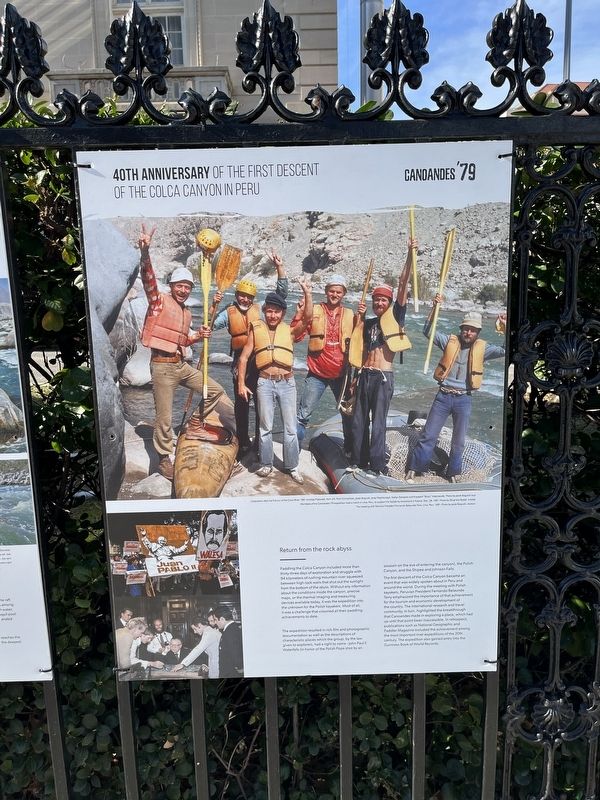
Paddling the Colca Canyon included more than thirty-three days of exploration and struggle with 94 kilometers of rushing mountain river squeezed between high rock walls that shut out the sunlight from the bottom of the abyss. Without any information about the conditions inside the canyon, precise maps, or the thermal imaging and measuring devices available today, it was the expedition into the unknown for the Polish kayakers. Most of all, it was a challenge that crowned all their paddling achievements to date.
The expedition resulted in rich film and photographic documentation as well as the descriptions of characteristic places which the group, by the law given to explorers, had the right to name — John Paul II Waterfalls (in honor of the Polish Pope shot by an assassin on the eve of entering the canyon), the Polish Canyon, and the Shipee and Johnson Falls.
The first descent of the Colca Canyon became an event that was widely spoken about in Peru and around the world. During the meeting with Polish kayakers, Peruvian President Fernando Belaunde Terry emphasized the importance of that achievement for the tourism
this page online
Erected by Consulate General of the Republic of Poland in New York; The Explorers Club; Ministry of Culture, National Heritage and Sport of the Republic of Poland.
Topics. This historical marker is listed in these topic lists: Exploration • Religion & Religious Structures • Waterways & Vessels. A significant historical month for this entry is June 1981.
Location. This marker has been replaced by another marker nearby. It was located near 38° 55.481′ N, 77° 2.199′ W. Marker was in Northwest Washington in Washington, District of Columbia. It was in Adams Morgan. It was on 16th Street Northwest just south of Fuller Street Northwest, on the right when traveling south. Touch for map.
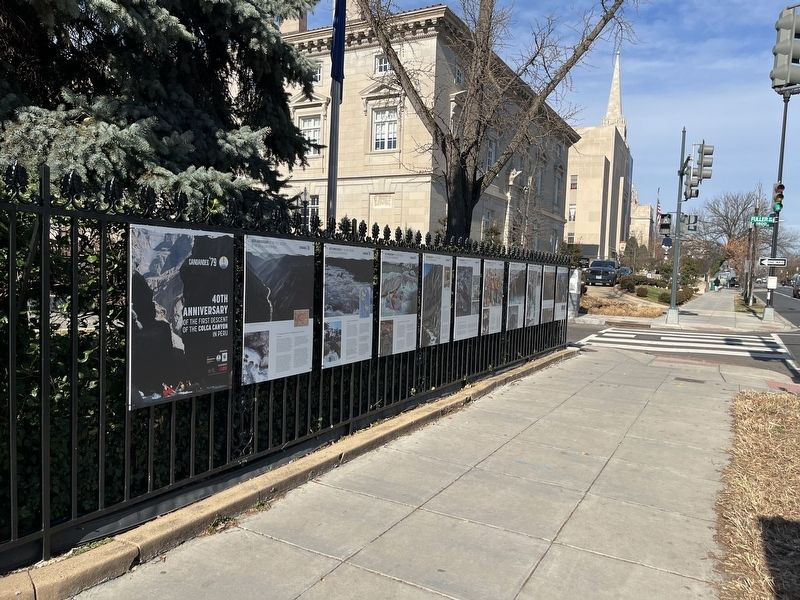
Photographed by Devry Becker Jones (CC0), January 12, 2022
2. 40th Anniversary of the First Descent of the Colca Canyon in Peru Exhibit

Regionally, this marker was in the Washington Metropolitan Area. It was also in the American Northeast, in the Upper South, in the Mid-Atlantic, in the Tidewater, and in the Chesapeake Bay Region. Globally, it was in North America, the Western Hemisphere, the Western World, and the Anglosphere.
Other nearby markers. within walking distance of this location: Touch for a list and map of all markers in Northwest Washington.
Other markers no longer nearby. Return to the Colca Canyon (was here, next to this marker but has been replaced with another marker now near it); The first run of the Colca Canyon - May/June 1981 (was here, next to this marker but has been replaced with another marker now near it); Nocturns (was here, next to this marker but has been permanently removed); a different marker also named The first run of the Colca Canyon - May/June 1981 (was here, next to this marker but has been replaced with another marker now near it); Jan Czochralski (was here, next to this marker but has been permanently removed); Waltzes (was here, next to this marker but has been permanently removed); Preludes (was here, next to this marker but has been permanently removed); Historic Expedition (was here, next to this marker but has been replaced with another marker now near it); Impromptus (was here, next to this marker but has been permanently removed); Sonatas (was here, next to this marker but has been permanently removed); Songs (was here, next to this marker but has been permanently removed); a different marker also named The first run of the Colca Canyon - May/June 1981 (was here, next to this marker but has been replaced with another marker now near it); Development of the Colca Valley (was here, next to this marker but has been replaced with another marker now near it); On the way to the Colca Canyon (was here, next to this marker but has been replaced with another marker now near it); Ernest Malinowski (was here, next to this marker but has been permanently removed); Canoandes'79 - 40 years later! (was here, next to this marker but has been replaced with another marker now near it).
Credits. This page was last revised on January 30, 2023. It was originally submitted on January 12, 2022, by Devry Becker Jones of Washington, District of Columbia. This page has been viewed 159 times since then and 14 times this year. Photos: 1, 2. submitted on January 12, 2022, by Devry Becker Jones of Washington, District of Columbia.
