Columbus in Stillwater County, Montana — The American West (Mountains)
Jacobs House
Photographed by Barry Swackhamer, July 22, 2021
1. Jacobs House Marker
Inscription.
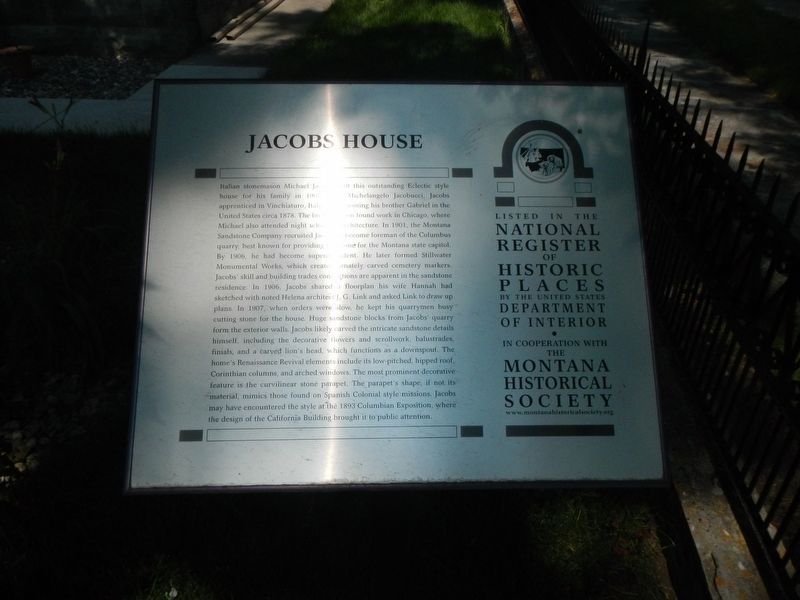
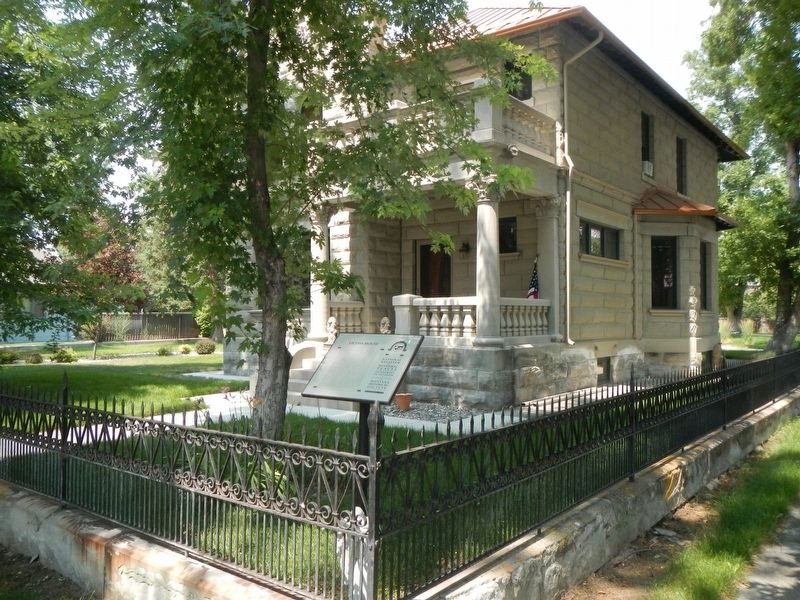
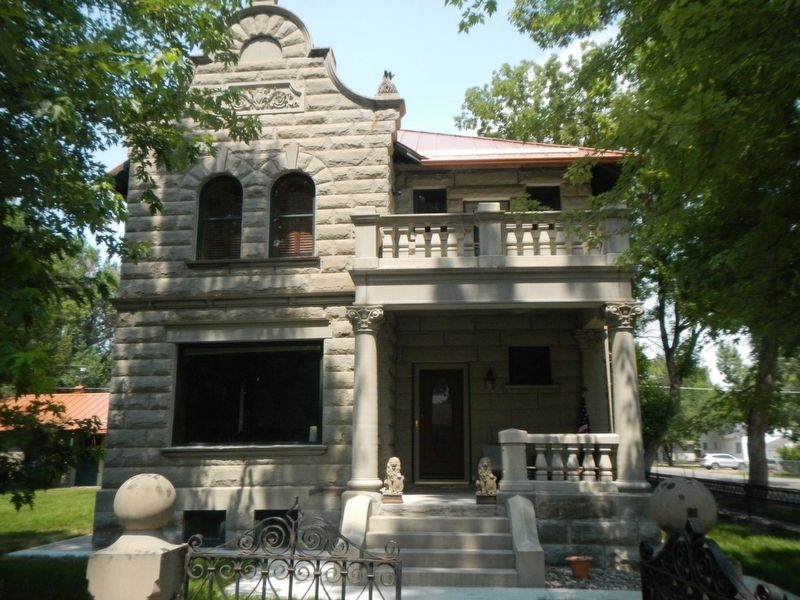
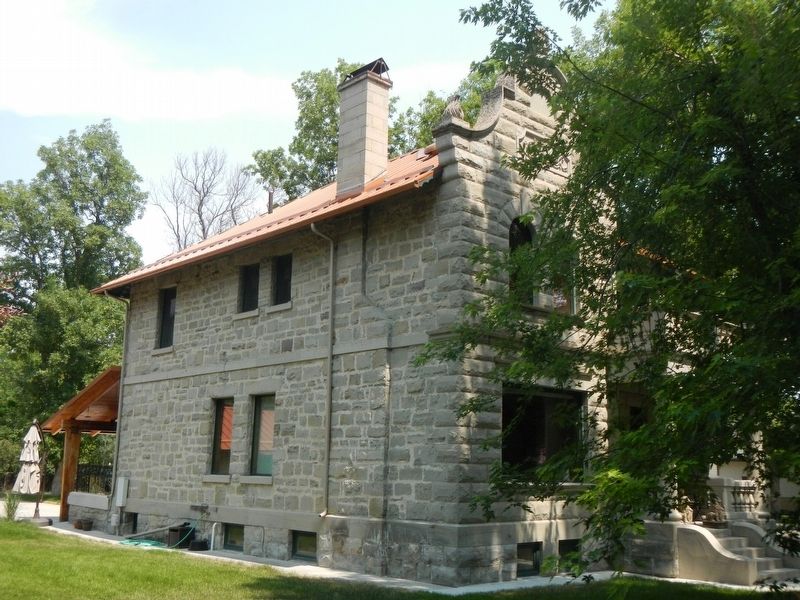
Italian stonemason Michael Jacobs built this outstanding Eclectic style house for his family in 1907. Born Michelangelo Jacobucci, Jacobs apprenticed in Vinchiaturo, Italy, before joining his brother Gabriel in the United States circa 1878. The brothers soon found work in Chicago, where Michael also attended night school in architecture. In 1901, the Montana Sandstone Company recruited Jacobs to become foreman of the Columbus quarry, best known for providing the stone for the Montana state capitol. By 1906, he had become superintendent. He later formed Stillwater Monumental Works, which created ornately carved cemetery markers. Jacobs’ skill and building trades connections are apparent in the sandstone residence. In 1906, Jacobs shared a floorplan his wife Hannah had sketched with noted Helena architect J. G. Link and asked Link to draw up plans. In 1907, when orders were slow, he kept his quarrymen busy cutting stone for the house. Huge sandstone blocks from Jacobs’ quarry form the exterior walls. Jacobs likely carved the intricate sandstone details himself, including the decorative flowers and scrollwork, balustrades,
Click or scan to see this page online
finials, and a carved lion’s head, which functions as a downspout. The home’s Renaissance Revival elements include its low-pitched, hipped roof, Corinthian columns, and arched windows. The most prominent decorative feature is the curvilinear stone parapet. The parapet’s shape, if not its material, mimics those found on Spanish Colonial style missions. Jacobs may have encountered the style at the 1893 Columbian Exposition, where the design of the California Building brought it to public attention.
Location. 45° 38.382′ N, 109° 15.594′ W. Marker is in Columbus, Montana, in Stillwater County. It is at the intersection of West 1st Avenue North and Quarry Street, on the right when traveling west on West 1st Avenue North. Touch for map. Marker is at or near this postal address: 4 W 1st Ave N, Columbus MT 59019, United States of America. Touch for directions.
Regionally,
Photographed by Barry Swackhamer, July 22, 2021
2. Jacobs House and Marker
this marker is in Yellowstone Country and in Greater Billings. It is also in the American Mountain West and in the Lewis & Clark Corridor. Globally, it is in North America, the Rocky Mountains, the Western Hemisphere, the Western World, and the Anglosphere. Historically, it finds itself in what was once Rupert’s Land and also the Louisiana Purchase.
Credits. This page was last revised on January 20, 2022. It was originally submitted on January 20, 2022, by Barry Swackhamer of Brentwood, California. This page has been viewed 337 times since then and 26 times this year. Photos:1, 2, 3, 4. submitted on January 20, 2022, by Barry Swackhamer of Brentwood, California.