St. Simons Island in Glynn County, Georgia — The American South (South Atlantic)
Hamilton Plantation
Photographed by Mike Stroud, 2009
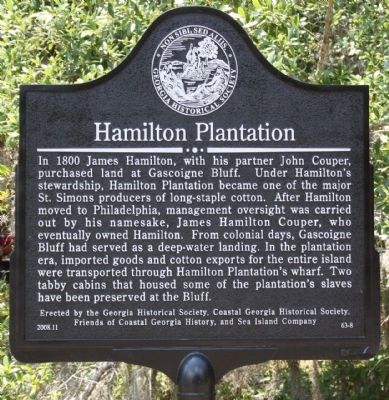
1. Hamilton Plantation Marker
In 1800 James Hamilton, with his partner John Couper, purchased land at Gascoigne Bluff. Under Hamilton’s stewardship, Hamilton Plantation became one of the major St. Simons producers of long-staple cotton. After Hamilton moved to Philadelphia, management oversight was carried out by his namesake, James Hamilton Couper, who eventually owned Hamilton. From colonial days, Gascoigne Bluff had served as a deep-water landing. In the plantation era, imported goods and cotton exports for the entire island were transported through Hamilton Plantation’s wharf. Two tabby cabins that housed some of the plantation’s slaves have been preserved at the Bluff.
Erected 2008 by Georgia Historical Society, Coastal Georgia Historical Society, Friends of Coastal Georgia History, and Sea Island Company. (Marker Number 63-8.)
Topics and series. This historical marker is listed in these topic lists: Industry & Commerce • Notable Places • Settlements & Settlers. In addition, it is included in the Georgia Historical Society series list. A significant historical year for this entry is 1800.
Location. 31° 10.181′ N, 81° 24.464′ W. Marker
this page online

Regionally, this marker is on the Coastal Plain, on the Georgia Coast and the Golden Isles, and on the Sea Islands. It is also in the American South, specifically in the Deep South, and on the Eastern Seaboard. Globally, it is in the North Atlantic Region, North America, the Western Hemisphere, the Western World, and the Anglosphere. Historically, it finds itself in what was once New Spain, the territory of the Mississippian Culture, one of the original Thirteen Colonies, one of the Confederate States of America, and the Antebellum South.
Other nearby markers. At least 8 other markers are within walking distance of this marker: Gascoigne Bluff (a few steps from this marker); Cassina Garden Club Houses (about 500 feet away, measured in a direct line); A Man Named Wesley Passed This Way / Lovely Lane Chapel (approx. 0.2 miles
Photographed by Mike Stroud, May 10, 2009
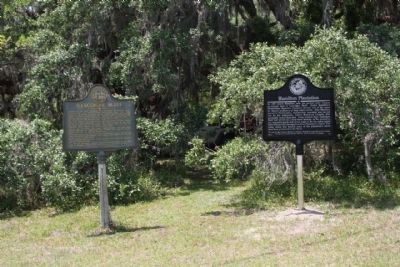
2. Hamilton Plantation Marker,(r), shares location with Gascoigne Bluff Marker
Regarding Hamilton Plantation. Hamilton Plantation was one of four major plantations on St. Simons Island. Hamilton Plantation was located at Gascoigne Bluff on the Frederica River, where deep water and the surrounding bluff had provided a natural landing site for ships since the colonial period. With such an accessible landing site, Hamilton Plantation played a key role in the export of the islands staple crop, long-stable cotton, and was itself one of the earliest sites for production of cotton on the island. In the years after the end of the plantation era Hamilton became the site of the Dart and Dodge-Meigs sawmills. Today all that remains of the original plantation buildings are two tabby cabins that once housed some of the plantation’s 125 slaves. Much of the remaining property has become residential
Photographed by Mike Stroud, 2009
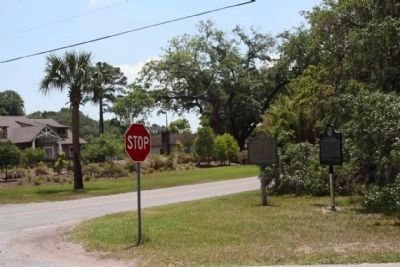
3. Hamilton Plantation Marker (r) at intersection of Hamilton Road and Arthur J. Moore Drive
Photographed by Mike Stroud, May 10, 2009
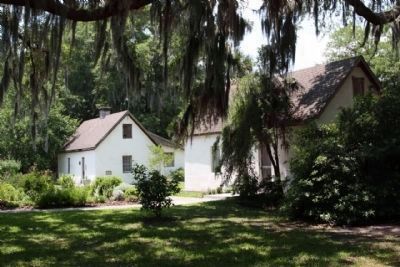
4. Hamilton Plantation : The 2 Slave cabins as mentioned on Marker
see nearby marker Cassina Garden Club Houses
Among the better surviving slave cabins in the South, they are made of tabby, a cement consisting of lime, water, and crushed oyster shells. The cabins have built-in windows and a central chimney. James Hamilton Couper, namesake of the owner and manager of the plantation, was an architect and a builder. He designed and built the cabins to house the slaves who served in the plantation's main house.
Among the better surviving slave cabins in the South, they are made of tabby, a cement consisting of lime, water, and crushed oyster shells. The cabins have built-in windows and a central chimney. James Hamilton Couper, namesake of the owner and manager of the plantation, was an architect and a builder. He designed and built the cabins to house the slaves who served in the plantation's main house.
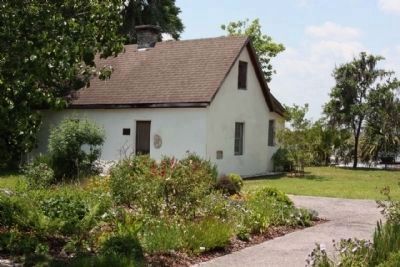
Photographed by Mike Stroud, May 10, 2009
5. Hamilton Plantation Slave Cabin, with cut away view of "tabby" walls
National Register Plaque can be seen at left of doorway. Information from the National Register includes:
Hamilton Plantation Slave Cabins ** (added 1988 - District - #88000968) •
Address Restricted, St. Simons Island •
Historic Significance: Information Potential, Event, Architecture/Engineering •
Architect, builder, or engineer: Couper, James Hamilton •
Architectural Style: No Style Listed •
Area of Significance: Architecture, Historic - Non-Aboriginal, Black •
Cultural Affiliation: Black slave •
Period of Significance: 1825-1849, 1850-1874 •
Owner: Private , Local Gov't •
Historic Function: Domestic •
Historic Sub-function: Multiple Dwelling •
Current Function: Social •
Current Sub-function: Clubhouse •
Credits. This page was last revised on November 25, 2020. It was originally submitted on May 17, 2009, by Mike Stroud of Bluffton, South Carolina. This page has been viewed 3,757 times since then and 125 times this year. Photos: 1, 2, 3, 4, 5. submitted on May 17, 2009, by Mike Stroud of Bluffton, South Carolina. • Syd Whittle was the editor who published this page.
