
Sullivan's Island in Charleston County, South Carolina — The American South (South Atlantic)
Fort Moultrie
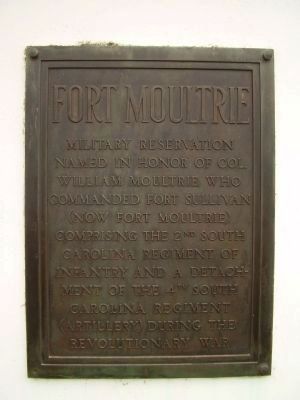
Photographed by Stanley and Terrie Howard, May 16, 2009
1. Fort Moultrie Marker
Topics. This historical marker is listed in these topic lists: Forts and Castles • War, US Revolutionary.
Location. 32° 45.548′ N, 79° 50.727′ W. Marker is on Sullivan's Island, South Carolina, in Charleston County. It is at the intersection of Middle Street and Station 18 Street, on the left when traveling west on Middle Street. Touch for map. Marker is in this post office area: Sullivans Island SC 29482, United States of America. Touch for directions.

Regionally, this marker is in Historic Charleston and in the Lowcountry. It is also in the American South, specifically in the Deep South, and on the Eastern Seaboard. Globally, it is in the North Atlantic Region, North America, the Western Hemisphere, the Western World, and the Anglosphere. Historically, it finds itself in what was once the territory
this page online
Other nearby markers. At least 8 other markers are within walking distance of this marker: Rear Gate & Second Post Chapel (a few steps from this marker); Sullivan's Island Life-Saving Station (about 500 feet away, measured in a direct line); US Coast Guard Historic District (about 800 feet away); Charleston Light (about 800 feet away); The Valor of Jimmie Dyess on Sullivan's Island and in Combat / The Remarkable Story of Jimmie Dyess (approx. 0.2 miles away); Parade Ground and Flagpole Area (approx. ¼ mile away); Civilian Conservation Corps (approx. 0.3 miles away); Sergeant Jasper (approx. 0.4 miles away). Touch for a list and map of all markers in Sullivan's Island.
Also see . . . Fort Moultrie- Defender of Charleston Harbor. On June 28, 1776, as British warships moved to conquer the South Carolina city of Charleston, Colonel William Moultrie and a force of Patriot soldiers stood behind unfinished palmetto log walls and prepared to defend the city. (Submitted on January 21, 2013.)
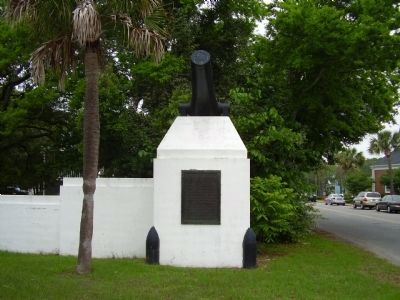
Photographed by Stanley and Terrie Howard, May 16, 2009
2. Fort Moultrie Marker
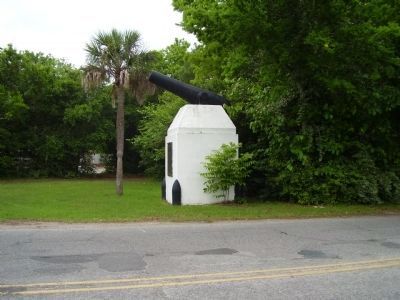
Photographed by Stanley and Terrie Howard, May 16, 2009
3. Fort Moultrie Marker
There is a Marker on the right and left side of the road. They are identical.
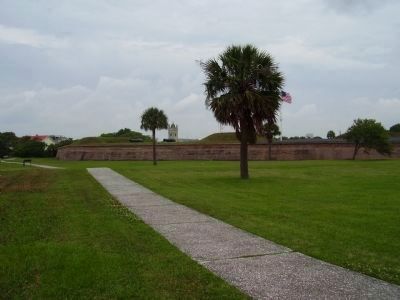
Photographed by Stanley and Terrie Howard, May 17, 2009
4. Fort Moultrie
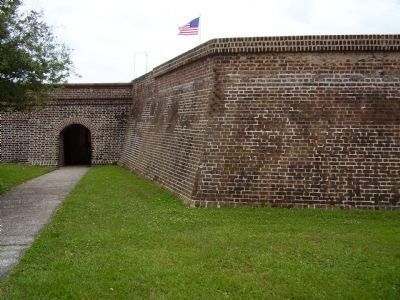
Photographed by Stanley and Terrie Howard, May 17, 2009
5. Fort Moultrie
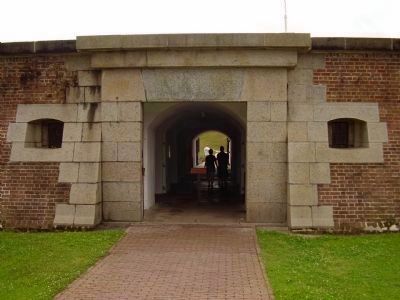
Photographed by Stanley and Terrie Howard, May 17, 2009
6. The Sally Port
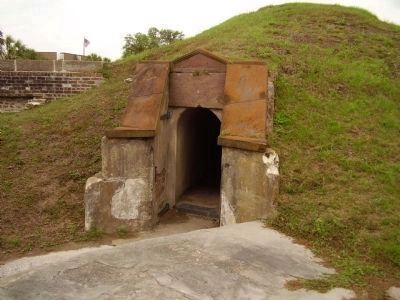
Photographed by Stanley and Terrie Howard, May 17, 2009
7. Bombproof
Photographed by Stanley and Terrie Howard, May 17, 2009
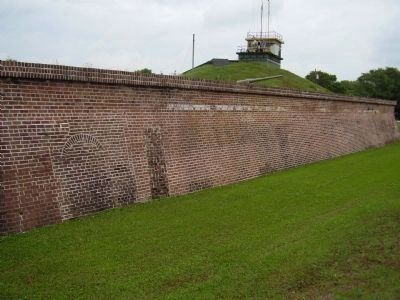
8. Exterior Wall
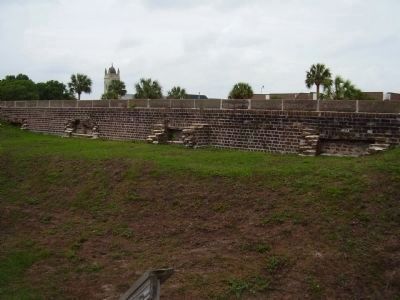
Photographed by Stanley and Terrie Howard, May 17, 2009
9. Interior Walls
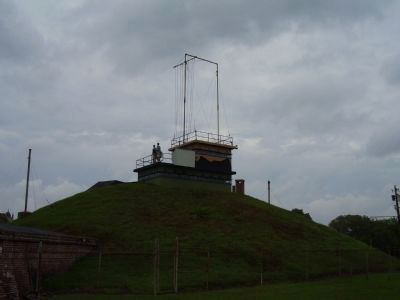
Photographed by Stanley and Terrie Howard, May 17, 2009
10. World War II Control Tower
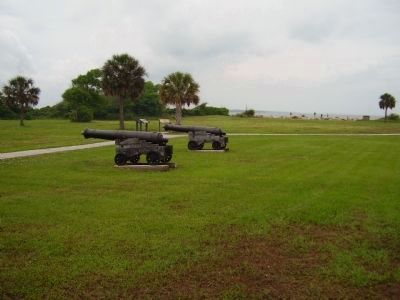
Photographed by Stanley and Terrie Howard, May 17, 2009
11. Revolutionary War Era Cannon
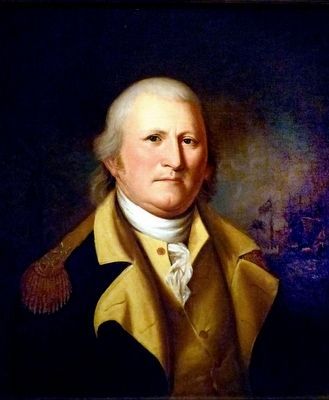
Photographed by Allen C. Browne, August 9, 2015
12. William Moultrie
This 1782 portrait of William Moultrie by Charles Willson Peale hangs in the National Portrait Gallery in Washington, DC.
“In June 1776, as eight British warships stood poised to put a quick end to the rebellion in the South, William Moultrie, a planter with some experience as a militia captain, was in charge of the hastily built fort on Sullivan's Island in Charles Town harbor. The soft palmetto logs of the fort successfully absorbed bombardment from one hundred guns, whereas Moultrie's men discharged their twenty-five guns with a deliberation that demolished ship rigging and slaughtered enemy sailors. After eleven and a half hours, the British slipped away, giving South Carolina a three-year respite from war.
In the background of this portrait showing Moultrie, risen to a general in the Continental army can be glimpsed the famous fort, renamed in Moultrie's honor.” — National Portrait Gallery
“In June 1776, as eight British warships stood poised to put a quick end to the rebellion in the South, William Moultrie, a planter with some experience as a militia captain, was in charge of the hastily built fort on Sullivan's Island in Charles Town harbor. The soft palmetto logs of the fort successfully absorbed bombardment from one hundred guns, whereas Moultrie's men discharged their twenty-five guns with a deliberation that demolished ship rigging and slaughtered enemy sailors. After eleven and a half hours, the British slipped away, giving South Carolina a three-year respite from war.
In the background of this portrait showing Moultrie, risen to a general in the Continental army can be glimpsed the famous fort, renamed in Moultrie's honor.” — National Portrait Gallery
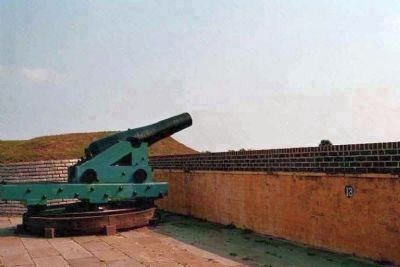
Photographed by Mike Stroud, April 2003
13. Fort Moultrie Cannon
Represents the period from 1873- 1898 ( N.P.S.ca 2003)
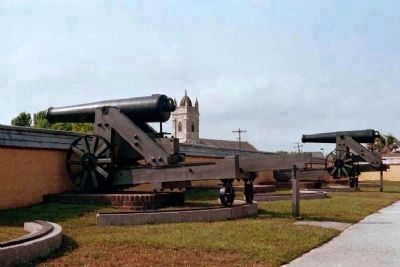
Photographed by Mike Stroud, April 2003
14. Fort Moultrie cannon,
Represents the period from 1809- 1860s (N.P.S.ca. 2003)
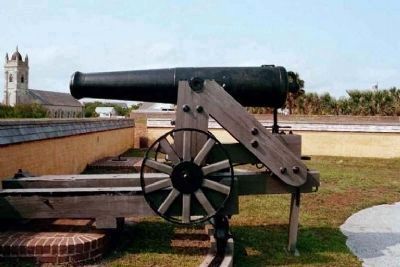
Photographed by Mike Stroud, April 2003
15. Fort Moultrie Cannon along northwest parapet
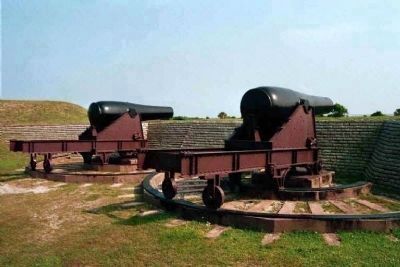
Photographed by Mike Stroud, April 2003
16. Fort Moultrie Cannon
these two weapons represent Fort Moultrie in the period from 1873-1898. (N.P.S. ca. 2003)
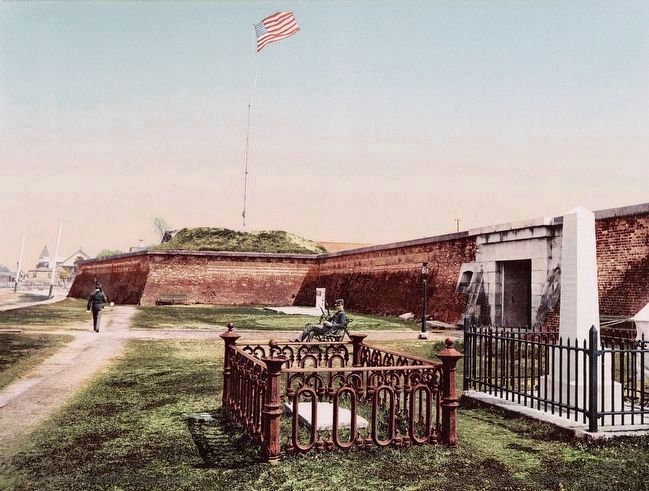
Postcard by the Detroit Publishing Company, 1900
17. Fort Moultrie, Charleston, S.C..
The grave in the foreground center is that of Oceola, noted Seminole Chief. Oceola was captured in October 1837 while negotiating a truce under a white flag. He was transferred to Fort Moultrie in December 1837, and died on January 30, 1838.
Credits. This page was last revised on June 5, 2023. It was originally submitted on May 18, 2009, by Stanley and Terrie Howard of Greer, South Carolina. This page has been viewed 1,958 times since then and 57 times this year. Photos: 1, 2, 3. submitted on May 18, 2009, by Stanley and Terrie Howard of Greer, South Carolina. 4, 5, 6, 7, 8, 9, 10, 11. submitted on June 7, 2009, by Stanley and Terrie Howard of Greer, South Carolina. 12. submitted on August 28, 2015, by Allen C. Browne of Silver Spring, Maryland. 13, 14, 15, 16. submitted on June 8, 2009, by Mike Stroud of Bluffton, South Carolina. 17. submitted on August 27, 2015. • Craig Swain was the editor who published this page.
