
South of Broad in Charleston in Charleston County, South Carolina — The American South (South Atlantic)
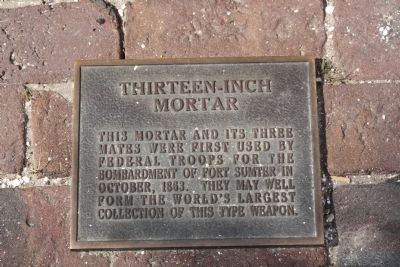
Thirteen - Inch Mortar
Photographed by Mike Stroud, May 12, 2009
1. Thirteen - Inch Mortar Marker
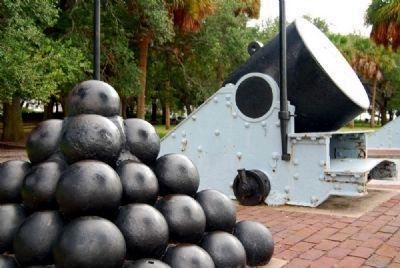
13-inch seacoast and Navy mortar, Model of 1861. Total length, 56.5 inches; weight, 17,250 pounds; total production, 162; known survivors, 27.
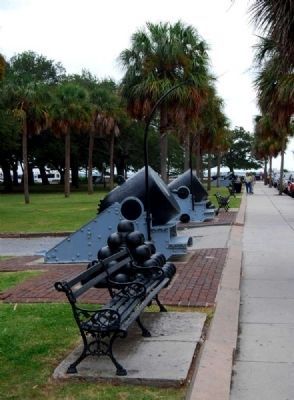
This mortar and its three mates were first used by Federal troops for the bombardment of Fort Sumter in October, 1863. They may well form the world's largest collection of this type weapon.
Topics. This historical marker is listed in this topic list: War, US Civil. A significant historical month for this entry is October 1863.
Location. 32° 46.165′ N, 79° 55.774′ W. Marker is in Charleston, South Carolina, in Charleston County. It is in South of Broad. It is on Murray Boulevard. Between E. Battery and King St. Battery Park - White Point Gardens. Touch for map. Marker is in this post office area: Charleston SC 29401, United States of America. Touch for directions.

Regionally, this marker is in Historic Charleston and in the Lowcountry. It is also in the American South, specifically in the Deep South, and on the Eastern Seaboard. Globally, it is in the North Atlantic Region, North America, the Western Hemisphere, the Western World, and the Anglosphere. Historically, it finds itself in what was once the territory of the Mississippian Culture, one of the original Thirteen Colonies, one of the Confederate States of America,
this page online
Other nearby markers. At least 10 other markers are within walking distance of this marker: A different marker also named Thirteen - Inch Mortar (within shouting distance of this marker); Thirteen-Inch Mortar (within shouting distance of this marker); Seven - Inch Banded Brooks Rifle (within shouting distance of this marker); Confederate Defenders of Charleston (within shouting distance of this marker); William Gilmore Simms (within shouting distance of this marker); Stede Bonnet / Richard Worley (within shouting distance of this marker); Thirteen Inch Mortar (within shouting distance of this marker); Ten - Inch Smooth Bore Columbaid Cannon (within shouting distance of this marker); Moultrie (within shouting distance of this marker); Charleston Waterfront (within shouting distance of this marker). Touch for a list and map of all markers in Charleston.
More about this marker. an In-pavement marker
Regarding Thirteen - Inch Mortar. Use of the Mortars
According to historian/reporter Warren Ripley, in his collected articles The Battery: Charlestown, South Carolina, the mortars in the battery cannot
Photographed by Mike Stroud, May 12, 2009
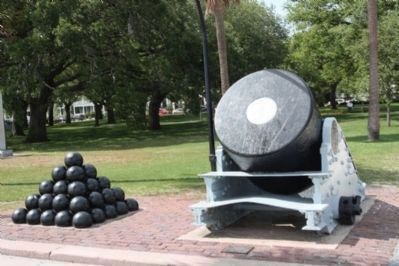
2. Thirteen - Inch Mortar Marker, a faint Foundry "Pitt" the only word to be found on mortar face
Type: Model 1861 13 inch Siege & Seacoast Mortar • Rarity: Uncommon • Years of Manufacture: Between 1860 and 1864 • Tube Composition: Iron • Bore Diameter: 13 inches • Standard Powder Charge: 20 lbs. • Projectiles: 200 lbs. Round Mortar Shells • Tube Length: 56.5 inches • Tube Weight: 17,250 lbs. • Range (at 45°): 4,325 yards • US Casting Foundry: Fort Pitt Foundry, Pittsburgh PA •
Also see . . . Wikipedia entry- Siege. The Second Battle of Charleston Harbor (or the Siege of Charleston Harbor, Siege of Fort Wagner, or Battle of Morris Island) (Submitted on May 20, 2009, by Mike Stroud of Bluffton, South Carolina.)
Additional commentary.
1. Is it authentic?
I assume that the original cast iron mortar was painted with a black lacquer, which I believe was common for that period. But this is the first time that I have seen the carriage painted white, which looks great, but is it authentic? If it is authentic, does anyone know what shade/finish of white paint that they would have used? Note To Editor only visible by Contributor and editor
— Submitted April 24, 2026, by Jeff Dutter of Rancho Mission Viejo, California.
Photographed by Mike Stroud, May 12, 2009
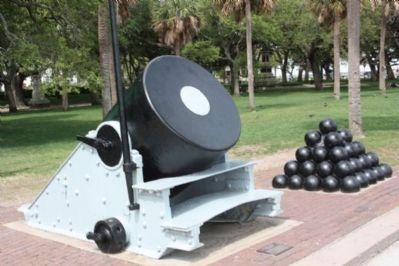
3. Thirteen - Inch Mortar Marker , another Mortar, with a duplicate marker
The 13-inch seacoast mortar had a maximum range of 4,300 yards, could be expected to be more accurate than it's smaller counterparts.
Photographed by Mike Stroud, May 12, 2009
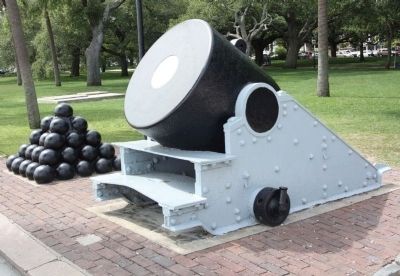
4. Thirteen - Inch Mortar
Photographed by Brian Scott, September 19, 2011
5. Thirteen - Inch Mortars
Looking East Along White Point Park
The Battery
Looking East Along White Point Park
The Battery
Photographed by Brian Scott, September 19, 2011
6. Thirteen - Inch Mortar and Mortar Shells

Photographed by Brian Scott, September 19, 2011
7. Mortar Shells Details
Credits. This page was last revised on May 19, 2026. It was originally submitted on May 18, 2009, by Mike Stroud of Bluffton, South Carolina. This page has been viewed 2,544 times since then and 75 times this year. Photos: 1, 2, 3, 4. submitted on May 19, 2009, by Mike Stroud of Bluffton, South Carolina. 5, 6, 7. submitted on September 22, 2011, by Brian Scott of Anderson, South Carolina. • Craig Swain was the editor who published this page.
