Waterside Promenade in Norfolk, Virginia — The American South (Mid-Atlantic)
The Bombardment of Norfolk, 1776
| — | Norfolk Heritage Cannonball Trail | — |
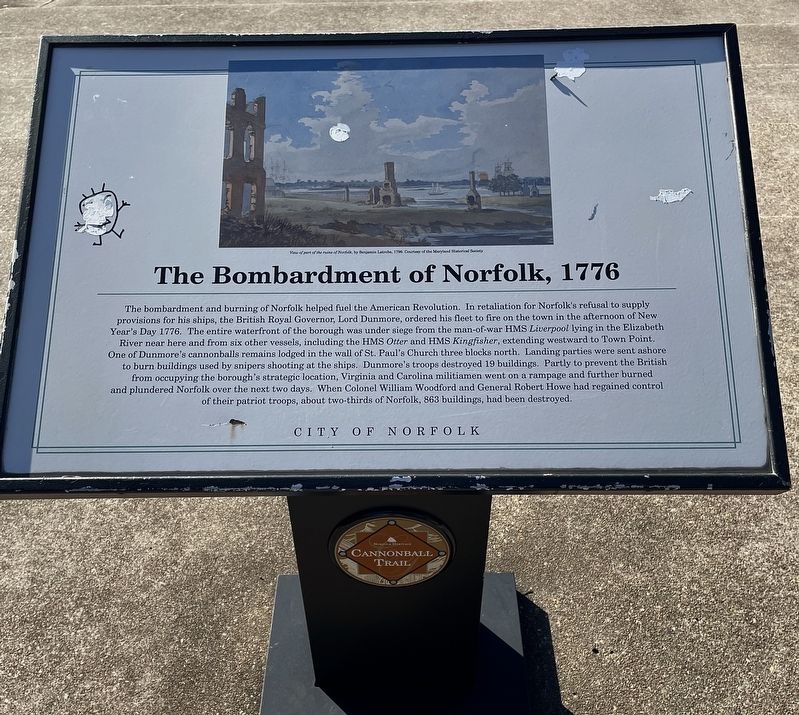
Photographed by Brandon D Cross, January 19, 2022
1. The Bombardment of Norfolk, 1776 Marker
(caption)
View of part of the ruins of Norfolk, by Benjamin Latrobe, 1796: Courtesy of the Maryland Historical Society
Erected by City
this page online
Topics. This historical marker is listed in these topic lists: War, US Revolutionary • Waterways & Vessels. A significant historical date for this entry is January 1, 1776.
Location. 36° 50.595′ N, 76° 17.304′ W. Marker is in Norfolk, Virginia. It is in Waterside Promenade. It can be reached from the intersection of Waterside Drive (Virginia Route 337) and East Water Street, on the right when traveling east. Marker is located at the rear of the Dominion Tower on the bulkhead. Touch for map. Marker is at or near this postal address: 999 Waterside Drive, Norfolk VA 23510, United States of America. Touch for directions.

Regionally, this marker is in Hampton Roads, specifically in Coastal Virginia, and in the Hampton Roads Metropolitan Area. It is also in the American South, specifically in the Upper South, in the Tidewater, and on the Eastern Seaboard. Globally, it is in the North Atlantic Region, North America, the Western Hemisphere, the Western World, and the Anglosphere. Historically, it finds itself in what was once the territory of the Mississippian Culture, one of the original Thirteen Colonies, one of the Confederate
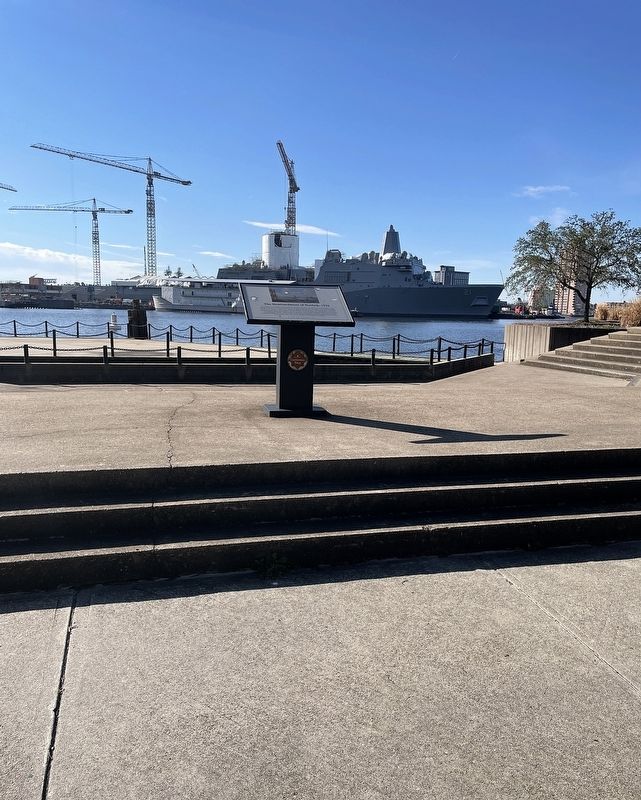
Photographed by Brandon D Cross, January 19, 2022
2. The Bombardment of Norfolk, 1776 Marker
Other nearby markers. At least 8 other markers are within walking distance of this marker: Elizabeth River (about 500 feet away, measured in a direct line); Sgt. William H. Carney (about 700 feet away); The Cannonball Trail (about 800 feet away); Ferries to Portsmouth and Berkley (approx. 0.2 miles away); Commercial Place (approx. 0.2 miles away); Lafayette's Tour (approx. 0.2 miles away); East Main Street (approx. 0.2 miles away); The Underground Railroad (approx. ¼ mile away). Touch for a list and map of all markers in Norfolk.
Also see . . . The Burning of Norfolk. Wikipedia (Submitted on February 2, 2022, by Brandon D Cross of Flagler Beach, Florida.)
Credits. This page was last revised on October 26, 2023. It was originally submitted on February 2, 2022, by Brandon D Cross of Flagler Beach, Florida. This page has been viewed 1,917 times since then and 118 times this year. Photos: 1, 2. submitted on February 2, 2022, by Brandon D Cross of Flagler Beach, Florida. • Bernard Fisher was the editor who published this page.
