West Main Hill in Kalamazoo in Kalamazoo County, Michigan — The American Midwest (Great Lakes)
Henderson Park West Main Hill Historic District
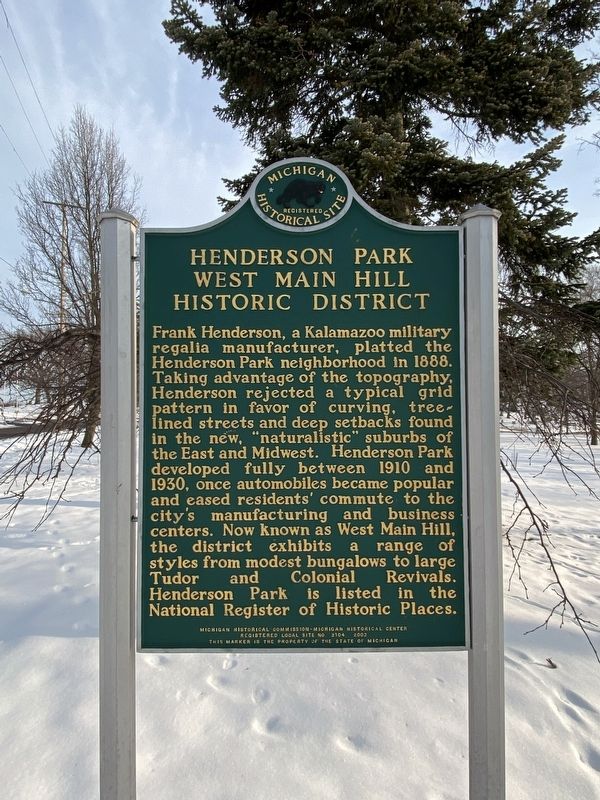
Photographed by J.T. Lambrou
1. Henderson Park West Main Hill Historic District Marker
Erected 2002 by Michigan Historical Commission-Michigan Historical Center. (Marker Number L2104.)
Topics and series. This historical marker is listed in this topic list: Settlements & Settlers. In addition, it is included in the Michigan Historical Commission series list. A significant historical year for this entry is 1888.
Location. 42° 17.545′ N, 85° 36.251′ W. Marker is in Kalamazoo, Michigan, in Kalamazoo County. It is in West Main Hill. It is at the
this page online

Regionally, this marker is in Southwest Michigan. It is also in the American Midwest. Globally, it is in North America, the Western Hemisphere, the Western World, and the Anglosphere. Historically, it finds itself in what was once the Northwest Territory.
Other nearby markers. At least 8 other markers are within walking distance of this marker: Edward Israel Arctic Pioneer (about 400 feet away, measured in a direct line); The Stuart House (approx. 0.4 miles away); French-Allen House (approx. 0.4 miles away); Stuart Neighborhood (approx. 0.4 miles away); a different marker also named Stuart Neighborhood (approx. 0.4 miles away); a different marker also named Stuart Neighborhood (approx. half a mile away); Western Michigan University (approx. 0.7 miles away); South Street Historic District (approx. 0.7 miles away). Touch for a list and map
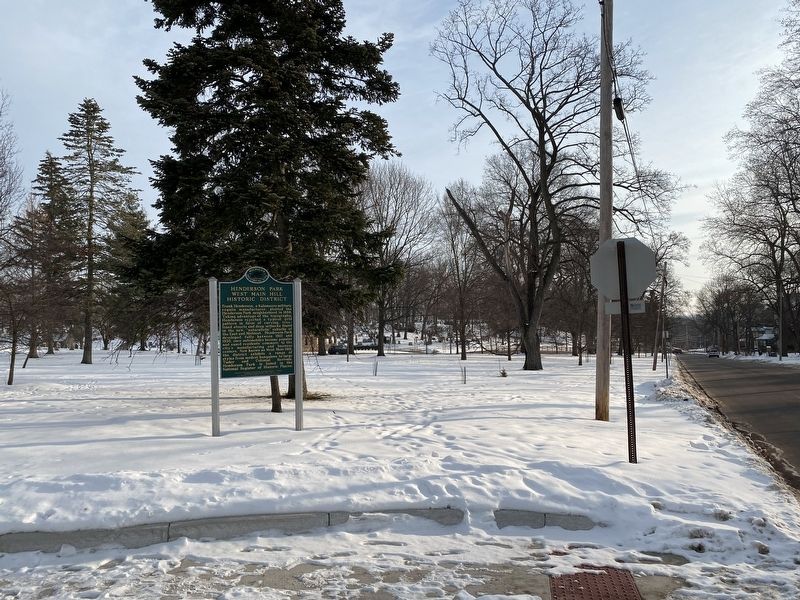
Photographed by J.T. Lambrou
2. Henderson Park West Main Hill Historic District Marker
Also see . . . Stuart Area Historic District. The Stuart Area Historic District was placed on the National Register of Historic Places in 1995. Some excerpts from the 104-page Nomination Form:
The Stuart Neighborhood/Henderson Park Historic District is significant as Kalamazoo's finest late nineteenth- and early twentieth-century residential neighborhood, containing the architecturally significant homes of a large number of the city's commercial, Industrial, and civic leaders. The district is also notable for the Mountain Home Cemetery, a fine rural cemetery with winding roadways, handsome funerary art, and an 1892, stone, sexton's lodge.(Submitted on July 25, 2026, by Joel Seewald of Madison Heights, Michigan.)
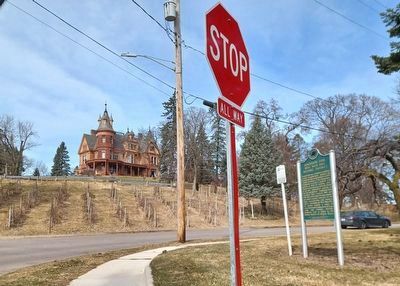
The Stuart neighborhood saw its beginnings in the 1840s and 1850s as a largely rural suburban adjunct of Kalamazoo. Mountain Home Cemetery, located on the hilly ground above what is now the Stuart area, was established in the late 1840s and in the 1840s and early 1850s the first suburban residences were built in the area. The building of United States Senator Charles E. Stuart's villa (1854-58) at 427 Stuart Avenue and the platting of the area in the 1850sled to further development in the 1860s and 1870s. However, the area's real growth began in 1884, when a horse-car line was introduced, and continued into the early twentieth century. In this period the Stuart neighborhood became the city's most fashionable residential quarter, as the city's leading carriage, paper, and plow manufacturers and other businessmen and professionals and no less than three United States senators—Charles E. Stuart, Francis B. Stockbridge, and Julius c. Burrows—located there.Photographed by Joel Seewald, March 4, 20263. Henderson Park West Main Hill Historic District MarkerMarker with Henderson Castle, built by Frank Henderson, in the background.
The district is notable in architectural terms for its fine houses exemplifying the Greek and Gothic modes and the Italianate, Mansard, Eastlake, Queen Anne, and Colonial Revival styles.
Credits. This page was last revised on July 25, 2026. It was originally submitted on February 3, 2022, by J.T. Lambrou of New Boston, Michigan. This page has been viewed 538 times since then and 42 times this year. Photos: 1, 2. submitted on February 3, 2022, by J.T. Lambrou of New Boston, Michigan. 3. submitted on July 25, 2026, by Joel Seewald of Madison Heights, Michigan. • J. Makali Bruton was the editor who published this page.
