Navy Yard in Philadelphia in Philadelphia County, Pennsylvania — The American Northeast (Mid-Atlantic)
U.S. Naval Aircraft Factory
1917 - 1956
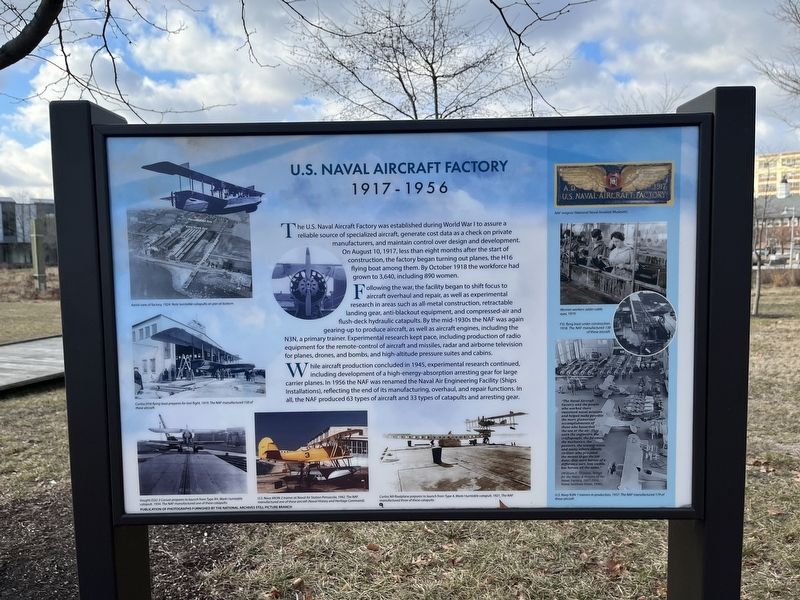
The U.S Naval Aircraft Factory was established during World War I to assure a reliable source of specialized aircraft, generate cost data as a check on private manufacturers, and maintain control over design and development. On August 10, 1917, less than eight months after the start of construction, the factory began turning out planes, the H16 flying boat among them. By October 1918 the the workforce had grown to 3,640, including 890 women.
Following the war, the facility began to shift focus to aircraft overhaul and repair, as well as experimental research in areas such as all-metal construction, retractable landing gear, anti-blackout equipment, and compressed-air and flush-deck hydraulic catapults. By the mid-1930s the NAF was again gearing-up to produce aircraft, as well as aircraft engines, including the N3N, a primary trainer. Experimental research kept pace, including production of radio equipment for the remote-control of aircraft and missiles, radar and airborne television for planes, drones, and bombs, and high-altitude pressure suites and cabins.
While aircraft production concluded in 1945, experimental
this page online
"The Naval Aircraft Factory and the people who worked there sustained naval aviation and helped make possible the more glamorous accomplishments of those who hazarded the sea or the air. They were the engineers, the craftspeople, the foremen, the mechanics, the painters, the seamstresses, and many others—mostly civilian—who provided the means to get the job done; they were heroes of a difference sort, less visible, but heroes all the same."
(William F. Trimble, Wings for the Navy: A History of the Naval Factory, 1917-1956, Naval Institute Press, 1990).
Topics. This historical marker is listed in these topic lists: Air & Space • Industry & Commerce • War, World I • War, World II. A significant historical date for this entry is August 10, 1917.
Location. 39° 53.501′ N, 75° 10.232′ W.
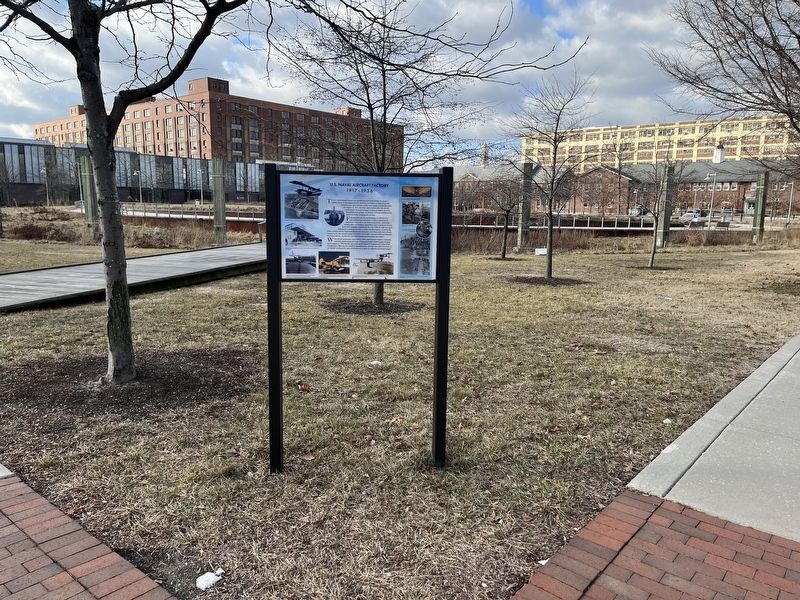

Regionally, this marker is in Southeast Pennsylvania. It is also in the American Northeast and in the Mid-Atlantic. Globally, it is in North America, the Western Hemisphere, the Western World, and the Anglosphere. Historically, it finds itself in what was once the Haudenosaunee (Iroquois) Confederacy, New Netherland, and one of the original Thirteen Colonies.
Other nearby markers. At least 8 other markers are within walking distance of this marker: To the lost at sea (about 400 feet away, measured in a direct line); World War II Submariners Memorial (about 500 feet away); Webster Road (approx. ¼ mile away); In Memoriam (approx. 0.3 miles away); 16"/50 Caliber Mark 7 Gun Barrel Number 293 (approx. 0.3 miles away); Rear Admiral George W. Melville (approx. 0.4 miles away); Naval Foundry and Propeller Center (approx. half a mile away); Harvey Pollack (approx. 0.6 miles away). Touch for a list and map of all markers in Philadelphia.
Credits. This page was last revised on February 2, 2024. It was originally submitted on February 6, 2022, by Devry Becker Jones of Washington, District of Columbia. This page has been viewed 740 times since then and 50 times this year. Photos: 1, 2. submitted on February 6, 2022, by Devry Becker Jones of Washington, District of Columbia.
