Bozeman in Gallatin County, Montana — The American West (Mountains)
North Tracy Avenue Historic District
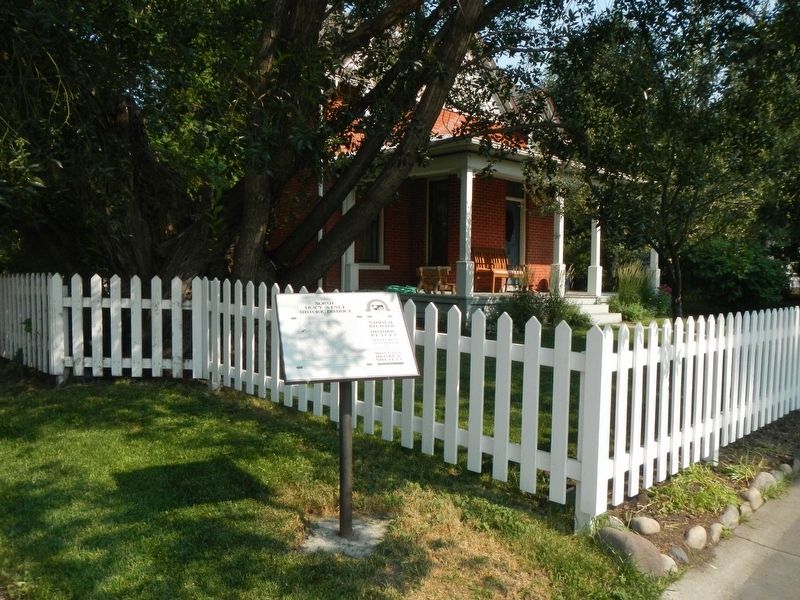
Photographed by Barry Swackhamer, July 25, 2021
1. North Tracy Avenue Historic District Marker
Inscription.
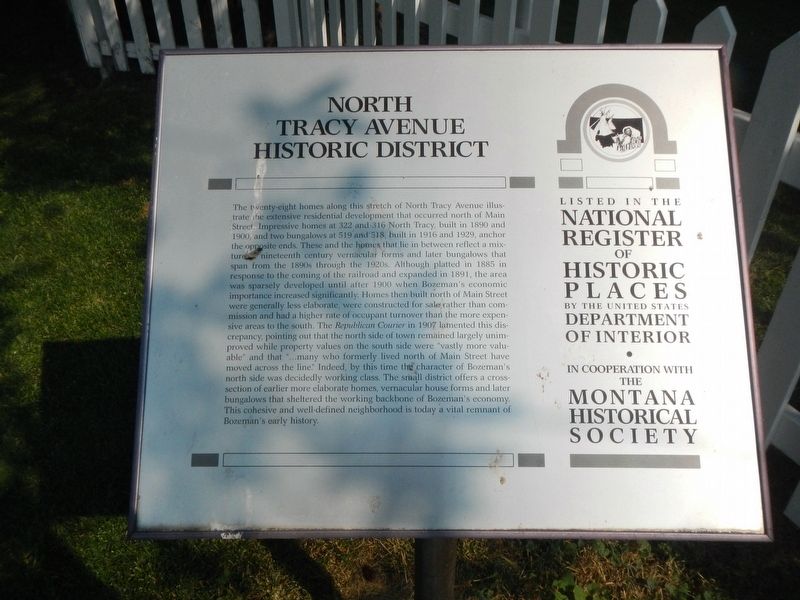
North Tracy Avenue Historic District. . The twenty-eight homes along this stretch of North Tracy Avenue illustrate the extensive residential development that occurred north of Main Street. Impressive homes at 322 and 316 North Tracy, built in 1890 and 1900, and two bungalows at 519 and 518, built in 1916 and 1929, anchor the opposite ends. These and the homes that lie in between reflect a mixture of nineteenth-century vernacular forms and later bungalows that span from the 1890s through the 1920s. Although platted in 1885 in response to the coming of the railroad and expanded in 1891, the area was sparsely developed until after 1900 when Bozeman’s economic importance increased significantly. Homes then built north of Main Street were generally less elaborate, were constructed for sale rather than commission, and had a higher rate of occupant turnover than the more expensive areas to the south. The Republican Courier in 1907 lamented this discrepancy, pointing out that the north side of town remained largely unimproved while property values on the south side were “vastly more valuable” and that “... many who formerly lived north of Main Street have moved across the line.” Indeed, by this time the character of Bozeman’s north side was decidedly working class. The small district offers a cross-section of earlier more elaborate homes, vernacular house forms, and later bungalows that sheltered the working backbone of Bozeman’s economy. This cohesive and well-defined neighborhood is today a vital remnant of Bozeman’s early history.
The twenty-eight homes along this stretch of North Tracy Avenue illustrate the extensive residential development that occurred north of Main Street. Impressive homes at 322 and 316 North Tracy, built in 1890 and 1900, and two bungalows at 519 and 518, built in 1916 and 1929, anchor the opposite ends. These and the homes that lie in between reflect a mixture of nineteenth-century vernacular forms and later bungalows that span from the 1890s through the 1920s. Although platted in 1885 in response to the coming of the railroad and expanded in 1891, the area was sparsely developed until after 1900 when Bozeman’s economic importance increased significantly. Homes then built north of Main Street were generally less elaborate, were constructed for sale rather than commission, and had a higher rate of occupant turnover than the more expensive areas to the south. The Republican Courier in 1907 lamented this discrepancy, pointing out that the north side of town remained largely unimproved while property values on the south side were “vastly more valuable” and that “... many who formerly lived north of Main Street have moved across
Click or scan to see this page online
the line.” Indeed, by this time the character of Bozeman’s north side was decidedly working class. The small district offers a cross-section of earlier more elaborate homes, vernacular house forms, and later bungalows that sheltered the working backbone of Bozeman’s economy. This cohesive and well-defined neighborhood is today a vital remnant of Bozeman’s early history.
Location. 45° 40.976′ N, 111° 2.232′ W. Marker is in Bozeman, Montana, in Gallatin County. It is at the intersection of North Tracy Avenue and East Villard Street, on the right when traveling north on North Tracy Avenue. Touch for map. Marker is at or near this postal address: 399 North Tracy Avenue, Bozeman MT 59715, United States of America. Touch for directions.

Regionally, this marker is in Montana’s Yellowstone Country. It is also in the American Mountain
Photographed by Barry Swackhamer, July 25, 2021
2. North Tracy Avenue Historic District Marker
West and in the Lewis & Clark Corridor. Globally, it is in North America, the Rocky Mountains, the Western Hemisphere, the Western World, and the Anglosphere. Historically, it finds itself in what was once Rupert’s Land and also the Louisiana Purchase.
Credits. This page was last revised on February 22, 2022. It was originally submitted on February 22, 2022, by Barry Swackhamer of Brentwood, California. This page has been viewed 168 times since then and 17 times this year. Photos:1, 2. submitted on February 22, 2022, by Barry Swackhamer of Brentwood, California.