Logan Square in Philadelphia in Philadelphia County, Pennsylvania — The American Northeast (Mid-Atlantic)
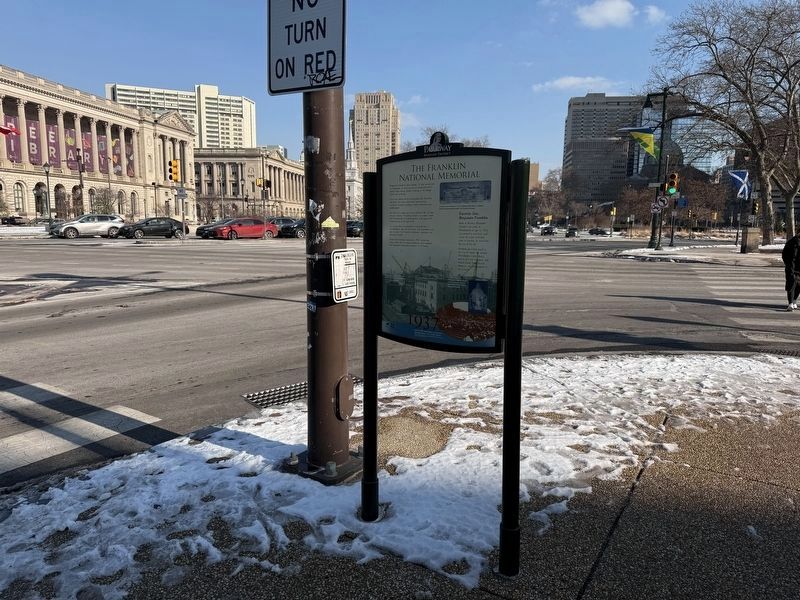
The Franklin National Memorial
1937
⎯⎯⎯
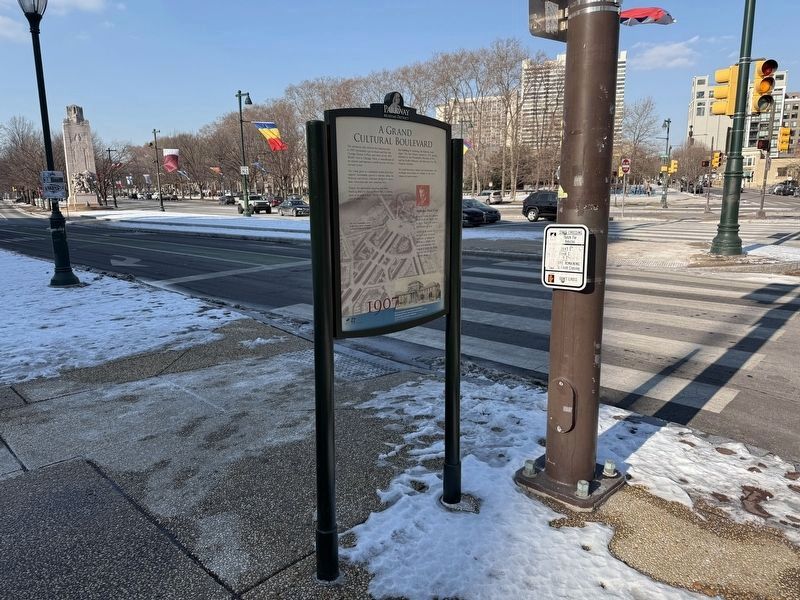
A Grand Cultural Boulevard
1907
| — | Parkway Museums District | — |

Photographed by Larry Gertner, September 2014
1. The Franklin National Memorial side of the marker
1937
Over the course of his remarkable life, Franklin did both. He was a successful businessman, scientist, inventor, printer, writer, humorist and philosopher.
He also led a long and active political life. As one of our country’s founding fathers, he helped draft the Declaration of Independence, and signed the Constitution at the age of 81.
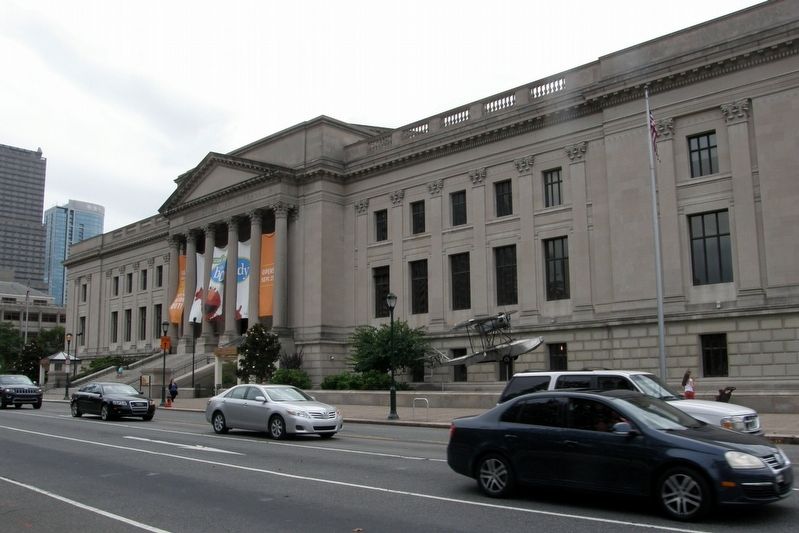
It’s fitting that his memorial is located here in Philadelphia, the city he loved. His monument sits just beyond The Franklin Institute’s entrance, in Memorial Hall.
When the Institute opened in 1937, what was then called the Fairmount Parkway, was renamed the Benjamin Franklin Parkway in his honor.
Favorite Son, Benjamin Franklin
Born in Boston, Benjamin Franklin ran away to Philadelphia at age 17. This city seemed to suit him, and except for a few extended stays in Europe, he lived here the rest of his life.
Franklin gave back much to the city he loved. He created Philadelphia's first library and its first fire company, and help found Pennsylvania Hospital, the first hospital in the colonies.
1907
The vision grew as community leaders lent their support. Institutions agreed to relocate along the Parkway and private collectors pledged to move their collections into new museums here.
Despite the enthusiasm, progress was slow. Funding dried up during World War I, forcing plans to be
this page online
But building by building, the Parkway took shape. The Free Library opened in 1927, quickly followed by the Philadelphia Museum of Art and the Rodin Museum, and then later, by The Franklin Institute.
Set amid fountains, statues and monuments, the buildings stand today as a tribute to the city's vision and perseverance.
Architect Paul Cret
Born in France and educated at the École des Beaux Arts in Paris, Paul Cret came to Philadelphia in 1903.
As one of the creators of the 1907 plan, he shared the vision of making the Parkway a cultural center lined with museums. He went on to design the Rodin Museum and the Benjamin Franklin Bridge.
[Captions:]
This 1907 Parkway plan, drawn by Paul Cret, shows numerous institutions lining the Parkway.
Paul Cret designed this building for the American Philosophical Society, which was to move to the Parkway, but the project was never completed.
Topics. This historical marker is listed in these topic lists: Arts, Letters, Music • Patriots & Patriotism. A significant historical year for this entry is 1937.
Location. 39° 57.483′ N, 75° 10.333′ W.

Photographed by Devry Becker Jones (CC0), January 24, 2025
2. A Grand Cultural Boulevard side of the marker

Regionally, this marker is in Southeast Pennsylvania. It is also in the American Northeast and in the Mid-Atlantic. Globally, it is in North America, the Western Hemisphere, the Western World, and the Anglosphere. Historically, it finds itself in what was once the Haudenosaunee (Iroquois) Confederacy, New Netherland, and one of the original Thirteen Colonies.
Other nearby markers. At least 8 other markers are within walking distance of this marker: Aero Memorial (a few steps from this marker); Aero Memorial Pillar (a few steps from this marker); The Franklin Institute (within shouting distance of this marker); All Wars Memorial to Colored Soldiers and Sailors (within shouting distance of this marker); a different marker also named All Wars Memorial to Colored Soldiers and Sailors (within shouting distance of this marker); The City Plan of Philadelphia
Photographed by Devry Becker Jones (CC0), January 24, 2025
3. The Franklin National Memorial side of the marker
Also see . . .
1. The Franklin Institute - Explore the Museum. The Franklin Institute homepage. (Submitted on April 16, 2020, by Larry Gertner of New York, New York.)
2. Benjamin Franklin National Memorial. Wikipedia entry. (Submitted on April 16, 2020, by Larry Gertner of New York, New York.)
Photographed by Devry Becker Jones (CC0), January 24, 2025
4. A Grand Cultural Boulevard side of the marker
Photographed by Larry Gertner, September 2014
5. The Franklin Institute
Credits. This page was last revised on January 26, 2025. It was originally submitted on August 7, 2017, by Larry Gertner of New York, New York. This page has been viewed 722 times since then and 34 times this year. Last updated on February 28, 2022, by Bradley Owen of Morgantown, West Virginia. Photos: 1. submitted on August 7, 2017, by Larry Gertner of New York, New York. 2, 3, 4. submitted on January 26, 2025, by Devry Becker Jones of Washington, District of Columbia. 5. submitted on August 7, 2017, by Larry Gertner of New York, New York. • Bill Pfingsten was the editor who published this page.
