Death Valley National Park in Inyo County, California — The American West (Pacific Coastal)
Twenty Mule Teams
Photographed by Craig Baker, April 3, 2022
1. Twenty Mule Teams Marker
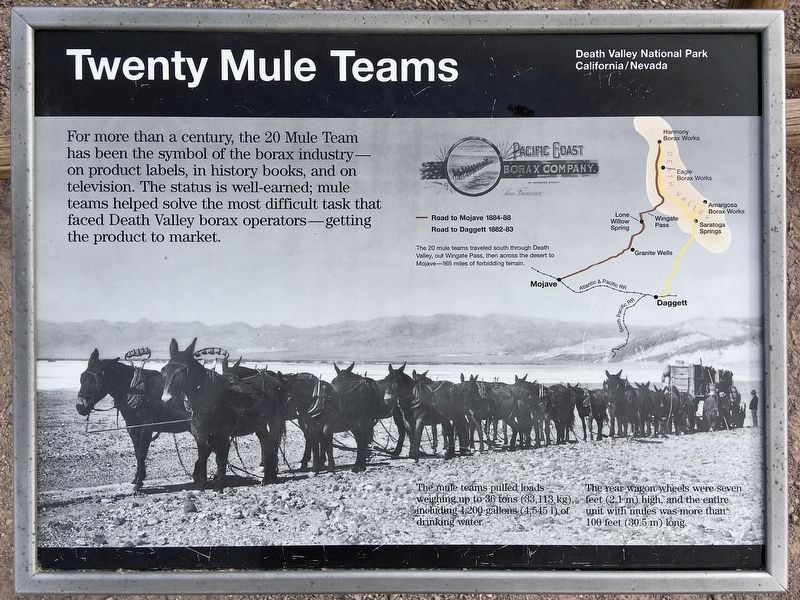
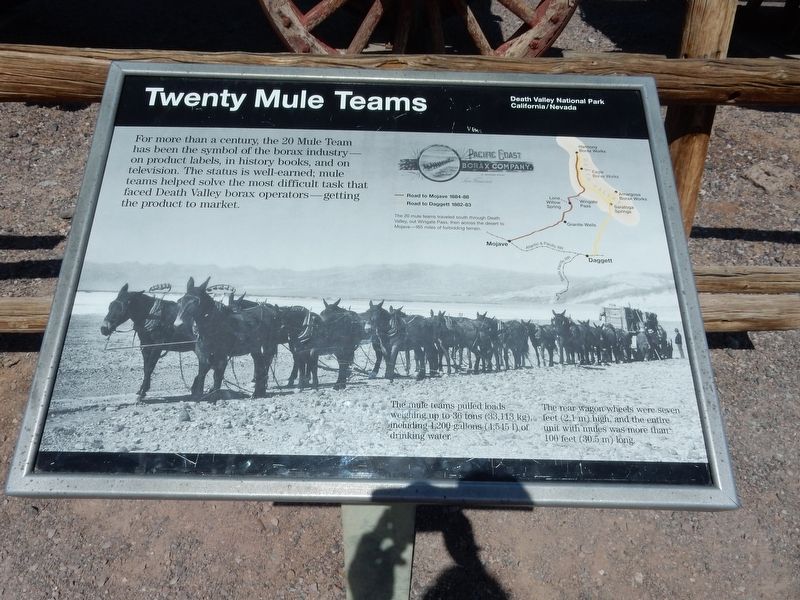
For more than a century, the 20 Mule Team has been the symbol of the Borax industry — on product labels, in history books, and on television. The status is well-earned; mule teams help solve the most difficult task that faced death Valley Borax operators — getting the product to market.
The mule teams pulled loads weighing up to 36 tons (33,113 kg) including 1200 gallons (4545 l) of drinking water. The rear wagon wheels were 7 feet (2.1m) high, and the entire unit with mules was more than 100 feet (30.5m) long.
The 20 mule teams traveled south through Death Valley, out Wingate Pass, then across the desert to Mojave — 165 miles of forbidding terrain.
Erected by Death Valley National Park.
Topics. This historical marker is listed in these topic lists: Animals • Industry & Commerce • Roads & Vehicles. A significant historical year for this entry is 1882.
Location. 36° 28.801′ N, 116° 52.526′ W. Marker is in Death Valley National Park, California, in Inyo County. It can be reached from Borax Mill Road west of California Route 190, on the left when traveling west. Located at Harmony Borax Works. Touch for map.
this page online

Regionally, this marker is in the Sierra Nevada. It is also in the American Mountain West. Globally, it is in North America, on the Ring of Fire, on the Pacific Rim, in the Western Hemisphere, in the Western World, and in the Anglosphere. Historically, it finds itself in what was once New Spain and also Mexico’s Alta California.
Other nearby markers. At least 8 other markers are within 2 miles of this marker, measured as the crow flies: Borax (a few steps from this marker); White Gold (within shouting distance of this marker); Old Harmony Borax Works (approx. 0.3 miles away); Stephen Tyng Mather (approx. 1.3 miles away); Vietnam Veterans Memorial (approx. 1.6 miles away); Old Dinah (approx. 1.7 miles away); 20 Mule Team Wagon Train (approx. 1.7 miles away); Borax Museum (approx. 1.7 miles away). Touch for a list and map of all markers in Death Valley National Park.
Another marker is no longer nearby. 20 Mule Team Barn (was approx. 1.7 miles away but has been permanently removed).
More about this marker.
Courtesy of Thomas P. Martin, April 14, 2016
2. Twenty Mule Teams Marker
Regarding Twenty Mule Teams. The twenty mule teams solved a transportation problem: between 1883 and 1888 they hauled more than 12 million pounds of borax from remote and inaccessible Death Valley to the railroad at Mojave.
When the Harmony Borax Works was built in 1882, teams of eight and ten mules hauled the ore. But with increased production, the first teams of twenty mules were tried. Stretching out more than a hundred feet from the wagons, the great elongated teams immediately proved a dependable means of transportation.
The borax wagons were large and well built. The rear wheels were 7 feet high, the front wheels 5 feet high. Each wheel had

Jasperdo via Flickr (CC BY-NC-ND 2.0), October 12, 2018
3. Twenty Mule Teams Marker and Original Wagons
The distance to Mojave was 165 miles. Travelling fifteen to eighteen miles a day, it took ten days to make the trip. After leaving the Valley the teams had to cross 100 miles of empty desert, where many of the overnight ștops were at dry camps. Water tanks were therefore attached to the wagons, to supply the men and animals between springs.
Three men operated these twenty mule teams - in actuality eighteen mules and two horses - the driver who wielded a formidable whip; the teamster, who harnessed and unharnessed the mules, rode one of the horses, and handled the brake of the lead wagon; and the swamper, who rode on the rear wagon, operated its brake on the downgrades, and was chief cook and dishwasher.
The twenty mule teams were not always 20 mules. Experience proved that it was best to have a pair of

Photographed by Craig Baker, October 29, 2020
4. Twenty Mule Teams Marker and Original Wagons
When rounding a sharp curve, by the time six or seven pairs of animals had turned, tremendous power was being exerted at an angle which could easily pull the wagons off the road. To counteract this, the pointers and sixes were trained to jump over the chain and pull furiously at an opposite angle until the wagons had safely reached the point of the turn.
Only the mule teams hauling freight wore bells. Freighters returning empty wore no bells, so they could hear approaching loaded wagons and have time to find a place to pull off to the side to let them pass.
If a teamster became stuck or broke down, and another teamster helped him to get going again, then he was obligated to give the assisting teamster his bells. From this custom came the saying "I'll be there with bells on" meaning I will make my own way without help from anyone.
When borax was discovered in the Calico Mountains early in the 1890's, twenty mule teams hauled the ore from Borate to the railroad at Daggett. Except for the brief interlude when the traction engine "Old Dinah" attempted the

Albertype Co. via Library of Congress, Prints and Photographs Division (public domain), circa 1885
5. Twenty Mule Team
A team of eighteen mules and two horses, attached to large wagons in the desert. Two pale horses, positioned closest to the wagon, wear coverings over their faces.
Among those who helped make the teams famous were J.W.S. Perry, PCB superintendent, who organized the first teams and mapped the routes; William Delameter, who constructed the wagons; Ed Stiles, driver of the first team; and teamsters Frank Tilton, Johnny O’Keefe and "Borax Bill" Parkinson.
-from exhibits in nearby Borax Museum
Twenty Mule Teams were made famous by the effective corporate branding of Pacific Coast Borax (and continued by U.S. Borax), including popular radio and TV programs that ran for decades. The campaign is credited to Stephen T. Mather (1867-1930), the marketing manager at the company's Chicago headquarters, who later made a fortune with his own borax mining company. In 1917, Mather became the first director of the National Park Service.
Related markers. Click here for a list of markers that are related to this marker. - Twenty Mule Team Routes.
Also see . . . Borax: The Twenty Mule Team. The Borax twenty mule team is one of the most memorable icons of the American West, and of the

Photographed by Craig Baker, March 28, 2025
6. Routes of the Twenty Mule Teams
This map is an exhibit at the nearby Borax Museum. Click on this or any photo to see it full size.
Credits. This page was last revised on February 17, 2026. It was originally submitted on March 25, 2022, by Duane and Tracy Marsteller of Murfreesboro, Tennessee. This page has been viewed 922 times since then and 73 times this year. Photos: 1. submitted on April 12, 2022, by Craig Baker of Sylmar, California. 2, 3. submitted on March 25, 2022, by Duane and Tracy Marsteller of Murfreesboro, Tennessee. 4. submitted on April 12, 2022, by Craig Baker of Sylmar, California. 5. submitted on March 25, 2022, by Duane and Tracy Marsteller of Murfreesboro, Tennessee. 6. submitted on November 17, 2025, by Craig Baker of Sylmar, California.
