Axtell Park in Sioux Falls in Minnehaha County, South Dakota — The American Midwest (Upper Plains)
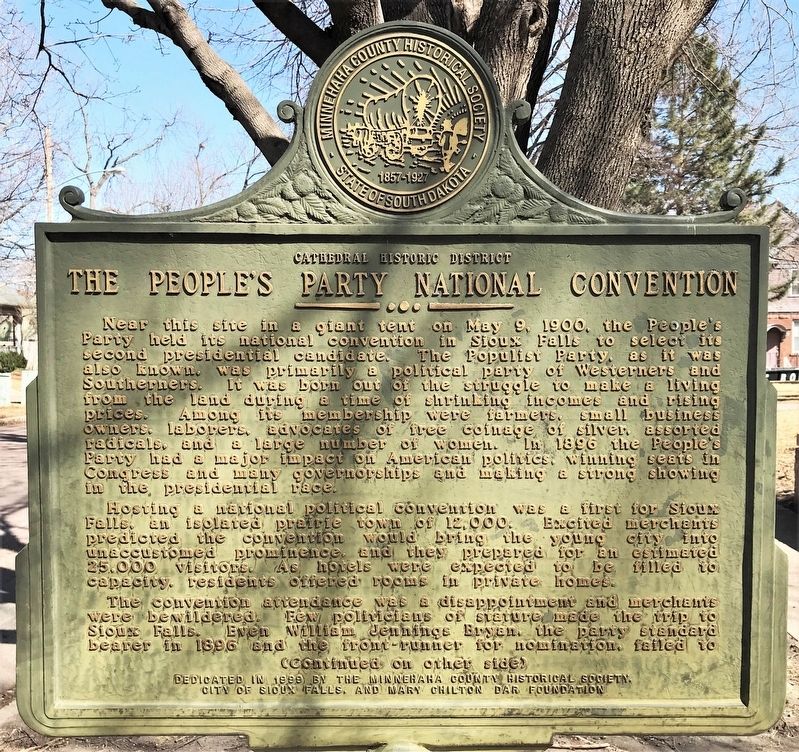
The People's Party National Convention
Cathedral Historic District
March 26, 2022
1. The People's Party National Convention Marker
Hosting a national political convention was a first for Sioux Falls, an isolated prairie town of 12,000. Excited merchants predicted the convention would bring the young city into unaccustomed prominence, and they prepared for an estimated 25,000 visitors. As hotels were expected to be filled to capacity, residents offered rooms in private homes.
The convention attendance was a disappointment and merchants were bewildered. Few
this page online
Nevertheless, while many concluded that the Populist movement was weakening, the convention crowd was enthusiastic about the party's future. Delegates and reporters from major national newspapers heard numerous fiery speeches. Sioux Falls' own United States Senator Richard F. Pettigrew, who had bolted the Republican Party in 1896, played a prominent role in the proceedings. Amid great cheering, the delegates selected William Jennings Bryan of Nebraska as their candidate for president and debated the major issues of the day: free silver, imperialism, and public ownership of utilities. The party platform contained many concepts that have since become law and policy.
Although the low turnout disappointed Pettigrew and the convention committee, they all rallied behind Bryan as their choice for president. Delegates returned to their respective states to engage in the great

March 26, 2022
2. The People's Party National Convention Marker
Erected 1999 by the Minnehaha County Historical Society, City of Sioux Falls, Mary Chilton DAR Foundation, Blake Law Offices, and Don & Cara Lee Davis.
Topics and series. This historical marker is listed in this topic list: Government & Politics. In addition, it is included in the Daughters of the American Revolution (DAR) series list. A significant historical date for this entry is May 9, 1900.
Location. 43° 32.833′ N, 96° 44.122′ W. Marker is in Sioux Falls, South Dakota, in Minnehaha County. It is in Axtell Park. It is at the intersection of West 9th Street and South Summit Avenue, on the right when traveling east on West 9th Street. Touch for map. Marker is at or near this postal address: 631 W 9th St, Sioux Falls SD 57104, United States of America. Touch for directions.

Regionally, this marker is in East River. It is also in the American Midwest, in the Lewis & Clark Corridor, in
March 26, 2022
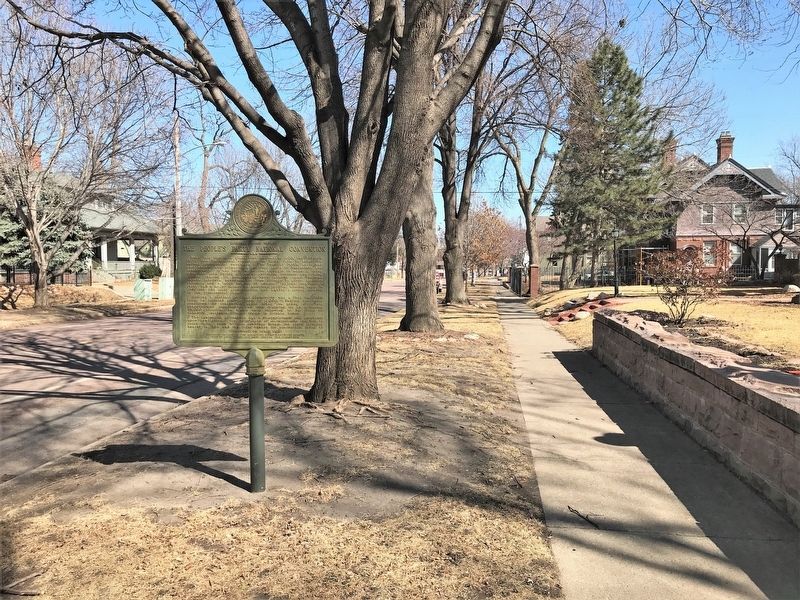
3. The People's Party National Convention Marker, from the west
Other nearby markers. At least 8 other markers are within walking distance of this marker: Prehistoric Prayer Rock (about 500 feet away, measured in a direct line); U.S. Senator R.F. Pettigrew (about 500 feet away); The Woman's Alliance (about 600 feet away); Dakota Conflict (about 700 feet away); 215 N Duluth Avenue (approx. 0.2 miles away); Kaufmann House Mystery (approx. 0.2 miles away); Two Cemeteries (approx. 0.2 miles away); Early Firefighting in Sioux Falls (approx. 0.2 miles away). Touch for a list and map of all markers in Sioux Falls.
Another marker is no longer nearby. Prehistoric Prayer Rock (was about 500 feet away but has been reported to have been replaced with another marker now near it).
March 26, 2022
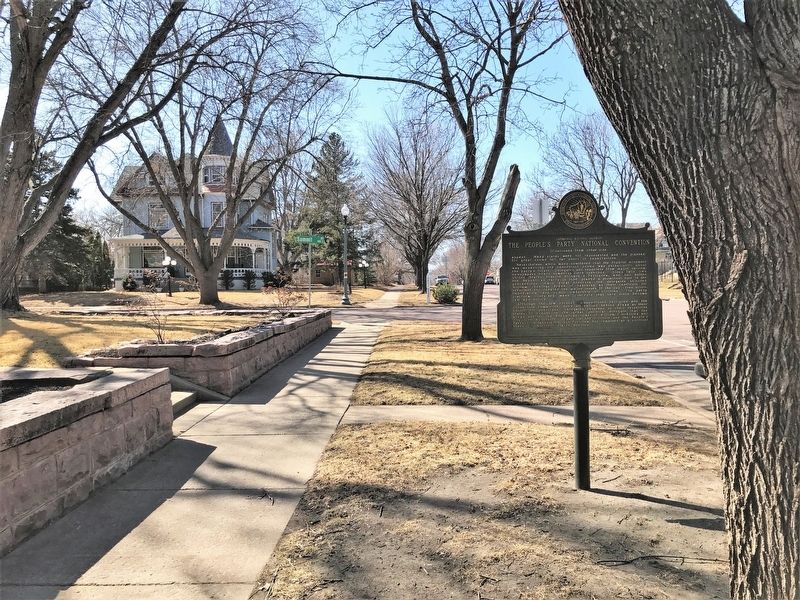
4. The People's Party National Convention Marker, from the east
Credits. This page was last revised on February 16, 2023. It was originally submitted on March 31, 2022. This page has been viewed 376 times since then and 51 times this year. Photos: 1, 2, 3, 4. submitted on March 31, 2022.
