
Mendon in Worcester County, Massachusetts — The American Northeast (New England)
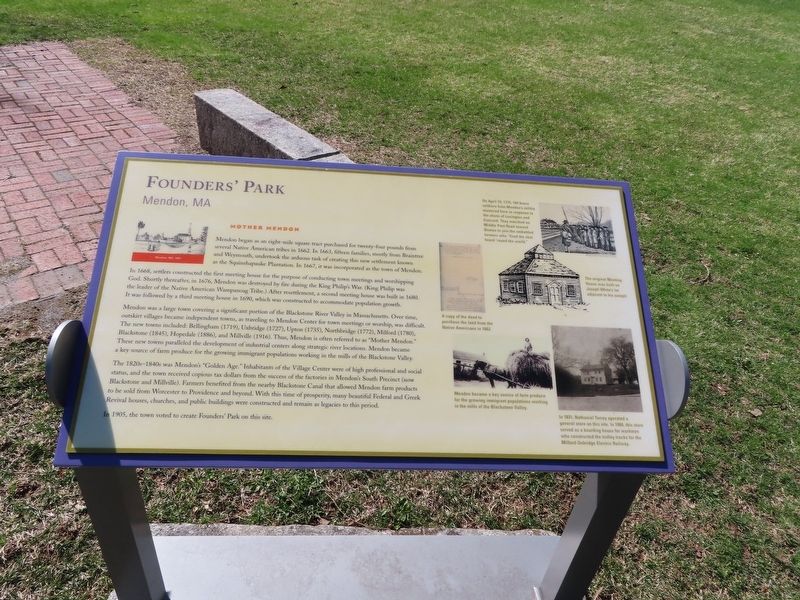
Founders’ Park
Photographed by Michael Herrick, April 11, 2022
1. Founders’ Park Marker
In 1668, settlers constructed the first meeting house for the purpose of conducting town meetings and worshipping God. Shortly thereafter, in 1676, Mendon was destroyed by fire during the King Philip's War. (King Philip was the leader of the Native American Wampanoag Tribe.) After resettlement, a second meeting house was built in 1680. It was followed by a third meeting house in 1690, which was constructed to accommodate population growth.
Mendon was a large town covering a significant portion of the Blackstone River Valley in Massachusetts. Over time, outskirt villages became independent towns, as traveling to Mendon Center for town meetings or worship, was difficult. The new towns included: Bellingham (1719), Uxbridge (1727), Upton (1735), Northbridge (1772), Milford (1780),
this page online
The 1820s-1840s was Mendon's "Golden Age." Inhabitants of the Village Center were of high professional and social status, and the town received copious tax dollars from the success of the factories in Mendon's South Precinct (now Blackstone and Millville). Farmers benefited from the nearby Blackstone Canal that allowed Mendon farm products to be sold from Worcester to Providence and beyond. With this time of prosperity, many beautiful Federal and Greek Revival houses, churches, and public buildings were constructed and remain as legacies to this period.
In 1905, the town voted to create Founders' Park on this site. ( photo captions )
— Mendon, MA, 1837
— On April 19, 1775, 164 brave soldiers from Mendon's militia mustered here in response to the alarm of Lexington and Concord. They marched
Photographed by Michael Herrick, April 11, 2022
2. Founders’ Park Marker
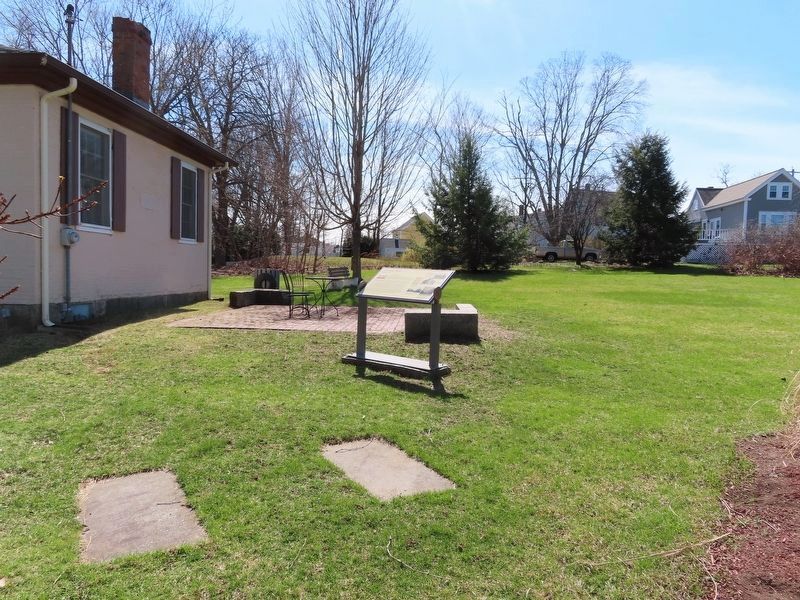
Next to the Mendon Historical Museum
Mendon Historical Society blog homepage:
Click for more information.
Mendon Historical Society blog homepage:
Click for more information.
— The original Meeting House was built on Joseph White's lot adjacent to his sawpit.
— A copy of the deed to purchase the land from the Native Americans in 1662. — Mendon became a key source of farm produce for the growing immigrant populations working in the mills of the Blackstone Valley.
— In 1831, Nathaniel Torrey operated a general store on this site. In 1900, this store served as a boarding house for workmen who constructed the trolley tracks for the Milford-Uxbridge Electric Railway.
Topics and series. This historical marker is listed in these topic lists: Government & Politics • Settlements & Settlers. In addition, it is included in the King Philip's War 1675-1676 series list. A significant historical date for this entry is April 19, 1775.
Location. 42° 6.43′ N, 71° 33.209′ W. Marker is in Mendon, Massachusetts, in Worcester County. It is at the intersection of Main Street and Hastings Street (Massachusetts Route 16), on the left when traveling north on Main Street. Located next to the Mendon Historical Museum. Touch for map. Marker is in this post office area: Mendon MA 01756, United States of America. Touch for directions.

Regionally, this marker is in Massachusetts’ Quiet Corner, in Greater Worcester, and in the Blackstone Valley. It is also in the American Northeast and in New England. Globally, it is in North America, the Western Hemisphere, the Western World, and the Anglosphere. Historically, it finds itself in what was once one of the original Thirteen Colonies.
Other nearby markers. At least 8 other markers are within walking distance of this marker: First Meeting House (here, next to this marker); a different marker also named Founders' Park (a few steps from this marker); Mendon Historical Society (a few steps from this marker); Mendon’s First Meeting House (within shouting distance of this marker); Mendon World War I Monument (about 700 feet away, measured in a direct line); Mendon Korean Vietnam Era Monument (about 700 feet away); Mendon World World War II Monument (about 700 feet away); Harrison Hall (approx. 0.2 miles away). Touch for a list and map of all markers in Mendon.
Credits. This page was last revised on May 31, 2022. It was originally submitted on April 15, 2022, by Michael Herrick of Southbury, Connecticut. This page has been viewed 660 times since then and 76 times this year. Photos: 1, 2. submitted on April 15, 2022, by Michael Herrick of Southbury, Connecticut.
