
Near Coldwater in Simcoe County, Ontario — Central Canada (North America)
Evolution of a Railway
⎯⎯⎯
Evolution d’un ber roulant
cmh2315fl via Flickr (CC BY-NC 2.0), August 3, 2017
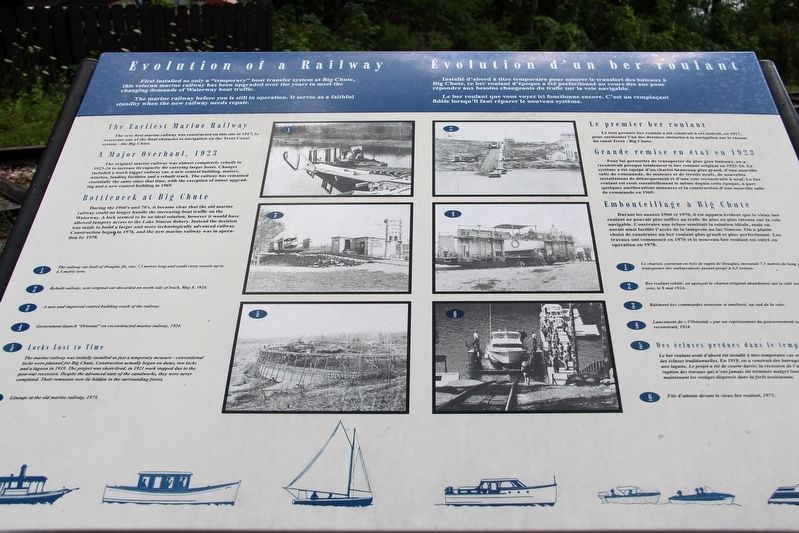
1. Evolution of a Railway / Evolution d’un ber roulant Marker
The marine railway before you is still in operation. It serves as a faithful standby when the new railway needs repair.
The Earliest Marine Railway The very first marine railway was constructed on this site in 1917, to overcome one of the final obstacles to navigation on the Trent Canal system – the Big Chute.
A Major Overhaul, 1923 The original marine railway was almost completely rebuilt in 1923-24 to increase its capacity for carrying larger boats. Changes included a much bigger railway car, a new control building, motors, winches, landing facilities and a rebuilt track. The railway has remained essentially the same since that time, with the exception of minor upgrading and a new control building in 1969.
Bottleneck at Big Chute During the 1960's and 70's, it became clear that the old marine railway could no longer handle the increasing boat traffic on the Waterway. A lock seemed to be an ideal solution, however it would
this page online
Captions:
1. The railway car built of Douglas fir, was 7.3 metres long and could carry vessels up to 4.5 metric tons.
2. Rebuilt railway; note original car discarded on north side of track, May 8, 1924.
3. A new and improved control building south of the railway.
4. Government launch "Oriental” on reconstructed marine railway, 1924.
5. Locks Lost to Time The marine railway was initially installed as just a temporary measure – conventional locks were planned for Big Chute. Construction actually began on dams, two locks and a lagoon in 1919. The project was short-lived; in 1921 work stopped due to the post-war recession. Despite the advanced state of the canalworks, they were never completed. Their remnants now lie hidden in the surrounding forest.
6. Lineups at the old marine railway, 1975.
[Francais] Installé d'abord à titre temporaire pour assurer le transfert des bateaux à Big Chute, ce ber roulant
cmh2315fl via Flickr (CC BY-NC 2.0), August 3, 2017
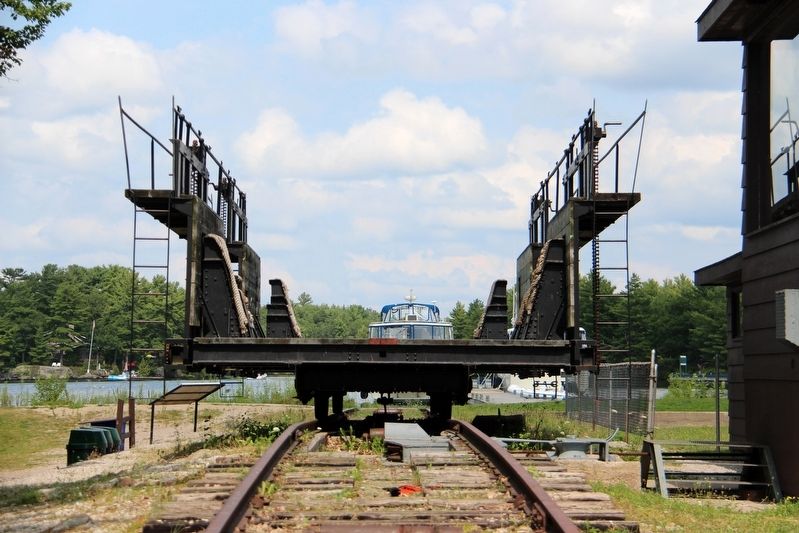
2. Original Big Chute Marine Railway
Originally constructed in 1917, it was substantially rebuilt in 1923-24.
Le ber roulant que vous voyez ici fonctionne encore. C’est un remplaçant fidèle lorsqu’il faut réparer le nouveau système.
Le premier ber roulant Le tout premier ber roulant a été construit à cet endroit, en 1917, pour surmonter l’un des derniers obstacles à la navigation sur le réseau du canal Trent : Big Chute.
Grande remise en étaten 1923 Pour lui permettre de transporter de plus gros bateaux, on a reconstruit presque totalement le ber roulant original en 1923-24. Le système a été équipé d’un chariot beaucoup plus grand, d'une nouvelle salle de commande, de moteurs et de treuils neufs, de nouvelles installations de débarquement et d'une voie reconstruite à neuf. Le ber roulant est resté essentiellement le même depuis cette époque, à part quelques améliorations mineures et la construction d'une nouvelle salle de commande en 1969.
Embouteillage à Big Chute Durant les années 1960 et 1970, il est apparu évident que le vieux ber roulant ne pouvait plus suffire au trafic de plus en plus intense sur la voie navigable. Construire
cmh2315fl via Flickr (CC BY-NC 2.0), August 3, 2017
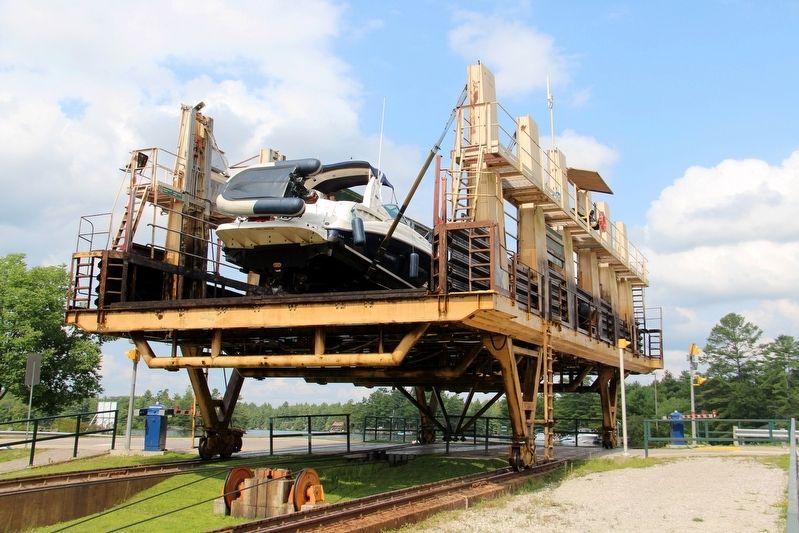
3. Current Big Chute Marine Railway
This railway has been in operation since 1978.
légendes des photos
1. Le chariot, construit en bois de sapin de Douglas, mesurait 7,3 mètres de long e transporter des embarcations pesant jusqu'à 4,5 tonnes.
2. Ber roulant rebâti; on aperçoit le chariot original abandonné sur le côté nor voie, le 8 mai 1924.
3.Bâtiment des commandes nouveau et amélioré, au sud de la voie.
4. Lancement de « l'Oriental » par un représentant du gouvernement su reconstruit, 1924.
5. Des éeluses perdues dans le temp Le ber roulant avait d'abord été installé à titre temporaire car on des écluses traditionnelles. En 1919, on a construit des barrages une lagune. Le projet a été de courte durée; la récession de l'ap ruption des travaux qui n'ont jamais été terminés malgré leur maintenant les vestiges dispersés dans la forêt avoisinante.
6. File d'attente devant le vieux ber roulant, 1975.
Topics. This historical marker is listed in these topic lists: Railroads & Streetcars • Waterways & Vessels. A significant historical year for this entry is 1917.
Location. 44° 53.105′ N, 79° 40.549′ W. Marker is near Coldwater, Ontario, in Simcoe County. It can be reached from Upper Big Chute Road 0.2 kilometers west of Little Chute Lane, on the left when traveling west. Marker is on a trail adjacent to the original marine railway. Touch for map. Marker is at or near this postal address: 7001 Upper Big Chute Rd, Coldwater ON L0K 1E0, Canada. Touch for directions.

Regionally, this marker is in Central Ontario Cottage Country and specifically in Georgian Bay Country. It is also in Central Canada. Globally, it is in North America, on the Great Lakes, in the Western Hemisphere, in the Western World, and in the Anglosphere. Historically, it finds itself in what was once a British colony, the Viceroyalty of New France, the Haudenosaunee (Iroquois) Confederacy, and Rupert’s Land.
Other nearby markers. At least 8 other markers are within 21 kilometers of this marker, measured as the crow flies: Water Control Dams/Port Severn – The Secondary Lock (approx. 9.7 kilometers away); Port Severn Swing Bridge, Lock 45 (approx. 9.8 kilometers away); St. Ignace II (approx. 18.8 kilometers away); The Arrival of the Jesuits in New France (approx. 19.3 kilometers away); Ataronchronon Village (approx. 19.3 kilometers away); The Rick Hansen Bridge (approx. 19.7 kilometers away); George R. Gray (approx. 19.9 kilometers away); The Chippewas of Lakes Huron and Simcoe & the War of 1812 (approx. 19.9 kilometers away). Touch for a list and map of all markers in Coldwater.
Credits. This page was last revised on April 21, 2022. It was originally submitted on April 21, 2022, by Duane and Tracy Marsteller of Murfreesboro, Tennessee. This page has been viewed 227 times since then and 36 times this year. Photos: 1, 2, 3. submitted on April 21, 2022, by Duane and Tracy Marsteller of Murfreesboro, Tennessee.
