
Hopewell, Virginia — The American South (Mid-Atlantic)
Housing Several Thousand Federal Troops
Photographed by Bernard Fisher, May 31, 2009
1. Housing Several Thousand Federal Troops CWT Marker
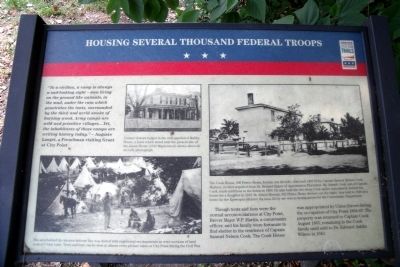
“To a civilian, a camp is always a sad-looking sight – men living on the ground like animals, in the mud, under the rain which penetrates the tents, surrounded by thick and acrid smoke of burning wood. Army camps are wild and primitive villages...Yet, the inhabitants of these camps are writing history today.” - Auguste Laugel, a Frenchman visiting Grant at City Point
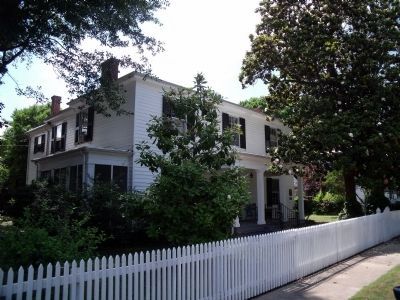
Though tents and huts were the normal accommodations at City Point, Brevet Major W.P. Martin, a commissary officer, and his family were fortunate to find shelter in the residence of Captain Samuel Nelson Cook. The Cook House was appropriated by Union forces during the occupation of City Point 1864-65. The property was returned to Captain Cook August 1865, remaining in the Cook family until sold to Dr. Edward Ashlin Wilson in 1943.
Erected by Virginia Civil War Trails.
Topics and series. This historical marker is listed in this topic list: War, US Civil. In addition, it is included in the Virginia Civil War Trails series list. A significant historical year for this entry is 1865.
Location. This marker has been replaced by another marker nearby. It was located near 37° 18.897′ N,
this page online

Regionally, this marker was in Central Virginia. It was also in the American South, specifically in the Upper South, and on the Eastern Seaboard. Globally, it was in the North Atlantic Region, North America, the Western Hemisphere, the Western World, and the Anglosphere. Historically, it found itself in what was once the territory of the Mississippian Culture, one of the original Thirteen Colonies, one of the Confederate States of America, and the Antebellum South.
Other nearby markers. At least 8 other markers are within walking distance of this location: A different marker also named Housing Several Thousand Federal Troops (here, next to this marker); a different marker also named Taverns (here, next to this marker); Women At City Point (within shouting distance of this marker); a different marker also
Photographed by Bernard Fisher, May 31, 2009
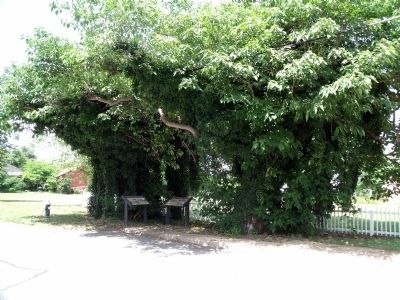
2. Housing Several Thousand Federal Troops Marker
Other markers no longer nearby. Taverns (was here, next to this marker but has been replaced with another marker now near it); a different marker also named Women At City Point (was within shouting distance of this marker but has been replaced with another marker now near it); One Soldier, One Family, One War (was about 300 feet away, measured in a direct line but has been replaced with another marker now near it); a different marker also named City Point’s Wiseman Family (was about 400 feet away but has been replaced with another marker now near it); Dr. Peter Eppes House (was about 500 feet away but has been replaced with another marker now near it).
More about this marker. On the upper left is a photo of the Maltby House with the caption, "Civilian visitors lodged in the well-appointed
Photographed by Bernard Fisher, May 31, 2009
3. Nearby Cook House.
On the lower left is a photo of a typical encampment with the caption, "The area behind the interior defense line was dotted with regimental encampments as were sections of land west of Cedar Lane. Tents and huts can be seen in almost every picture taken at City Point during the Civil War."
On the upper right is a photo of the Cook House. The caption reads, "The Cook House, 600 Prince Henry Avenue (on the left), was built 1857-58 by Captain Samuel Nelson Cook, Mariner, on land acquired from Dr. Richard Eppes of Appomattox Plantation. Mr. Joseph Cook, son of Captain Cook, made additions to the house in 1890. He also built the two story Cook annex immediately behind his house for a daughter in 1913. St. John's Rectory, 602 Prince Henry Avenue (on the right), was built in 1848 as a home for the Episcopal minister. Its most likely use was as headquarters for the Commissary Department."
Related marker. Click here for another marker that is related to this marker. New Marker At This Location also titled "Housing Several Thousand Federal Troops".
Credits. This page was last revised on November 6, 2021. It was originally submitted on June 4, 2009, by Bernard Fisher of Richmond, Virginia. This page has been viewed 1,940 times since then and 17 times this year. Photos: 1, 2. submitted on June 4, 2009, by Bernard Fisher of Richmond, Virginia. 3. submitted on June 5, 2009, by Bernard Fisher of Richmond, Virginia.
