South of Broad in Charleston in Charleston County, South Carolina — The American South (South Atlantic)
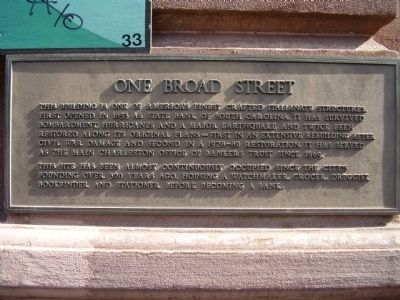
One Broad Street
Photographed by Stanley and Terrie Howard, May 16, 2009
1. One Broad Street Marker
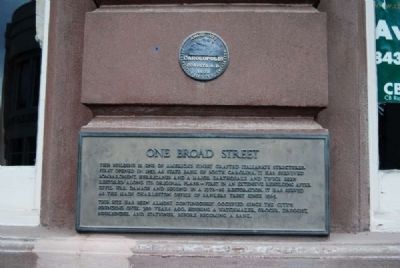
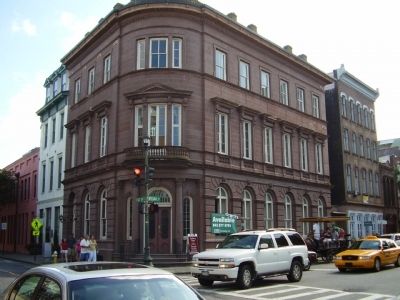
This building is one of America's finest crafted Italianate structures.
First opened in 1853 as State Bank of South Carolina, it has survived Bombardment, Hurricanes and a Major Earthquake, and Twice been restored along its original plans - First in an extensive rebuilding after Civil War damage and second in a 1978-80 restoration. It has served as the Main Charleston Office of Bankers Trust since 1969.
This site has been almost continuously occupied since the city's founding over 300 years ago, Housing a Watchmaker, Grocer, Druggist, Bookbinder and Stationer before becoming a Bank.
Topics. This historical marker is listed in these topic lists: Landmarks • Notable Buildings. A significant historical year for this entry is 1853.
Location. 32° 46.606′ N, 79° 55.635′ W. Marker is in Charleston, South Carolina, in Charleston County. It is in South of Broad. It is at the intersection of One Broad Street and East Bay Street (U.S. 52 Spur), on the right when traveling west on One Broad Street. Touch for map. Marker is at or near this postal address: 1 Broad Street, Charleston SC 29401, United States of America. Touch for directions.

Regionally,
this page online
Other nearby markers. At least 10 other markers are within walking distance of this marker: Walker, Evans & Cogswell Company (a few steps from this marker); The Old Exchange (within shouting distance of this marker); Second Bank of the United States (within shouting distance of this marker); Convention on Ratification (within shouting distance of this marker); Smith-Gordon-People's Building (within shouting distance of this marker); Slave Auctions (within shouting distance of this marker); Lee Cohen Harby (within shouting distance of this marker); As Old as Charleston (within shouting distance of this marker); The Tavern (within shouting distance of
Photographed by Brian Scott, September 20, 2011
2. One Broad Street Marker
Also see . . . Italianate architecture. The Italianate style of architecture was a distinct 19th-century phase in the history of Classical architecture. (Submitted on December 11, 2011, by Brian Scott of Anderson, South Carolina.)
Photographed by Stanley and Terrie Howard, May 16, 2009
3. One Broad Street
Photographed by Stanley and Terrie Howard, May 16, 2009
4. One Broad Street Marker
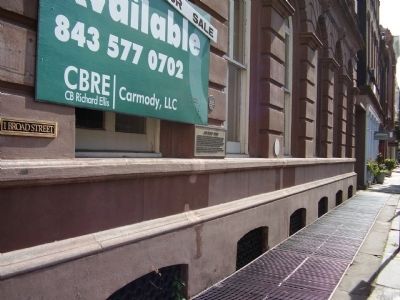
Photographed by Stanley and Terrie Howard, May 16, 2009
5. One Broad Street Marker
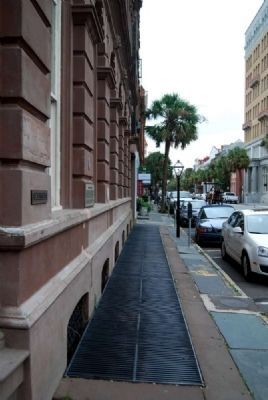
Photographed by Brian Scott, September 20, 2011
6. One Broad Street Marker
View West Along Broad Street
View West Along Broad Street
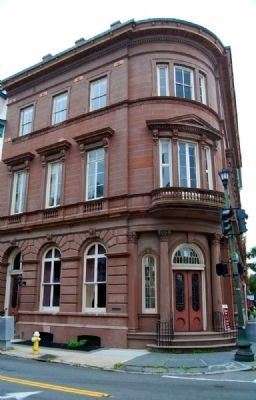
Photographed by Brian Scott, September 20, 2011
7. One Broad Street
Main Entrance
Main Entrance
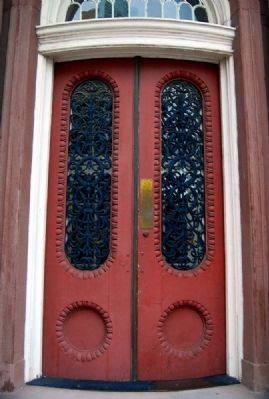
Photographed by Brian Scott, September 20, 2011
8. One Broad Street
Door Detail
Door Detail
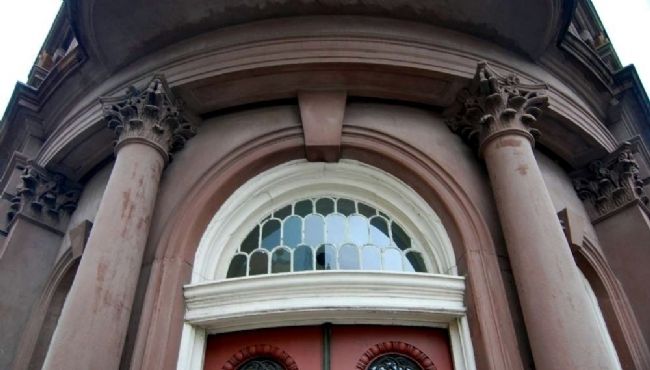
Photographed by Brian Scott, September 20, 2011
9. One Broad Street
Door Fanlight
Door Fanlight
Credits. This page was last revised on February 16, 2023. It was originally submitted on June 4, 2009, by Stanley and Terrie Howard of Greer, South Carolina. This page has been viewed 2,063 times since then and 120 times this year. Photos: 1. submitted on June 4, 2009, by Stanley and Terrie Howard of Greer, South Carolina. 2. submitted on December 10, 2011, by Brian Scott of Anderson, South Carolina. 3, 4, 5. submitted on June 4, 2009, by Stanley and Terrie Howard of Greer, South Carolina. 6. submitted on December 10, 2011, by Brian Scott of Anderson, South Carolina. 7, 8, 9. submitted on December 11, 2011, by Brian Scott of Anderson, South Carolina. • Kevin W. was the editor who published this page.
