Lake Buena Vista in Orange County, Florida — The American South (South Atlantic)
English Tea Garden
Twinings Presents The
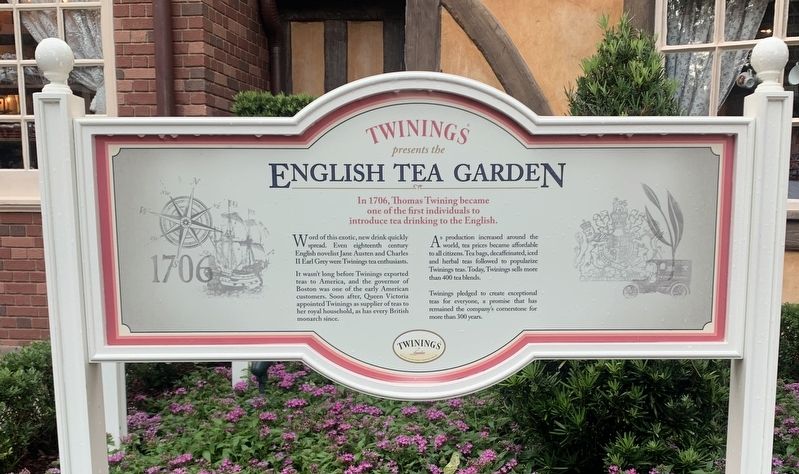
Photographed by Steve Stoessel, May 18, 2022
1. English Tea Garden Marker
In 1706, Thomas Twining became one of the first individuals to introduce tea drinking to the English.
Word of this exotic, new drink quickly spread. Even eighteenth century English novelist Jane Austen and Charles II Earl Grey were Twinings tea enthusiasts. It wasn't long before Twinings exported teas to America, and the governor of Boston was one of the early American customers. Soon after, Queen Victoria appointed Twinings as supplier of teas to her royal household, as has every British monarch since.
As production increased around the world, tea prices became affordable to all citizens. Tea bags, decaffeinated, iced and herbal teas followed to popularize Twinings teas. Today, Twinings sells more than 400 tea blends.
Twinings pledged to create exceptional teas for everyone, a promise that has remained the company's cornerstone for more than 300 years.
Erected by Twinings.
Topics. This historical marker is listed in these topic lists: Agriculture • Industry & Commerce. A significant historical year for this entry is 1706.
Location. 28° 22.226′ N, 81° 33.124′ W. Marker is in Lake Buena
this page online

Regionally, this marker is in Greater Orlando and in Central Florida. It is also in the American South. Globally, it is in the North Atlantic Region, North America, a Gulf of Mexico state, the Western Hemisphere, the Western World, and the Anglosphere. Historically, it finds itself in what was once New Spain, the territory of the Mississippian Culture, one of the Confederate States of America, and the Antebellum South.
Other nearby markers. At least 8 other markers are within walking distance of this marker: The Tale of a Whale (about 400 feet away, measured in a direct line); The Eagle and the Beaver (about 400 feet away); The Torii (approx. 0.2 miles away); The Shishinden (approx. 0.2 miles away); Bonsai (approx. 0.2 miles away); The Goju-No-To (approx. 0.2 miles away); Nishikigoi (approx. 0.2 miles away); Genie's Lamp (approx. ¼ mile away). Touch for a list and map of all markers in

Photographed by Steve Stoessel, May 19, 2022
2. English Tea Garden Marker
Also see . . .
1. Tea (Wikipedia). (Submitted on May 20, 2022, by Steve Stoessel of Niskayuna, New York.)
2. Twinings History. (Submitted on May 20, 2022, by Steve Stoessel of Niskayuna, New York.)

Photographed by Steve Stoessel, May 18, 2022
3. History of Tea Drinking
On a marker to the left and rear of “English Tea Garden”, a very brief history of tea drinking is related as follows:
TWININGS presents the ENGLISH TEA GARDEN
All teas are born from the Camellia sinensis plant.
Once picked, the leaves are treated to different processes on their way to becoming black, oolong, green or white tea.
Tea plants thrive in cool, moist climates with acidic soils, and are native to tropical and subtropical mountain regions in China. Today, tea is grown around the world. To ease harvesting, the plants are grown in rows. They are trimmed, and only the top bud and two leaves are plucked. The origin of tea dates back to an early Chinese legend that tells how tea was discovered by Emperor Shen Nung when leaves from a tea tree fell into his pan of boiling water. For several hundred years, people drank tea because of its medicinal qualities. Due to the limited amount of tea plants, early tea drinkers were mostly royalty. As more tea plants were discovered, tea drinking became more common among all classes - not only for health reasons, but also for its taste.
Credits. This page was last revised on January 25, 2026. It was originally submitted on May 20, 2022, by Steve Stoessel of Niskayuna, New York. This page has been viewed 458 times since then and 25 times this year. Photos: 1, 2, 3. submitted on May 20, 2022, by Steve Stoessel of Niskayuna, New York. • Bill Pfingsten was the editor who published this page.
