Greenville in Greenville County, South Carolina — The American South (South Atlantic)
Slater
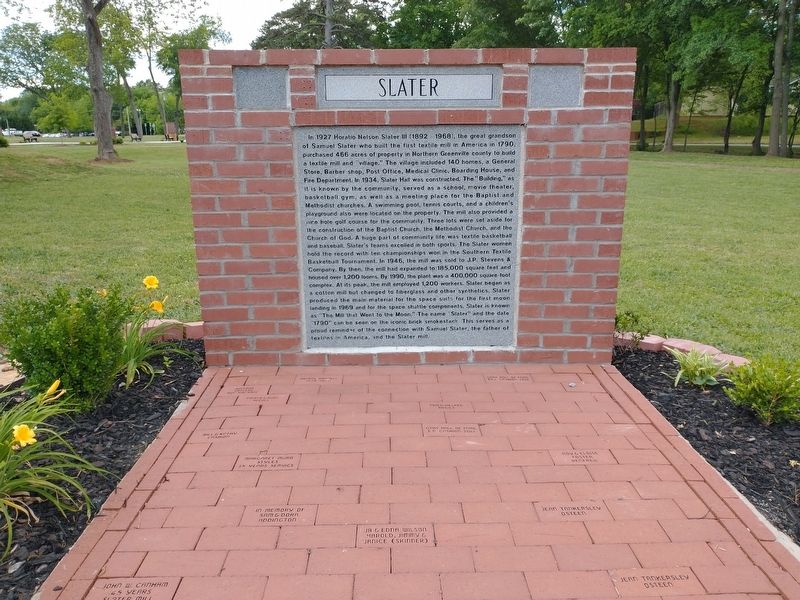
Photographed by Tom Bosse, May 14, 2022
1. Slater Marker
Inscription.
Slater. . In 1927 Horatio Nelson Slater III (1892-1968), the great grandson of Samuel slater who built the first textile mill in America in 1790, purchased 466 acres of property in Northern Greenville county to build a textile mill and village. The village included 140 homes, a General Store, Barber shop, Post Office, Medical Clinic, Boarding House, and Fire Department. In 1934 Slater Hall was constructed. The Building as it is known by the community, served as a school, movie theater, basketball gym, as well as a meeting place for he Baptist and Methodist churches. A swimming pool, tennis courts, and a childrens playground also were located on the property. The mill also provided a nine hole golf course for the community. Three lots were set aside for the construction of the Baptist Church, the Methodist Church, and the Church of God. A huge part of community life was textile basketball and baseball. Slaters teams excelled in both sports. The Slater women hold the record with ten championships won in the Southern Textile Basketball tournament. In 1946, the mill was sold to J.P. Stevens and Company. By then, the mill had expanded to 185,000 square feet and housed over 1,200 looms. By 1990, the plant was a 400,000 square-foot complex. At its peak, the mill employed 1,200 workers. Slater began as a cotton mill but changed to fiberglass and other synthetics. Slater produced the main material for the space suits for the first moon landing in 1969 and for the space shuttle components. Slater is know as The Mill that Went to the Moon. The name Slater: and the date 1790 can be seen on the iconic brick smokestack. This serves as a proud reminder of the connection with Samuel Slater, the father of textiles in America, and the Slater mill.
In 1927 Horatio Nelson Slater III (1892-1968), the great grandson of Samuel slater who built the first textile mill in America in 1790, purchased 466 acres of property in Northern Greenville county to build a textile mill and village. The village included 140 homes, a General Store, Barber shop, Post Office, Medical Clinic, Boarding House, and Fire Department. In 1934 Slater Hall was constructed. The Building as it is known by the community, served as a school, movie theater, basketball gym, as well as a meeting place for he Baptist and Methodist churches. A swimming pool, tennis courts, and a childrens playground also were located on the property. The mill also provided a nine hole golf course for the community. Three lots were set aside for the construction of the Baptist Church, the Methodist Church, and the Church of God. A huge part of community life was textile basketball and baseball. Slaters teams excelled in both sports. The Slater women hold the record with ten championships won in the Southern Textile Basketball tournament. In 1946, the mill was sold to J.P. Stevens & Company. By then, the mill had expanded
Click or scan to see this page online
to 185,000 square feet and housed over 1,200 looms. By 1990, the plant was a 400,000 square-foot complex. At its peak, the mill employed 1,200 workers. Slater began as a cotton mill but changed to fiberglass and other synthetics. Slater produced the main material for the space suits for the first moon landing in 1969 and for the space shuttle components. Slater is know as The Mill that Went to the Moon. The name Slater: and the date 1790 can be seen on the iconic brick smokestack. This serves as a proud reminder of the connection with Samuel Slater, the father of textiles in America, and the Slater mill.
Topics and series. This historical marker is listed in this topic list: Industry & Commerce. In addition, it is included in the Greenville Textile Heritage series list. A significant historical year for this entry is 1927.
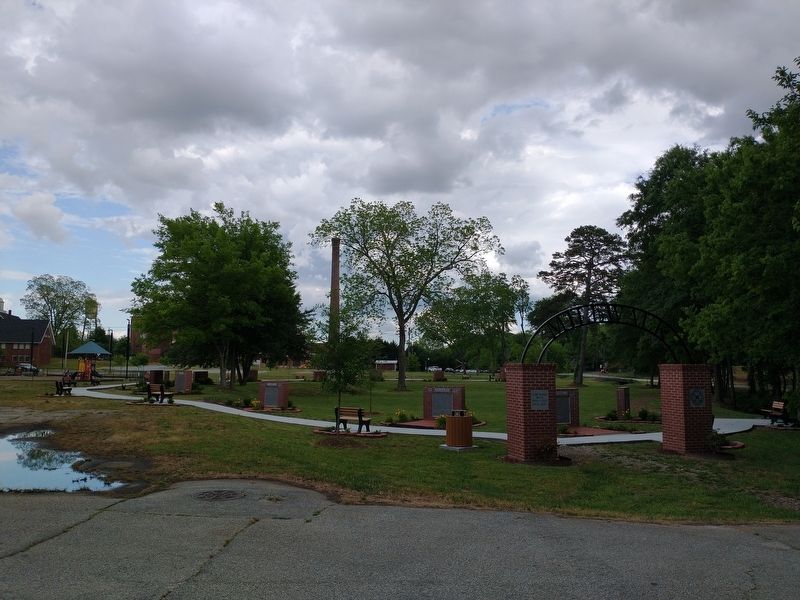
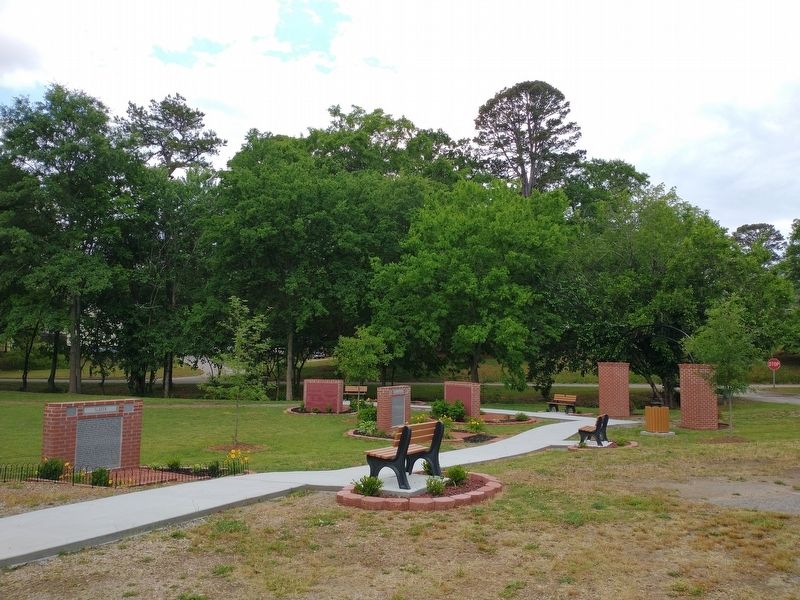
Location. 34° 52.078′ N, 82° 25.615′ W. Marker is in Greenville, South Carolina, in Greenville County. It is on Ravenel Street west of Smythe Street, on the right when traveling west. Marker located in Greenville Textile Heritage Park. Touch for map. Marker is in this post office area: Greenville SC 29611, United
Regionally, this marker is in Upstate. It is also in the American South, specifically in the Deep South, in Appalachia, and specifically in Southern Appalachia. Globally, it is in North America, the Western Hemisphere, the Western World, and the Anglosphere. Historically, it finds itself in what was once the original Cherokee Nation, the territory of the Mississippian Culture, one of the original Thirteen Colonies, one of the Confederate States of America, and the Antebellum South.
Other nearby markers. At least 8 other markers are within walking distance of this marker: Parker High School (here, next to this marker); Poinsett (a few steps from this marker); American Spinning (a few steps from this marker); Poe Mill (a few steps from this marker); Piedmont (within shouting distance of this marker); Camperdown (within shouting distance of this marker); Mills Mill (within shouting distance of this marker); Monaghan (within shouting distance of this marker). Touch for a list and map of all markers in Greenville.
Marker is second from left. Monaghan Mill can be seen in the background.
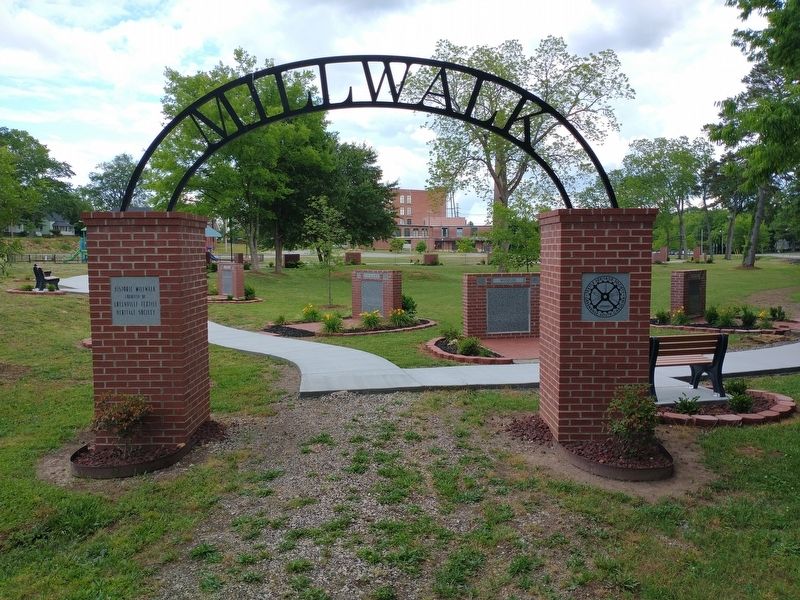
Photographed by Tom Bosse, May 14, 2022
4. Greenville Textile Heritage Park
Credits. This page was last revised on May 30, 2022. It was originally submitted on May 29, 2022, by Tom Bosse of Jefferson City, Tennessee. This page has been viewed 1,049 times since then and 87 times this year. Photos:1, 2, 3, 4. submitted on May 29, 2022, by Tom Bosse of Jefferson City, Tennessee. • Bernard Fisher was the editor who published this page.