Palacio in Madrid, Spain — Southwestern Europe (Iberian Peninsula)
Caños del Peral
Photographed by Andrew Ruppenstein, April 18, 2022
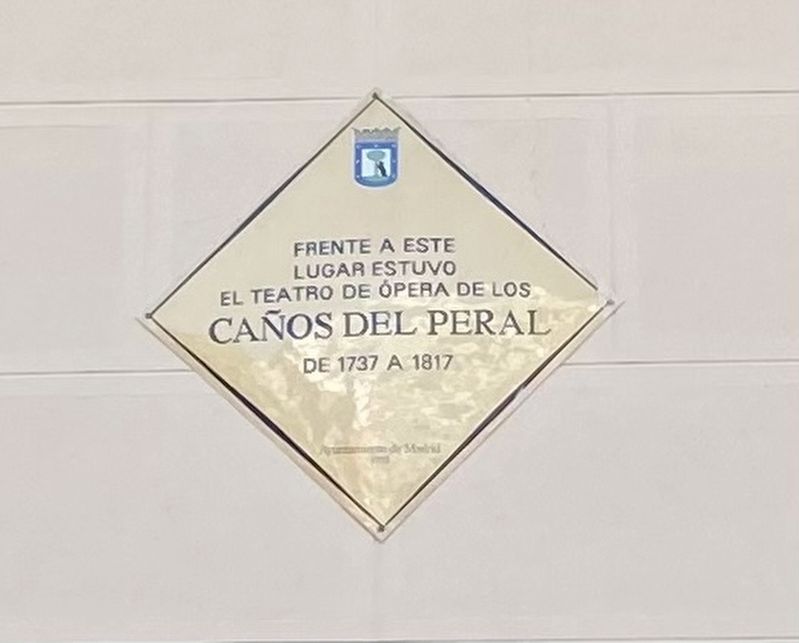
1. Caños del Peral Marker

Frente a este lugar estuvo el teatro de ópera de los Caños De Peral de 1737 a 1817
In front of this location was the Caños De Peral opera house from 1737 to 1817
Erected 1991 by Ayuntamiento de Madrid.
Topics and series. This historical marker is listed in these topic lists: Arts, Letters, Music • Entertainment. In addition, it is included in the City of Madrid - "Yellow Diamond" series list. A significant historical date for this entry is September 30, 1817.
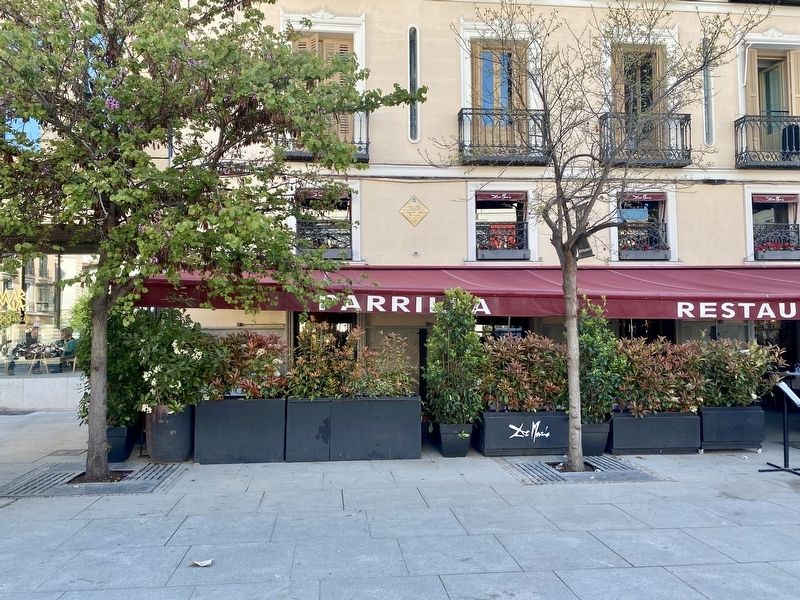
Location. 40° 25.09′ N, 3° 42.541′ W. Marker is in Madrid. It is in Palacio. It is on Plaza de Isabel II, on the left when traveling south. Touch for map. Marker is at or near this postal address: Plaza de Isabel II 8, Madrid 28013, Spain. Touch for directions.

Regionally, it is in the North Atlantic Region, in Europe, in the European Union, in Atlantic Europe, on the Iberian Peninsula, in the Schengen Area, in a coastal Mediterranean country, and in the Western World. Historically, it finds itself in what was once the Roman Empire.
Other nearby markers. At least 8 other markers are within walking distance of this marker:
this page online
Also see . . . Caños De Peral (Memoria de Madrid, in Spanish).
Excerpt (in translation): "This theater was built at the request of Philip V and by the patronage of Francisco Palomares, who later bought the site because it was municipal property. The year 1737, as indicated on the marker, corresponds to the inauguration of this first permanent Opera House of the Court. Its architectural importance is of the utmost since it resembled more modern theaters (the first in Spain), although it preserved some peculiarities in the accommodation of spectators. Its layout was attributed to Virgilio Rabaglio and Santiago Bonavía....Its demolition, by royal mandate, occurred on September 30, 1817.(Submitted on June 3, 2022.)This was due to the state of ruin in which it was found and the need to adapt the new space to the creation of the Plaza de Oriente.Photographed by Andrew Ruppenstein, April 18, 20222. Caños del Peral Marker - wide view
Credits. This page was last revised on October 9, 2025. It was originally submitted on June 3, 2022, by Andrew Ruppenstein of Lamorinda, California. This page has been viewed 196 times since then and 32 times this year. Photos: 1, 2. submitted on June 3, 2022, by Andrew Ruppenstein of Lamorinda, California.
