Monnaie in Paris in Département de Paris, Île-de-France, France — Western Europe
Porte de Buci ⎯⎯⎯ Buci Gate
—
Histoire de Paris
—
Photographed by Andrew Ruppenstein, April 17, 2022
1. Porte de Buci / Buci Gate Marker
Inscription.
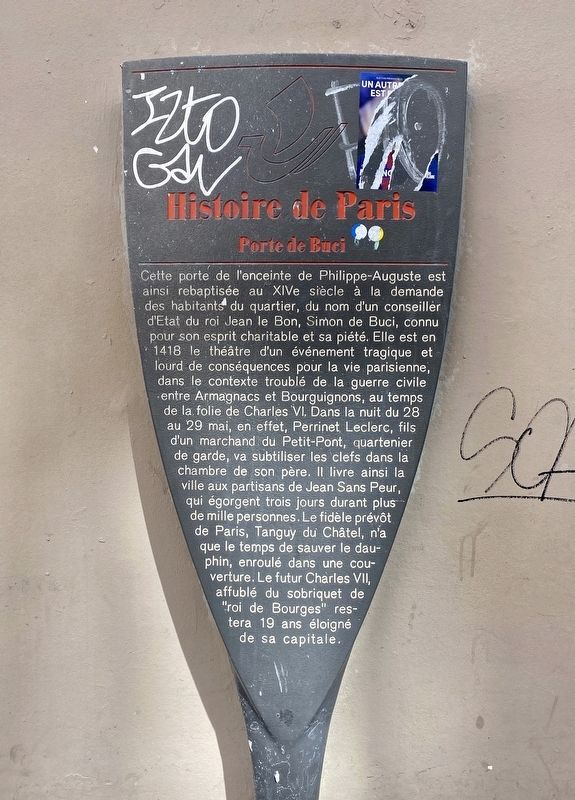
Porte de Buci, also, Buci Gate. . (English translation:), This gate in the Philippe-Auguste city walls was thus renamed in the 14th century at the request of the inhabitants of the district, to the name of a State Councilor of King Jean le Bon, Simon de Buci, known for his charitable spirit and devotion. In 1418, it was the scene of a tragic event with serious consequences for Parisian life, in the troubled context of the civil war between Armagnacs and Burgundians, at the time of the madness of Charles VI. On the night of May 28 to 29, Perrinet Leclerc, son of a Petit-Pont merchant and quartermaster on duty, stole the keys to the gate from his father's room. He thus delivered the city to the supporters of Jean Sans Peur, who then cut the throats of more than a thousand people over three days. The faithful provost of Paris, Tanguy du Châtel, only had time to save the Dauphin, wrapped in a blanket. The future Charles VII, decked out with the nickname "King of Bourges", would remain 19 years away from his capital. . This historical marker was erected by Ville de Paris. It is in Monnaie in Paris in Département de Paris Île-de-France France
Cette porte de l'enceinte de Philippe-Auguste est ainsi rebaptisée au XIVe siècle à la demande des habitants du quartier, du nom d'un conseillèr d'Etat du roi Jean le Bon, Simon de Buci, connu pour son esprit charitable et sa piété. Elle est en 1418 le théâtre d'un événement tragique et lourd de conséquences pour la vie parisienne, dans le contexte troublé de la guerre civile entre Armagnacs et Bourguignons, au temps de la folie de Charles VI. Dans la nuit du 28 au 29 mai, en effet, Perrinet Leclerc, fils d'un marchand du Petit-Pont, quartenier de garde, va subtiliser les clefs dans la chambre de son père. Il livre ainsi la ville aux partisans de Jean Sans Peur, qui égorgent trois jours durant plus de mille personnes. Le fidèle prévôt de Paris, Tanguy du Châtel, n'a que le temps de sauver le dauphin, enroulé dans une cou- verture. Le futur Charles VII, affublé du sobriquet de "roi de Bourges” restera 19 ans éloigné de sa capitale.,
Cette porte de l'enceinte de Philippe-Auguste est
ainsi rebaptisée au XIVe siècle à la demande
des habitants du quartier, du nom d'un conseillèr
d'Etat du roi Jean le Bon, Simon de Buci, connu
pour son esprit charitable et sa piété. Elle est en
1418 le théâtre d'un événement tragique et
lourd de conséquences pour la vie parisienne,
dans le contexte troublé de la guerre civile
entre Armagnacs et Bourguignons, au temps
de la folie de Charles VI. Dans la nuit du 28
au 29 mai, en effet, Perrinet Leclerc, fils
d'un marchand du Petit-Pont, quartenier
de garde, va subtiliser les clefs dans la
chambre de son père. Il livre ainsi la
ville aux partisans de Jean Sans Peur,
qui égorgent trois jours durant plus
de mille personnes. Le fidèle prévôt
de Paris, Tanguy du Châtel, n'a
que le temps de sauver le dauphin, enroulé dans une cou-
verture. Le futur Charles VII,
affublé du sobriquet de
"roi de Bourges” restera 19 ans éloigné
de sa capitale.
(English translation:)
This gate in the Philippe-Auguste city walls was thus renamed in the 14th century at the request of the inhabitants of the district, to
Click or scan to see this page online
the name of a State Councilor of King Jean le Bon, Simon de Buci, known for his charitable spirit and devotion. In 1418, it was the scene of a tragic event with serious consequences for Parisian life, in the troubled context of the civil war between Armagnacs and Burgundians, at the time of the madness of Charles VI. On the night of May 28 to 29, Perrinet Leclerc, son of a Petit-Pont merchant and quartermaster on duty, stole the keys to the gate from his father's room. He thus delivered the city to the supporters of Jean Sans Peur, who then cut the throats of more than a thousand people over three days. The faithful provost of Paris, Tanguy du Châtel, only had time to save the Dauphin, wrapped in a blanket. The future Charles VII, decked out with the nickname "King of Bourges", would remain 19 years away from his capital.
Erected by Ville de Paris.
Topics and series. This historical marker is listed in this topic list: Forts and Castles. In addition, it is included in the Histoire de Paris series list. A significant historical date for this entry is May 28, 1418.
Location. 48° 51.212′ N, 2° 20.344′ E. Marker is in Paris, Île-de-France, in
Photographed by Andrew Ruppenstein, April 17, 2022
2. Porte de Buci / Buci Gate Marker - wide view
Département de Paris. It is in Monnaie. It is on Rue Saint-André des Arts, on the left when traveling east. Touch for map. Marker is at or near this postal address: 57 Rue Saint-André des Arts, Paris, Île-de-France 75006, France. Touch for directions.
Regionally, it is in the North Atlantic Region,Europe, the European Union, Atlantic Europe, the Schengen Area, Western Europe, a coastal Mediterranean country, and the Western World. Historically, it finds itself in what was once a French colony and also the Roman Empire.
Also see . . . Perrinet Leclerc (Wikipedia, in French). A somewhat more detailed description Leclerc's actions that lead to the opening of the gate and the subsequent massacre. (Submitted on June 15, 2022.)
Additional keywords. panneau
Credits. This page was last revised on May 2, 2025. It was originally submitted on June 15, 2022, by Andrew Ruppenstein of Lamorinda, California. This page has been viewed 577 times since then and 65 times this year. Photos:1, 2. submitted on June 15, 2022, by Andrew Ruppenstein of Lamorinda, California.