North Capitol in Nashville in Davidson County, Tennessee — The American South (East South Central)
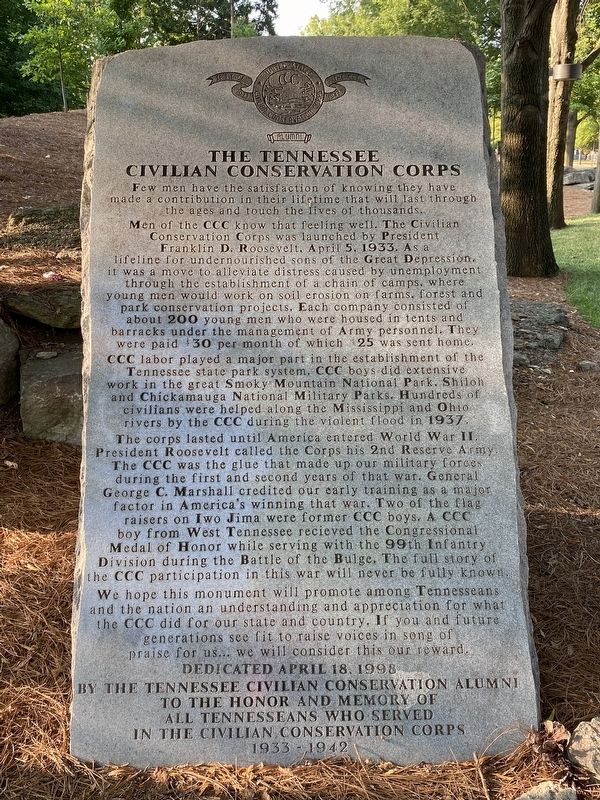
The Tennessee Civilian Conservation Corps
Photographed by Darren Jefferson Clay, July 5, 2022
1. The Tennessee Civilian Conservation Corps Marker
this page online
We hope this monument will promote among Tennesseans and the nation an understanding and appreciation for what the CCC did for our state and country. If you and future generations see fit to raise voices in song of praise for us... we will consider this our reward.
To the Honor and Memory of all Tennesseans who served in the Civilian Conservation Corps
1933-1942
Erected 1998 by the Tennessee Civilian Conservation Alumni.
Topics and series. This historical marker is listed in this topic list: Charity & Public Work. In addition, it is included in the Civilian Conservation Corps (CCC)
Photographed by Darren Jefferson Clay, July 5, 2022
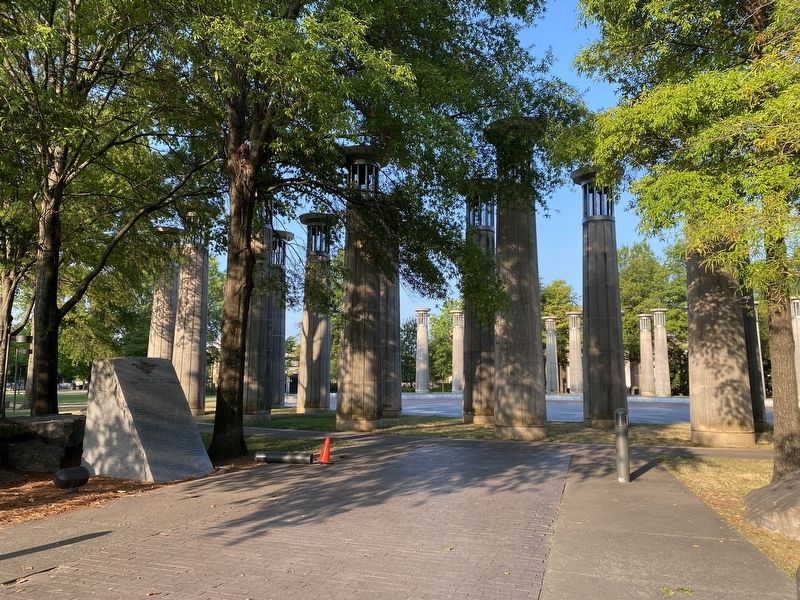
2. The Tennessee Civilian Conservation Corps Marker
Location. 36° 10.378′ N, 86° 47.307′ W. Marker is in Nashville, Tennessee, in Davidson County. It is in North Capitol. It is on 6th Avenue North, on the left when traveling north. Touch for map. Marker is at or near this postal address: 1049 6th Ave N, Nashville TN 37208, United States of America. Touch for directions.

Regionally, this marker is in Middle Tennessee. It is also in the American South and specifically in the Upper South. Globally, it is in North America, the Western Hemisphere, the Western World, and the Anglosphere. Historically, it finds itself in what was once the territory of the Mississippian Culture, one of the Confederate States of America, and the Antebellum South.
Other nearby markers. At least 8 other markers are within walking distance of this marker: Johnson County (within shouting distance of this marker); Carter County (within shouting distance of this marker); Unicoi County (within shouting distance of this marker); Washington County (within shouting distance of this marker); Walkway of the Counties / Mountains (within shouting distance of this marker); Sullivan County (within shouting distance of this marker); Greene County (within shouting distance of this marker); Hamblen County (within shouting distance of this marker). Touch for a list and map of all markers in Nashville.
Credits. This page was last revised on February 7, 2023. It was originally submitted on July 5, 2022, by Darren Jefferson Clay of Duluth, Georgia. This page has been viewed 409 times since then and 25 times this year. Photos: 1, 2. submitted on July 5, 2022, by Darren Jefferson Clay of Duluth, Georgia. • Mark Hilton was the editor who published this page.
