Caddo Gap in Montgomery County, Arkansas — The American South (West South Central)
The Town of Caddo Gap
Photographed by Jason Armstrong, January 23, 2022
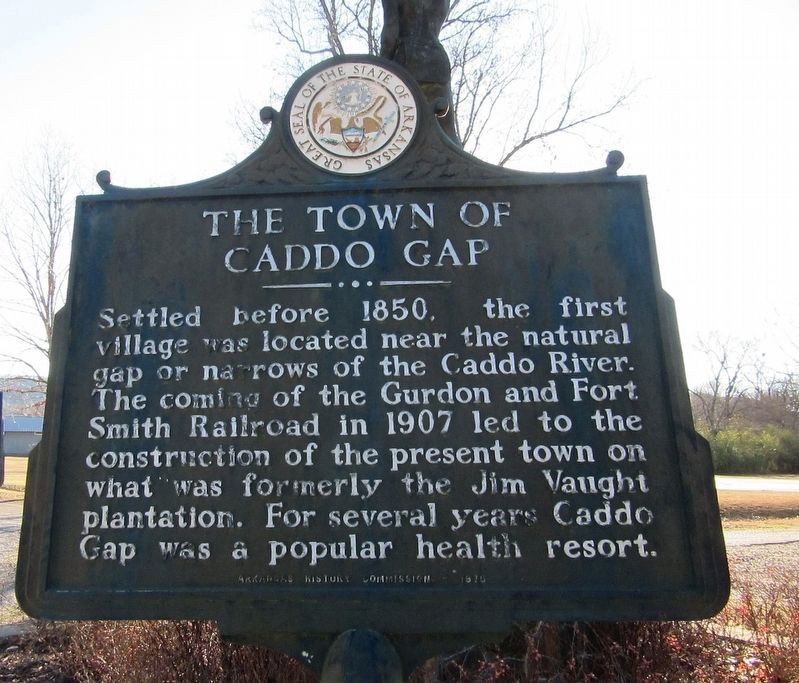
1. The Town of Caddo Gap Marker
Settled before 1850, the first village was located near the natural gap or narrows of the Caddo River. The coming of the Gurdon and Fort Smith Railroad in 1907 led to the construction of the present town on what was formerly the Jim Vaught plantation. For several years Caddo Gap was a popular health resort.
Erected 1976 by Arkansas History Commission.
Topics. This historical marker is listed in this topic list: Settlements & Settlers. A significant historical year for this entry is 1850.
Location. 34° 24.095′ N, 93° 37.14′ W. Marker is in Caddo Gap, Arkansas, in Montgomery County. It is at the intersection of Indian Valley Road and Vaught Street, on the right when traveling east on Indian Valley Road. Touch for map. Marker is in this post office area: Caddo Gap AR 71935, United States of America. Touch for directions.

Regionally, this marker is in the Ouachita Mountains and in Caddo Territory. It is also in the American South and specifically in the Upper South. Globally, it is in North America, the Western Hemisphere, the Western World, and the Anglosphere. Historically, it finds itself in what was once
this page online
Other nearby markers. At least 8 other markers are within 11 miles of this marker, measured as the crow flies: De Soto at Caddo Gap (here, next to this marker); The Narrows on Caddo River (here, next to this marker); The Caddo People (here, next to this marker); Archeological Analysis of Norman Caddo Indian Burial Ground (approx. 4.8 miles away); Arkansas State Quarter (approx. 10.7 miles away); Montgomery County (approx. 10.8 miles away); Montgomery County in the Civil War (approx. 10.8 miles away); Montgomery County Civil War Memorial (approx. 10.8 miles away). Touch for a list and map of all markers in Caddo Gap.
Photographed by Jason Armstrong, January 23, 2022
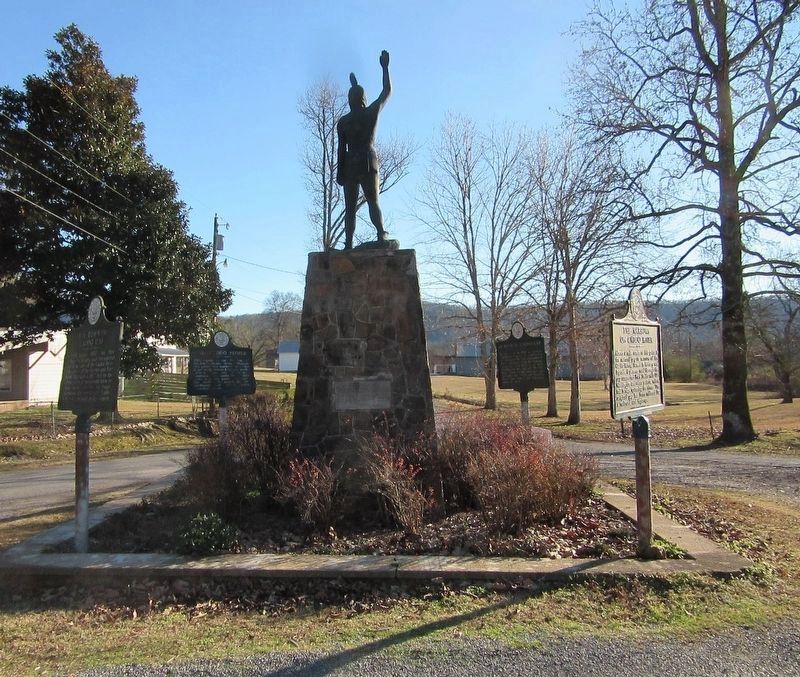
2. The Town of Caddo Gap Marker
The marker is part of a group of markers and a statue.
Credits. This page was last revised on July 7, 2022. It was originally submitted on July 5, 2022, by Jason Armstrong of Talihina, Oklahoma. This page has been viewed 1,204 times since then and 97 times this year. Photos: 1, 2. submitted on July 5, 2022, by Jason Armstrong of Talihina, Oklahoma. • J. Makali Bruton was the editor who published this page.
