Piapot in Piapot No. 110, Saskatchewan — The Prairie Region (North America)
The Ranching Industry

Photographed by Cosmos Mariner, June 25, 2022
1. The Ranching Industry Marker
During the 1870’s, as the vast buffalo herds disappeared, ranchers came to this area to fill the empty prairie with cattle and horses. The arrival of the North-West Mounted Police, who established posts at nearby centres like Fort Walsh, helped this industry in three ways. They provided protection against cattle rustling, they purchased beef from the ranchers and retired policemen often established ranches.
The early ranches were small and locally owned, but later businessmen from Britain and eastern Canada established larger operations. The completion of the Canadian Pacific Railway in 1885 opened up new markets for ranchers but also brought the threat of homesteaders claiming the same land. However, the ranchers prevailed and prospered.
The winter of 1906-07 changed ranching forever. Heavy snow followed by cycles of thaws and freezes killed thousands of cattle, with some large operations losing three quarters of their herds. This led to the breakup of most of the large ranches.
Erected by Government of Saskatchewan.
Topics. This historical marker is listed in these topic lists: Agriculture • Industry & Commerce • Railroads & Streetcars • Settlements & Settlers. A significant historical year for this entry is 1885.
Location. 50° 1.094′ N, 109° 4.121′ W. Marker is in Piapot, Saskatchewan, in Piapot No. 110. It is on Trans-Canada Highway (Provincial Highway 1) 4.6 kilometers east of Provincial Road 614, on the right when traveling east. Marker is located at the Trans-Canada Highway Piapot Rest Stop. Touch for map. Marker is at or near this postal address: 7820 SK-1, Piapot SK S0N 1Y0, Canada. Touch for directions.

Regionally, this marker is in Southeast Saskatchewan. It is also in the Prairies. Globally, it is in North America, the Western Hemisphere, the Western World, and the
this page online
Other nearby markers. At least 4 other markers are within 6 kilometers of this marker, measured as the crow flies: The Lister-Kaye Enterprises (here, next to this marker); The "76" Ranch (here, next to this marker); Piapot Saloon (approx. 5.2 kilometers away); Piapot (approx. 5.4 kilometers away).
Related markers. Click here for a list of markers that are related to this marker.
Also see . . . Saskatchewan is no stranger to bad winters.
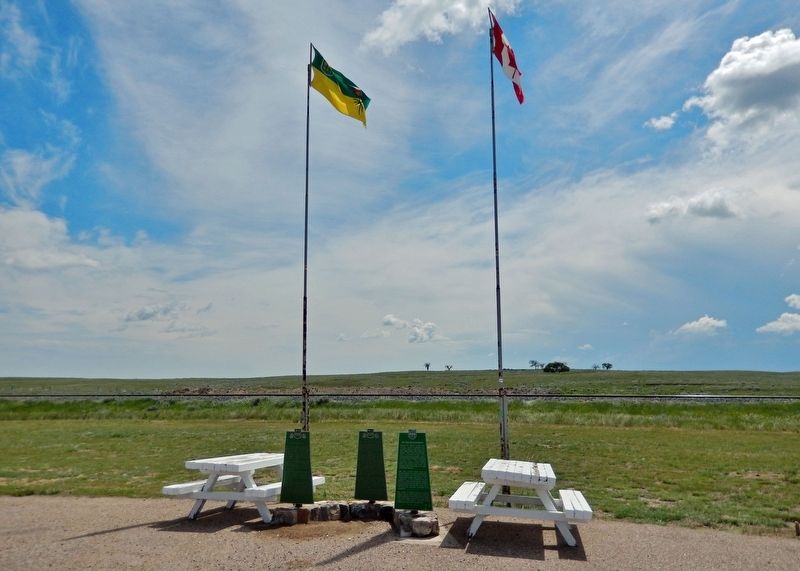
One of the most deadly was the killing winter of 1906-07. The winter began innocently with the first fall of snow on Nov. 5, 1906. Then, a little more than a week later, a brutal three-day blizzard raged across the West, dumping several feet of snow. Pioneers called it “the earliest, most violent, and longest storm in living memory.” December hinted at a return to normal weather, but a series of heavy snowfalls, accompanied by record low temperatures, pounded the region through most of January and February. When ranch hands in southwestern Saskatchewan went to assess the carnage(Submitted on July 8, 2022, by Cosmos Mariner of Cape Canaveral, Florida.)in the spring and count the stock losses, they found dead cows hanging in trees in the coulees because the snow had been so deep.Photographed by Cosmos Mariner, June 25, 20222. The Ranching Industry Marker(looking south • rightmost of 3 Saskatchewan markers at this location)

Photographed by Jimmy Emerson, September 30, 2024
3. The Ranching Industry Marker
Credits. This page was last revised on October 15, 2025. It was originally submitted on July 8, 2022, by Cosmos Mariner of Cape Canaveral, Florida. This page has been viewed 301 times since then and 21 times this year. Photos: 1, 2. submitted on July 8, 2022, by Cosmos Mariner of Cape Canaveral, Florida. 3. submitted on October 11, 2025, by Jimmy Emerson of Dalton, Georgia.
