Penn Quarter in Northwest Washington in Washington, District of Columbia — The American Northeast (Mid-Atlantic)
The Chinese Hackberry Tree
Witnessing a Century of Change
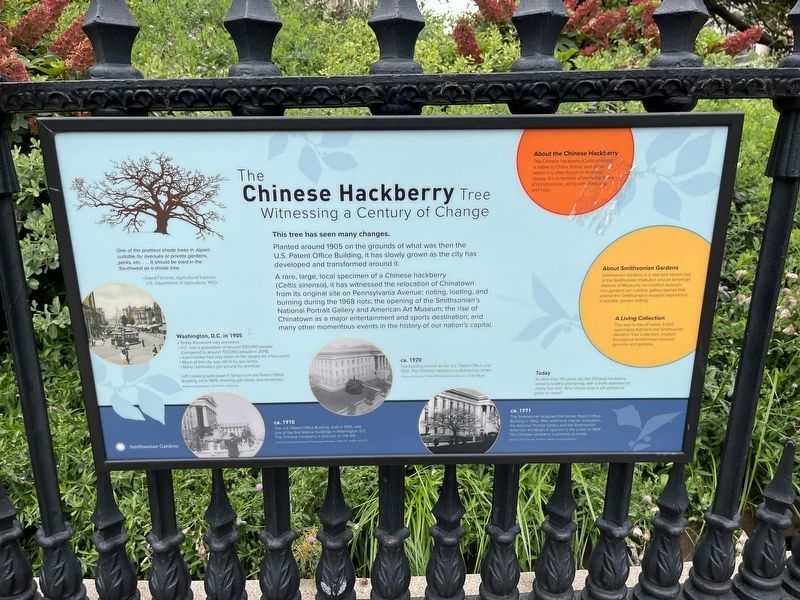
This tree has seen many changes.
Planted around 1905 on the grounds of what was then the U.S. Patent Office Building, it has slowly grown as the city has developed and transformed around it.
A rare, large, local specimen of a Chinese hackberry (Celtis sinensis), it has witnessed the relocation of Chinatown from its original site on Pennsylvania Avenue; rioting, looting, and burning during the 1968 riots; the opening of the Smithsonian's National Portrait Gallery and American Art Museum; the rise of Chinatown as a major entertainment and sports destination; and many other momentous events in the history of our nation's capital.
One of the prettiest shade trees in Japan, suitable for avenues or private gardens, parks, etc.... It should be tried in the Southwest as a shade tree.
—David Fairchild, Agricultural Explorer, U.S. Department of Agriculture, 1903
Washington, D.C. in 1905
• Teddy Roosevelt was president.
• D.C. had a population of about 300,000 people (compared to around 700,000 people in 2019)
• Automobiles had only been on the streets for a few years.
• Much of the city was still lit by gas lamps.
• Many commuters got around by street car.
Left: Looking west down F Street from the Patent Office Building, circa 1909, showing gas lamps and streetcars.
Streets of Washington / CC BY-NC 2.0 license
ca. 1910
The U.S. Patent Office Building, built in 1836, was one of the first federal buildings in Washington, D.C. The Chinese hackberry is pictured on the left.
Library of Congress, Prints & Photographs Division, HABS DC, WASH, 503-37
ca. 1920
The building served as the U.S. Patent Office until 1932. The Chinese hackberry is pictured at center.
Library of Congress, Prints & Photographs Division, LC-USZ62-136246
ca. 1971
The Smithsonian acquired the former Patent Office Building in 1962. After extensive interior renovation, the National Portrait Gallery and the Smithsonian American Art Museum opened to the public in 1968. The Chinese hackberry is pictured at center.
National Park Service, W. Brown Morton, III, photographer
Today
At more than 115 years old, the Chinese hackberry remains healthy and strong, with a trunk diameter of nearly four feet. Who knows what it will witness in years to come?
[Sidebar:]
About the Chinese Hackberry
The Chinese hackberry (Celtis sinensis) is native to China, Korea, and Japan, where it is often found on forested slopes. It is a member of the hemp family (Cannabaceae), along with marijuana and hops.
About Smithsonian Gardens
Smithsonian Gardens is a vital and vibrant part of the Smithsonian Institution and an American Alliance of Museums-accredited museum. Our gardens are outdoor gallery spaces that extend the Smithsonian's museum experience in a public garden setting.
A Living Collection
This tree is one of nearly 2,000 specimens that form the Smithsonian Gardens Tree Collection, located throughout Smithsonian museum grounds and gardens.
Erected by Smithsonian
this page online
Topics and series. This historical marker is listed in these topic lists: Arts, Letters, Music • Government & Politics • Horticulture & Forestry • Industry & Commerce. In addition, it is included in the Historic Trees series list. A significant historical year for this entry is 1905.
Location. 38° 53.845′ N, 77° 1.331′ W. Marker is in Northwest Washington in Washington, District of Columbia. It is in the Penn Quarter. It is at the intersection of F Street Northwest and 7th Street Northwest, on the right when traveling west on F Street Northwest. Touch for map. Marker is at or near this postal address: 611 7th St NW, Washington DC 20004, United States of America. Touch for directions.

Regionally, this marker is in the Washington Metropolitan Area. It is also in the American Northeast, in the Upper South, in the Mid-Atlantic, in the Tidewater, and in the Chesapeake Bay Region. Globally, it is in North America, the Western Hemisphere, the Western World, and the Anglosphere.
Other nearby markers. At least 8 other markers are within walking distance of this marker: The Daguerre Monument

Other markers no longer nearby. The Roots of Freedom and Equality (was within shouting distance of this marker but has been replaced with another marker now near it); Abraham Lincoln Walked Here (was within shouting distance of this marker but has been replaced with another marker now near it).
Credits. This page was last revised on June 29, 2025. It was originally submitted on July 17, 2022, by Devry Becker Jones of Washington, District of Columbia. This page has been viewed 854 times since then and 72 times this year. Photos: 1, 2. submitted on July 17, 2022, by Devry Becker Jones of Washington, District of Columbia.
