
Youngstown in Mahoning County, Ohio — The American Midwest (Great Lakes)
The Mahoning River
Photographed by Craig Doda, July 2, 2022
1. The Mahoning River Marker
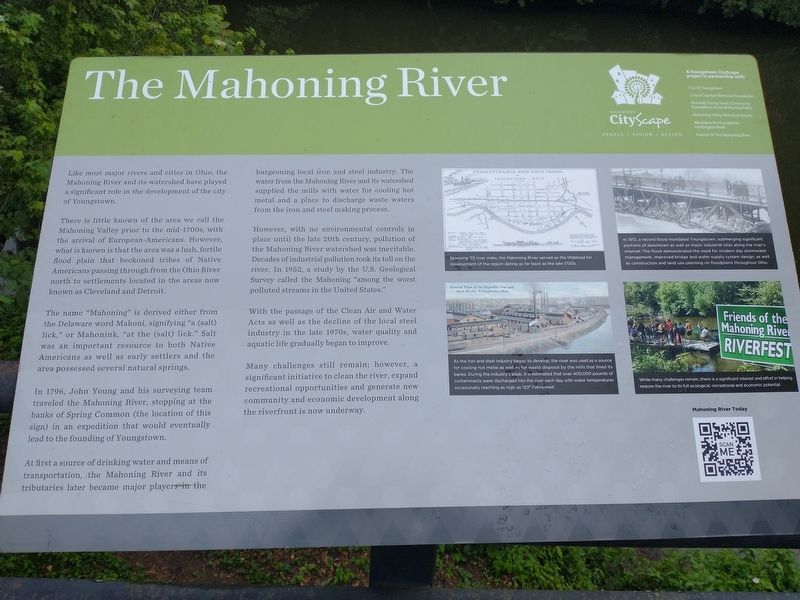
There is little known of the area we call the Mahoning Valley prior to the mid-1700s, with the arrival of European-Americans. However, what is known is that the area was a lush, fertile flood plain that beckoned tribes of Native Americans passing through from the Ohio River north to settlements located in the areas now known as Cleveland and Detroit.
The name "Mahoning” is derived either from the Delaware word Mahoni, signifying "a (salt) lick,” or Mahonink, "at the (salt) lick.” Salt was an important resource to both Native Americans as well as early settlers and the area possessed several natural springs.
In 1796, John Young and his surveying team traveled the Mahoning River, stopping at the banks of Spring Common (the location of this sign) in an expedition that would eventually lead to the founding of Youngstown.
At first a source of drinking water and means of transportation, the Mahoning River and its tributaries later became major
this page online
However, with no environmental controls in place until the late 20th century, pollution of the Mahoning River watershed was inevitable. Decades of industrial pollution took its toll on the river. In 1952, a study by the U.S. Geological Survey called the Mahoning "among the worst polluted streams in the United States."
With the passage of the Clean Air and Water Acts as well as the decline of the local steel industry in the late 1970s, water quality and aquatic life gradually began to improve.
Many challenges still remain; however, a significant initiative to clean the river, expand recreational opportunities and generate new community and economic development along the riverfront is now underway.
Spanning 113 river miles, the Mahoning River served as the lifeblood for development of the region dating as far back as the late 1700s.
As the iron and steel industry began
Photographed by Craig Doda, July 2, 2022
2. The Mahoning River
In 1913, a record flood inundated Youngstown, submerging significant portions of downtown as well as major industrial sites along the river's channel. The flood demonstrated the need for modern day stormwater management, improved bridge and water supply system design, as well as construction and land use planning on floodplains throughout Ohio.
While many challenges remain, there is a significant interest and effort in helping restore the river to its full ecological, recreational and economic potential.
Erected by Youngstown CityScape.
Topics. This historical marker is listed in these topic lists: Environment • Industry & Commerce • Waterways & Vessels. A significant historical year for this entry is 1796.
Location. 41° 6.184′ N, 80° 39.463′ W. Marker is in Youngstown, Ohio, in Mahoning
Photographed by Craig Doda, July 2, 2022
3. The Mahoning River
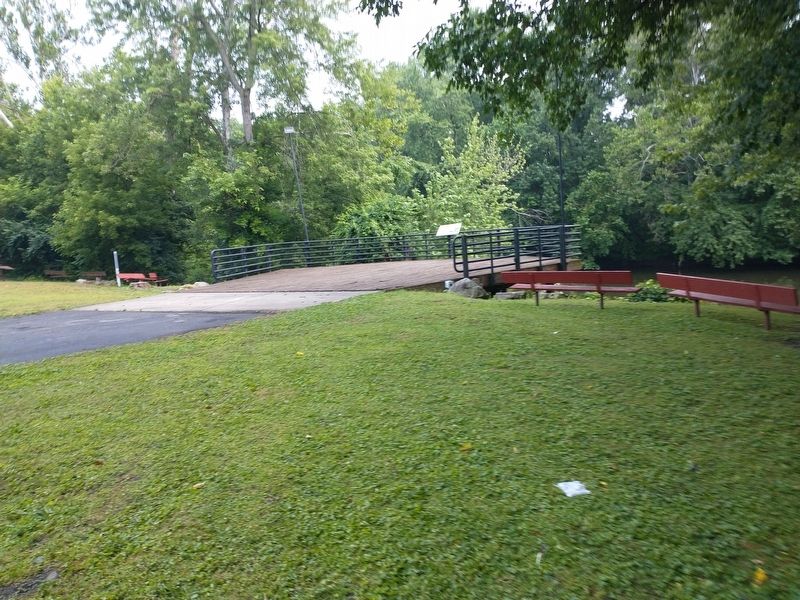
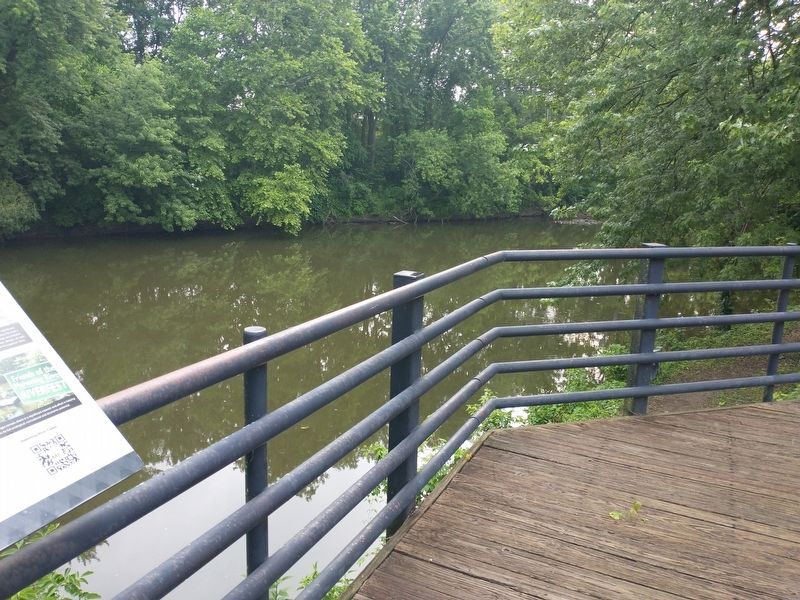
Looking north at the marker.

Regionally, this marker is in Ohio’s Western Reserve and in the Mahoning Valley. It is also in the American Midwest. Globally, it is in North America, the Western Hemisphere, the Western World, and the Anglosphere. Historically, it finds itself in what was once the Haudenosaunee (Iroquois) Confederacy, the territory of the Mississippian Culture, and the Northwest Territory.
Other nearby markers. At least 8 other markers are within walking distance of this marker: First Ohio Settlers in the Mahoning River Valley (about 700 feet away, measured in a direct line); The Founding of Youngstown (about 700 feet away); Harry Burt and Good Humor / Ross Radio Company (approx. 0.2 miles away); The Warner Theater (approx. ¼ mile away); Working Class Heroes (approx. 0.3 miles away); Little Steel Strike (approx. 0.4 miles away); A Little Bit of Youngstown’s History (approx. 0.4 miles away); The First Log School (approx.
Photographed by Craig Doda, July 2, 2022
4. The Mahoning River
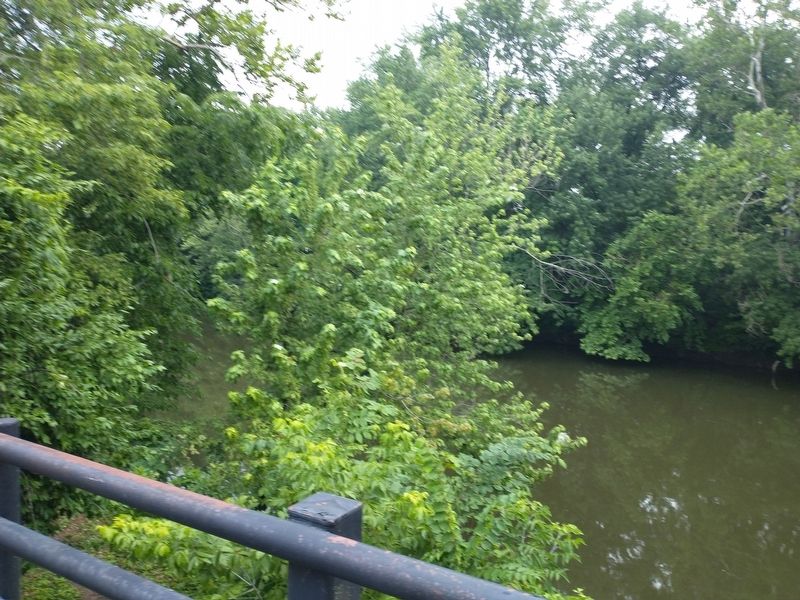
Looking south at the marker.
Another marker is no longer nearby. Warner Brothers (was approx. ¼ mile away but has been confirmed missing).
Credits. This page was last revised on November 12, 2024. It was originally submitted on July 18, 2022, by Craig Doda of Napoleon, Ohio. This page has been viewed 1,424 times since then and 111 times this year. Photos: 1, 2, 3, 4. submitted on July 18, 2022, by Craig Doda of Napoleon, Ohio. • J. Makali Bruton was the editor who published this page.
