Lexington in Lee County, Texas — The American South (West South Central)
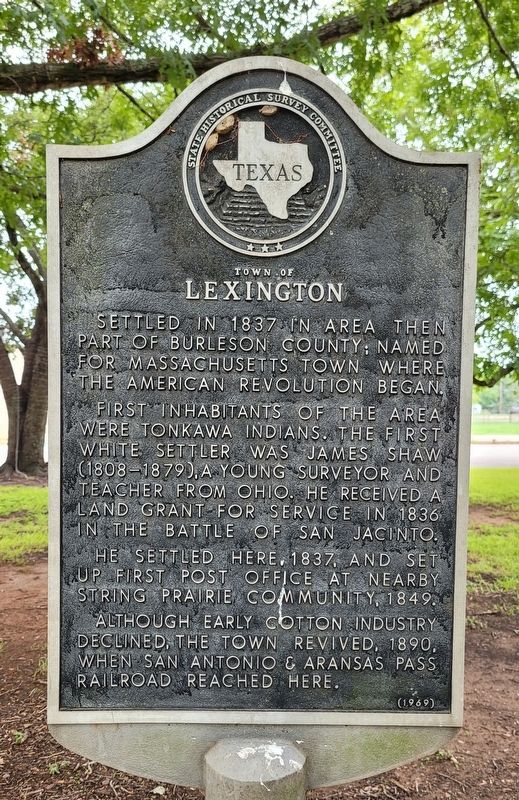
Town of Lexington
Photographed by James Hulse, August 31, 2022
1. Town of Lexington Marker
Erected 1969 by State Historical Survey Committee. (Marker Number 8167.)
Topics. This historical marker is listed in these topic lists: Indigenous Peoples and Communities • Railroads & Streetcars • Settlements & Settlers. A significant historical year for this entry is 1837.
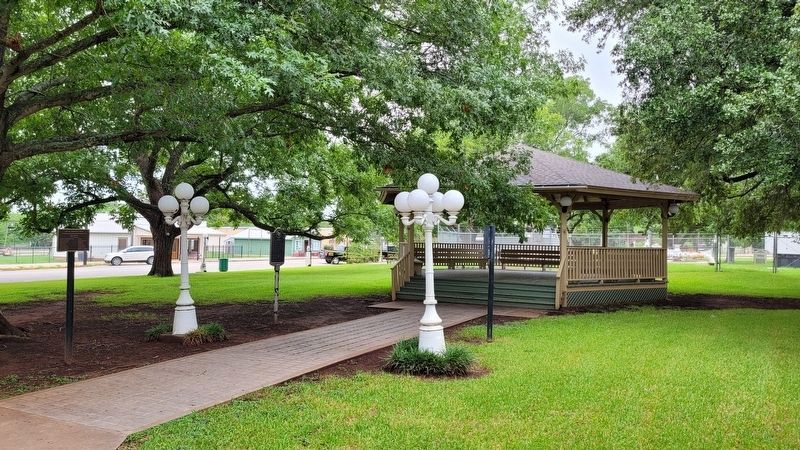
Location. 30° 24.872′ N, 97° 0.607′ W. Marker is in Lexington, Texas, in Lee County. It is at the intersection of Wheatley Street and 3rd Street on Wheatley Street. The marker is located in the central park by the gazebo. Touch for map. Marker is at or near this postal address: 616 Wheatley Street, Lexington TX 78947, United States of America. Touch for directions.

Regionally, this marker is in Central Texas. It is also in the American South. Globally, it is in North America, a Gulf of Mexico state, the Western Hemisphere, the Western World, and the Anglosphere. Historically, it finds itself in what was once New Spain, the Republic of Texas, one of the Confederate States of America, and the Antebellum South.
Other nearby markers. At least 8 other markers are within 8 miles of this marker, measured as the crow flies: Lexington Veterans Memorial (within shouting distance of this marker); Lexington Masonic Lodge No. 138 (about 300 feet away, measured in a direct line);
this page online
Also see . . .
1. Lexington, Texas. Wikipedia
Lexington's first postoffice was called String Prairie in 1848, named for the surrounding prairie. The first postmaster was veteran and legislator, James Shaw. In 1850, residents changed the name of the settlement to Lexington to honor the location of the first battle of the American Revolution.(Submitted on September 5, 2022, by James Hulse of Medina, Texas.)
2. Tonkawa. Wikipedia
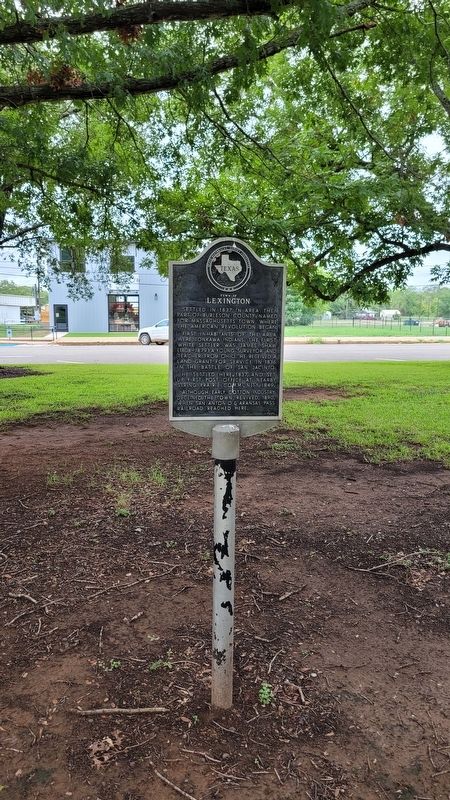
Scholars once thought the Tonkawa originated in Central Texas. Recent research, however, has shown that the tribe inhabited northwestern Oklahoma in 1601. By 1700, Apache and Wichita enemies had pushed the Tonkawa south to the Red River which forms the border between current-day Oklahoma and Texas. In the 16th century, the Tonkawa(Submitted on September 5, 2022, by James Hulse of Medina, Texas.)tribe probably had around 1,900 members. Their numbers diminishes to around 1,600 by the late 17th century due to fatalities from new infectious diseases and conflict with other tribes, most notably the Apache.Photographed by James Hulse, August 31, 20222. The Town of Lexington Marker in the city park
Photographed by James Hulse, August 31, 2022
3. The Town of Lexington Marker is next to the gazebo
The marker is on the left side of the sidewalk next to the gazebo.
Credits. This page was last revised on September 5, 2022. It was originally submitted on September 4, 2022, by James Hulse of Medina, Texas. This page has been viewed 673 times since then and 49 times this year. Photos: 1, 2, 3. submitted on September 5, 2022, by James Hulse of Medina, Texas.
