
Short North Arts District in Columbus in Franklin County, Ohio — The American Midwest (Great Lakes)
“Arch City”
| — | Short North Arts District | — |

Photographed by J. J. Prats, June 5, 2016
1. “Arch City” Information Kiosk
It was 1888 and the country was celebrating the centennial of the creation of the Northwest Territory. Since Ohio had been the first state carved out of the Territory, Columbus was chosen to host the commemorative event. Knowing that 300,000 people would be descending upon a city of 80,000, Columbus set out to make a statement. The idea: construct a series of arches throughout downtown to light the streets and dazzle visitors. On parade day, more than 50,000 Union veterans marched down High Street. It was the biggest parade of Union Army Veterans since the end of the Civil War. There would never be a bigger one. Columbus as Arch City was born.
Unlike today's version, the first arches were build wood and featured gas lamps. Due to the obvious risk, they were soon replaced by metal structures. Over the years, repair costs mounted and lampposts became the norm. By 1916, the arches disappeared completely. It was
this page online
In 2002, the Short North Arts District unveiled 7 new arches over High Street, and new computer-controlled LED bulbs were installed in 2007. The system's 860 individually programmable lights can be turned any of a million colors. The arches provide a mile-long rainbow that has become the hallmark of the District. Light shows now commemorate a number of Columbus celebrations that cn be seen after dark.
Erected by Short North Special Improvement District.
Topics. This historical marker is listed in these topic lists: Architecture • Entertainment. A significant historical year for this entry is 1888.
Location. Marker has been permanently removed. It was located near 39° 58.895′ N, 83° 0.258′ W. Marker was in Columbus, Ohio, in Franklin County. It was in the Short North Arts District. It was on North High Street south of West 2nd Avenue, on the left when traveling south. Touch for map. Marker was at or near this postal address: 940 N High St, Columbus OH 43201, United States of America.
We have been informed that this marker is no longer there and will not be replaced. This page is an archival view of what was.
Regionally,
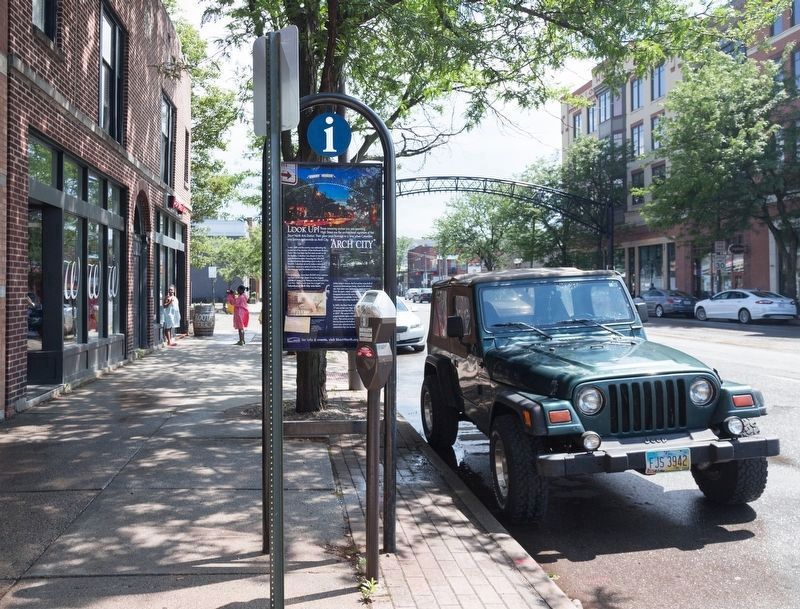
Photographed by J. J. Prats, June 5, 2016
2. “Arch City” Information Kiosk
This view is south. One of the Short North’s arches can be seen in the distance.

Other nearby markers. At least 7 other markers are within walking distance of this location: The Fireproof Building (about 600 feet away, measured in a direct line); The Makers Monument (approx. 0.2 miles away); Pride Circles (approx. 0.3 miles away); Stonewall Union (approx. 0.3 miles away); Father Rocco Petrarca (approx. 0.4 miles away); Chiesa Italiana u San Giovanni Battista (approx. 0.4 miles away); Chiesa Italiana di San Giovanni Battista (approx. 0.4 miles away). Touch for a list and map of all markers in Columbus.
Other markers no longer nearby. Short North Murals (was within shouting distance of this marker but has been permanently removed); Elijah Pierce (was within shouting distance of this marker but has been permanently removed); Emerson Burkhart

Photographed by J. J. Prats, June 5, 2016
3. “Arch City” Information Kiosk
This view is north, where another arch can be seen.
Related markers. Click here for a list of markers that are related to this marker. This list contains many of the information kiosks that dotted North High Street in the Short North in the mid 2010s.
Also see . . . Wikipedia entry for Columbus Streetcar Arches. Excerpt:
After the G.A.R. convention, the arches remained installed on city streets to memorialize the significant event. Within several years, the city's prominent horse-driven streetcar companies consolidated. The new Columbus Railway, Power & Light Company looked for a way to power new electric streetcars, and constructed a network of arches in Downtown(Submitted on September 5, 2022.)Columbus in 1896.[1] One section of the city, "the Hub" around Fourth and Main Streets, had a smaller system of arch lighting.[2]Detroit Publishing Co. (Public Domain) via Wikimedia Commons, circa 19004. At Dark, Arch City, Columbus, O.
By the early 1900s, the city became known as "Arch City" due to the streetcar arches’ popularity and prevalence, as defined as the “Twin Cities” of Minneapolis-St. Paul and the “City of Brotherly Love,” Philadelphia.
Initially, the arches were only used in high-traffic areas, mostly in Downtown Columbus, with other areas using freestanding wires. Residents of other neighborhoods soon wished to have streetcar arches, as they had become the single clearest identifier for the city, something other neighborhoods wanted to partake in. The electric company said it would provide power so long as the residents provide the arches. Efforts to raise money for arches in Columbus neighborhoods were often unsuccessful, but businesses in the Short North raised enough from 1907 to 1908 to place arches along High Street for a stretch. Within one year, businessmen on Broad Street west from High to the Toledo & Ohio station raised funds for their own arches. These were dedicated in a ceremony of parades, speeches, and fireworks on July 7, 1909.

Credits. This page was last revised on February 11, 2023. It was originally submitted on September 5, 2022, by J. J. Prats of Powell, Ohio. This page has been viewed 772 times since then and 77 times this year. Photos: 1, 2, 3, 4. submitted on September 5, 2022, by J. J. Prats of Powell, Ohio.
