
Downtown Austin in Travis County, Texas — The American South (West South Central)
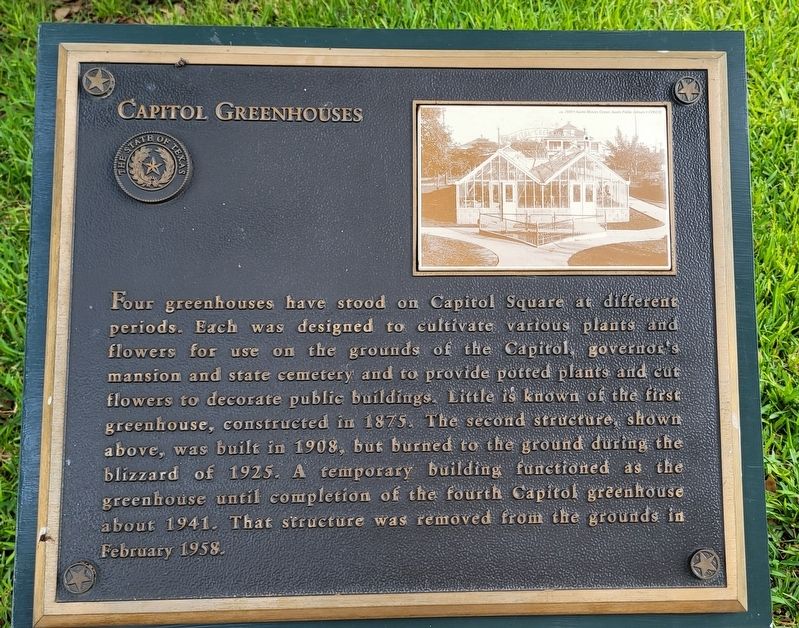
Capitol Greenhouses
Photographed by James Hulse, August 30, 2022
1. Capitol Greenhouses Marker
Erected by State of Texas.
Topics. This historical marker is listed in this topic list: Notable Buildings. A significant historical month for this entry is February 1958.
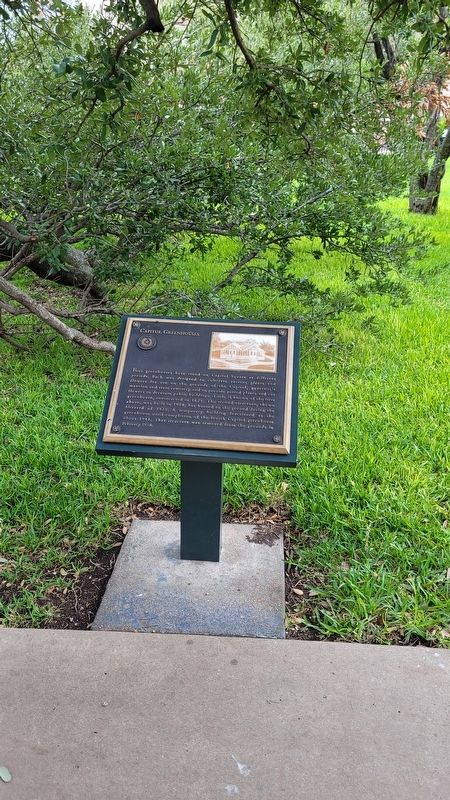
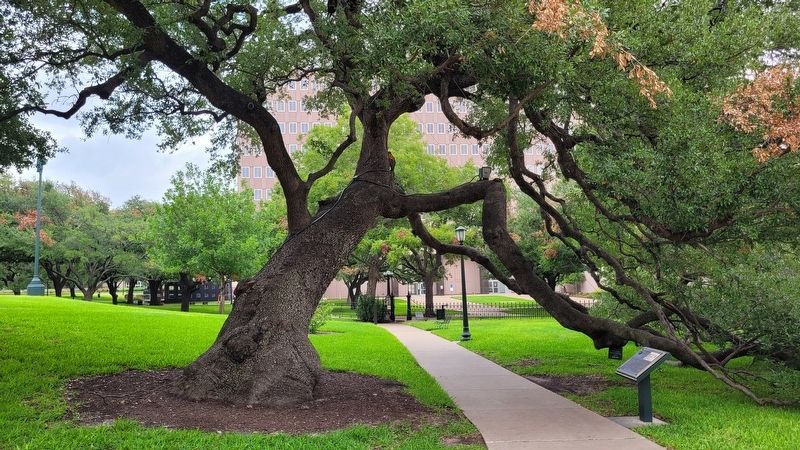
Location. 30° 16.462′ N, 97° 44.344′ W. Marker is in Austin, Texas, in Travis County. It is in Downtown Austin. It can be reached from the intersection of Congress Avenue and East 11th Street. The marker is located on the southeastern section of the Texas Capital grounds along the walkway and a large old oak tree. Touch for map. Marker is at or near
this page online

Regionally, this marker is in Central Texas. It is also in the American South. Globally, it is in North America, a Gulf of Mexico state, the Western Hemisphere, the Western World, and the Anglosphere. Historically, it finds itself in what was once New Spain, the Republic of Texas, one of the Confederate States of America, and the Antebellum South.
Other nearby markers. At least 8 other markers are within walking distance of this marker: 1928 Granite Water Fountain (a few steps from this marker); Hood’s Texas Brigade Monument (within shouting distance of this marker); Texas and the Civil War (within shouting distance of this marker); The Lorenzo de Zavala State Archives and Library Building (within shouting distance of this marker); The Archive War (within shouting distance of this marker); Disabled American Veterans of Texas Monument (about 300 feet away, measured in a direct line); Cisterns (about 300 feet away); Artesian Well and East Drinking Fountain (about 400 feet away). Touch for a list and map of all markers
Photographed by James Hulse, August 30, 2022
2. Capitol Greenhouses Marker
Also see . . . Texas State Capitol. Wikipedia
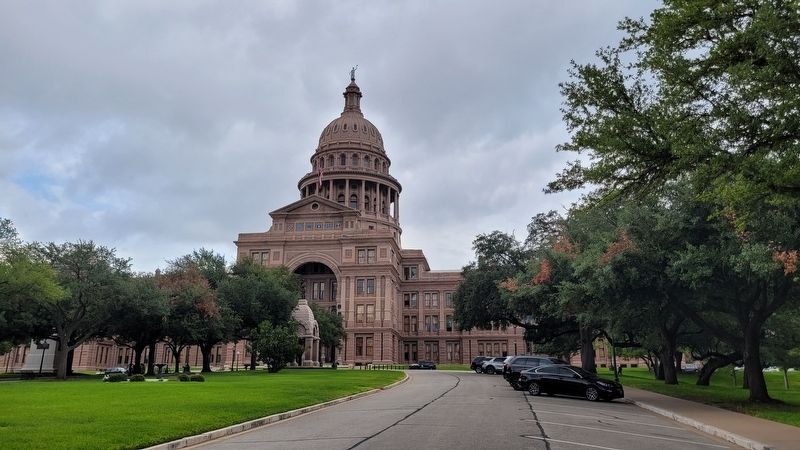
The Texas State Capitol is the capitol and seat of government of the American state of Texas. Located in downtown Austin, Texas, the structure houses the offices and chambers of the Texas Legislature and of the Governor of Texas. Designed in 1881 by architect Elijah E. Myers, it was constructed from 1882 to 1888 under the direction of civil engineer Reuben Lindsay Walker. A $75 million underground extension was completed in 1993. The building was added to the National Register of Historic Places in 1970 and recognized as a National Historic Landmark in 1986.(Submitted on September 7, 2022, by James Hulse of Medina, Texas.)
Photographed by James Hulse, August 30, 2022
3. The view of the Texas State Capitol
Photographed by James Hulse, August 30, 2022
4. The view of the Capitol Greenhouses Marker on the grounds of the Texas State Capitol
Credits. This page was last revised on February 1, 2023. It was originally submitted on September 6, 2022, by James Hulse of Medina, Texas. This page has been viewed 518 times since then and 32 times this year. Photos: 1, 2, 3, 4. submitted on September 7, 2022, by James Hulse of Medina, Texas.
