Downtown Austin in Travis County, Texas — The American South (West South Central)
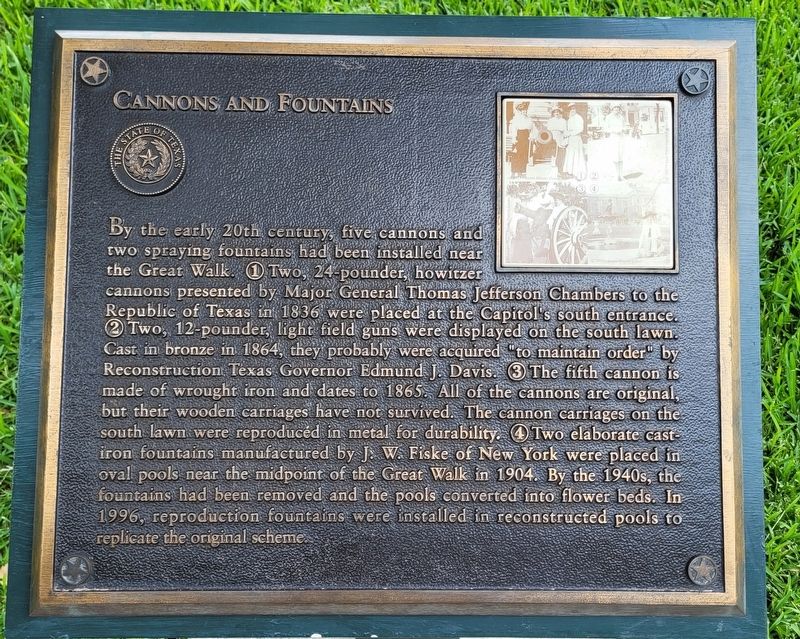
Cannons and Fountains
Photographed by James Hulse, August 30, 2022
1. Cannons and Fountains Marker
Erected by State of Texas.
Topics. This historical marker is listed in this topic list: Notable Places. A significant historical year for this entry is 1836.
Location. 30° 16.409′ N,
this page online

Regionally, this marker is in Central Texas. It is also in the American South. Globally, it is in North America, a Gulf of Mexico state, the Western Hemisphere, the Western World, and the Anglosphere. Historically, it finds itself in what was once New Spain, the Republic of Texas, one of the Confederate States of America, and the Antebellum South.
Other nearby markers. At least 8 other markers are within walking distance of this marker: Capitol of 1852-53 (here, next to this marker); Southern Confederacy Monument (within shouting distance of this marker); Terry’s Texas Rangers Monument (within shouting distance of this marker); Terry Rangers Monument (within shouting distance of this marker);
Photographed by James Hulse, August 30, 2022
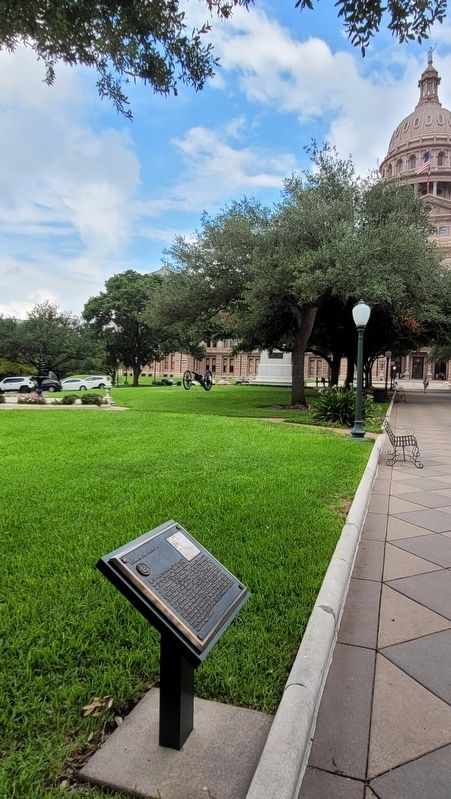
2. The view of the Cannons and Fountains Marker along the Great Walk
Also see . . . Texas State Capitol. Wikipedia
The Texas State Capitol is the capitol and seat of government of the American state of Texas. Located in downtown Austin, Texas, the structure houses the offices and chambers of the Texas Legislature and of the Governor of Texas. Designed in 1881 by architect Elijah E. Myers, it was constructed from 1882 to 1888 under the direction of civil engineer Reuben Lindsay Walker. A $75 million underground extension was completed in 1993. The building was added to the National Register of Historic Places in 1970 and recognized as a National Historic Landmark in 1986.(Submitted on September 7, 2022, by James Hulse of Medina, Texas.)
Photographed by James Hulse, August 30, 2022
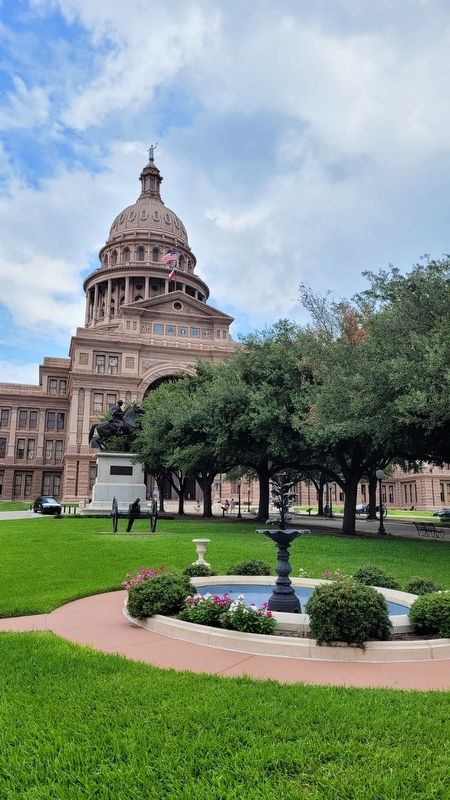
3. The Cannons and Fountains in front of the Texas State Capitol
Photographed by James Hulse, August 30, 2022
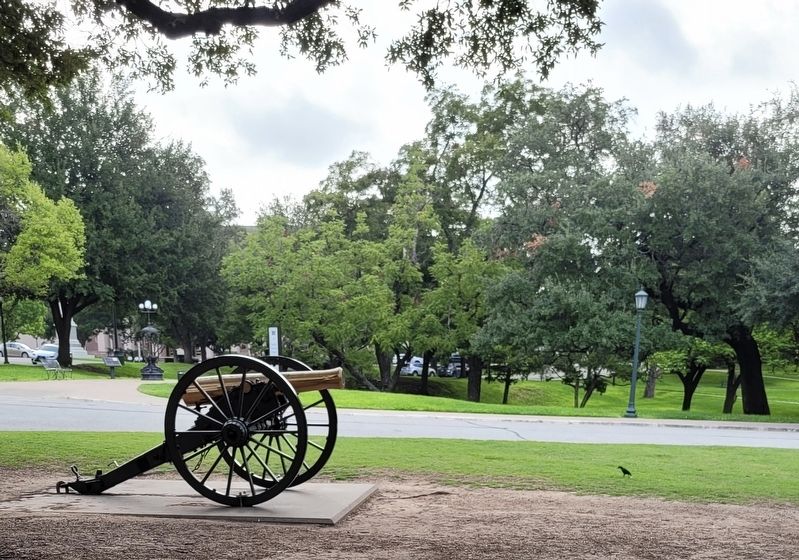
4. Cannon at the south entrance to Texas State Capitol
Credits. This page was last revised on February 1, 2023. It was originally submitted on September 6, 2022, by James Hulse of Medina, Texas. This page has been viewed 680 times since then and 74 times this year. Photos: 1, 2, 3, 4. submitted on September 7, 2022, by James Hulse of Medina, Texas.
