Midtown in Nashville in Davidson County, Tennessee — The American South (East South Central)
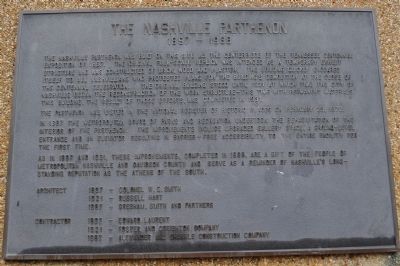
The Nashville Parthenon
1897-1988
Photographed by Sandra Hughes, September 26, 2009
1. The Nashville Parthenon Marker
The Parthenon was listed in the National Register of Historic Places on February 23, 1972.
In 1987 the Metropolitan Board of Parks and Recreation undertook the rehabilitation of the interior of the Parthenon. The improvements include upgraded gallery space, a ground-level entrance and an elevator resulting in barrier-free accessibility to the entire facility for the first time.
As in 1897 and 1931, these improvements, completed in 1988, are a gift of the people of Metropolitan Nashville and Davidson County
this page online
Architect
1897 - Colonel W.C. Smith
1921 - Russell Hart
1987 - Gresham, Smith and Partners
Contractors
1897 - Edward Laurent
1921 - Foster and Creighton Company
1987 - Alexander and Shankle Construction Company
Topics. This historical marker is listed in this topic list: Notable Buildings. A significant historical month for this entry is February 1887.
Location. 36° 8.998′ N, 86° 48.779′ W. Marker is in Nashville, Tennessee, in Davidson County. It is in Midtown. It can be reached from 27th Avenue N 0.2 miles north of Poston Avenue. Located in Centennial Park. Touch for map. Marker is at or near this postal address: 2600 West End Avenue, Nashville TN 37203, United States of America. Touch for directions.

Regionally, this marker is in Middle Tennessee. It is also in the American South and specifically in the Upper South. Globally, it is in North America, the Western Hemisphere, the Western World, and the Anglosphere. Historically, it finds itself in what was once the territory of the Mississippian Culture, one of the Confederate States
Photographed by Sandra Hughes, September 26, 2009
2. Athena Parthenos / Alan Lequire, Sculptor
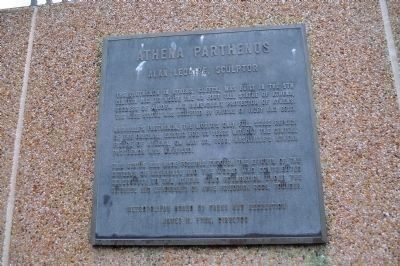
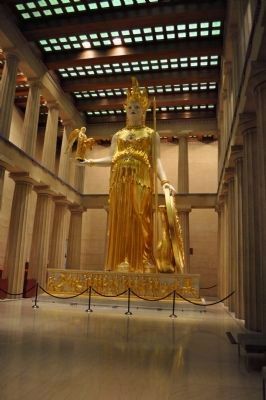
The Parthenon in Athens, Greece, was built in the 5th century B.C. to house the 42 foot tall statue of Athena, Goddess of Wisdom and Benevolent Protector of Athens. The hugh statue was sculpted by Phidias of Ivory and Gold.
Nashville's Parthenon, the world's only full scale replica of the original, existed for 93 years without the central figure of Athena. On May 20, 1990, Nashville's Athena Parthenos was unveiled.
This statue was made possible through the efforts of the citizens of Nashville and the world who contributed generously to the Athena Fund Foundation under the guidance and leadership of the Anne Friedrich Roos, Founder.
Metropolitan Board of Parks and Recreation
James H Fyke, Director
Nashville's Parthenon, the world's only full scale replica of the original, existed for 93 years without the central figure of Athena. On May 20, 1990, Nashville's Athena Parthenos was unveiled.
This statue was made possible through the efforts of the citizens of Nashville and the world who contributed generously to the Athena Fund Foundation under the guidance and leadership of the Anne Friedrich Roos, Founder.
James H Fyke, Director
Other nearby markers. At least 8 other markers are within walking distance of this marker: Tennessee Woman Suffrage Monument (within shouting distance of this marker); Jane Greenebaum Eskind (within shouting distance of this marker); Beth Halteman Harwell (within shouting distance of this marker); Lois Marie DeBerry (within shouting distance of this marker); Nineteenth Amendment To The United States Constitution (about 300 feet away, measured in a direct line); The Exposition Ends, Centennial Park Begins (about 300 feet away); The Parthenon (about 400 feet away); Major Wilbur Fisk Foster (about 400 feet away). Touch for a list and map of all markers in Nashville.
Also see . . . The Parthenon. Nashville Parks & Recreation (Submitted on February 21, 2011, by Bernard Fisher of Richmond, Virginia.)
Photographed by Sandra Hughes, September 26, 2009
3. The Parthenon
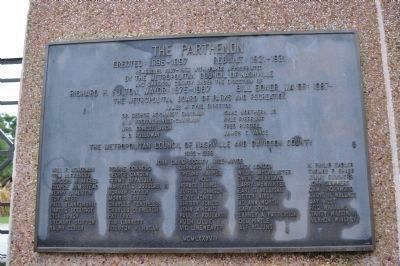
Remodeled 1987-1988 with funds appropriated
By the Metropolitan Council of Nashville
and Davidson County under the direction of
Richard H. Fulton, Mayor: 1975-1987
Bill Boner, Mayor 1987-
The Metropolitan Board of Parks and Recreation
James H. Fyke, Director
Dr. George Reichardt, Chairman • A.J. Kreithner, Vice-Chairman • A.D. Holloway • Isaac Northern Jr. • Fred Russell • James C. Vance
The Metropolitan Council of Nashville and Davidson County
Photographed by Sandra Hughes, September 26, 2009
4. The Nashville Parthenon & Markers
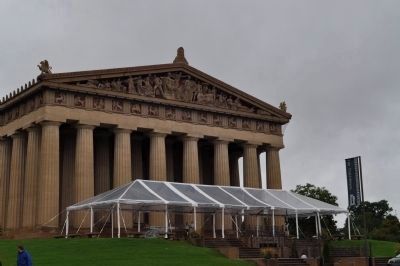
All 3 markers are next to the steps, at the lower level entrance on the wall.
Photographed by Sandra Hughes, September 26, 2009
5. About The Myth of Athena
In Greek Mythology, Athena is the Goddess of Wisdom and the useful arts, and the protector of cities. Her title Athena Parthenon refers to her status as a maiden goddess; the name for the Parthenon is derived from the Epithet and Translates into English as “The house of the Maiden.” Born from the head of Zeus, King of the Gods, Athena inherited much of her father’s power and wisdom. Athena’s preeminent place in the myths depicted on the artwork adorning the Parthenon also reflects the Preeminent position the city of Athens enjoyed in the mid-fifth Century B.C.
Photographed by Sandra Hughes, September 26, 2009
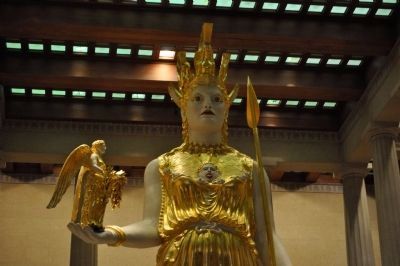
6. The Aegis
The armored breastplate Athena wears on her shoulders is said to have magic powers. Given to her by Zeus, the Aegis makes Athena impervious to her enemies’ weapons. In the center of the breastplate is the Medusa’s head, given by Peruses in return for Athena’s help killing Medusa.
Photographed by Sandra Hughes, September 26, 2009
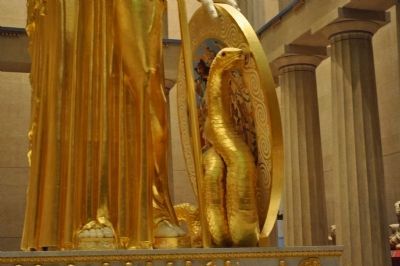
7. The Serpent & The Sandals
Thought by some to represent Erichonios, a legendary deified king of early Athens, the snake is also thought to symbolized the people of Athens themselves who, like this creature of the earth, arose “from the soil of Attica.”
The Sandals
Athens’s sandals are decorated with a scene depicting the slaying of Centaurs, a reflection of scenes carved on the metopes of the Parthenon’s Doric frieze.
Photographed by Sandra Hughes, September 26, 2009
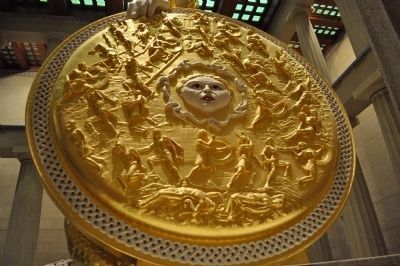
8. The Shield
The Shield
Athena’s shield protects the snake, indicating her role in defending the people of Athens from harm.
Photographed by Sandra Hughes, September 26, 2009
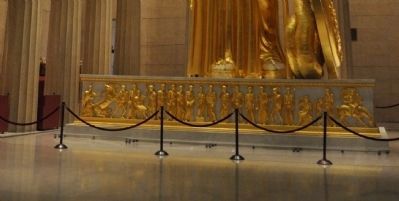
9. The Frieze
The frieze across the front of the marble base depicts the birth of Pandora, whose name means “all gifts”. The figures, in order, from left to right are Helios, Hermes, Hera, Zeus, Nike, Dionysus, the three Horai (hours or seasons) Pandora, Hephaistos, Athena, Poseidon, Artemis, Apollo, Ares, Demeter, Hestia, Eros, Aphrodite, and Selene.
Credits. This page was last revised on February 7, 2023. It was originally submitted on February 21, 2011, by Sandra Hughes Tidwell of Killen, Alabama, USA. This page has been viewed 2,659 times since then and 95 times this year. Last updated on September 16, 2022, by Darren Jefferson Clay of Duluth, Georgia. Photos: 1, 2, 3, 4, 5, 6, 7, 8, 9. submitted on February 21, 2011, by Sandra Hughes Tidwell of Killen, Alabama, USA. • Mark Hilton was the editor who published this page.
