
Weesp in Amsterdam, North Holland, Netherlands — Northwestern Europe
Soldaat en Geschut
⎯⎯⎯
Soldiers and Artillery
Photographed by Andrew Ruppenstein, July 23, 2022
1. Soldaat en Geschut / Soldiers and Artillery Marker

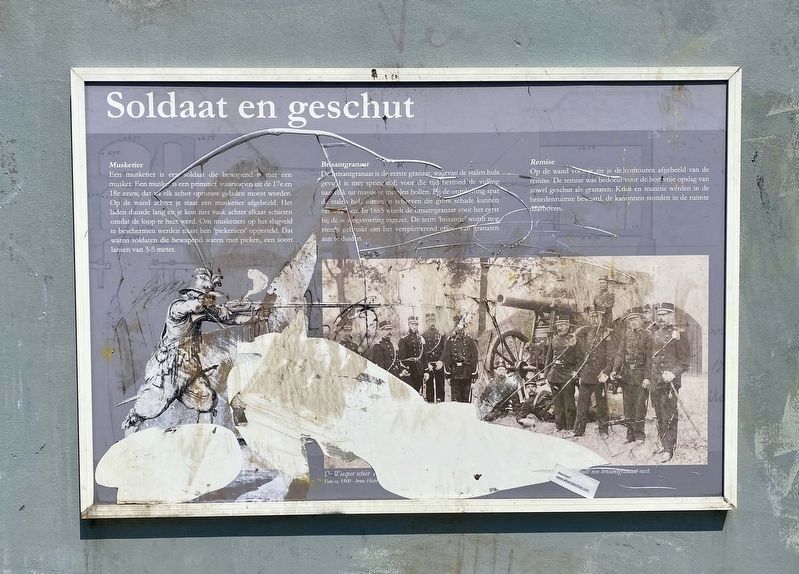
Musketier
Een musketier is een soldaat die bewapend met een musket. Een musket is een primitief vuurwaapen uit de 17e en 18e eeuw, dat na elk schot opnieuw geladen moest worden. Op de wand achter je staat een musketier afgebeeld. Het laden duurde lang en je kon niet vaak achter elkaar schieten omdat de loop te heet werd. Om musketiers op het slagveld beschermen werden naast hen 'pickeniers' opgesteld. Dat waren soldaten die bewapend waren met picken, een soort laren van 3-5 meter.
Brisantgranaat
De Brisantgranaat is de eerste granaat, waarvan de stalen huls gevuld is met springstof; voor die tijd bestond de vulling namelijk uit massieve metallen bollen. Bij de ontploffing spat de stalen huls uiteen scherven die grote schade kunnen veroorzaken. In 1885 wordt de brisantgranaat voor het eerst by de orllogsvoering ingezet. De term 'brisantie' wordt nog steeds gebruikt om het versplinterend effect van granaten aan te duiden.
Remise
Op de wand vor je zie je de contouren afgebeeld van de remise. De remise was bedoeld voor de bomfrije opslag van zowel geschut als granaten. Kruit en munitie
this page online
Musketeer
A musketeer is a soldier who is armed with a musket. A musket is a primitive firearms from the 17th and 18th centuries that had to be reloaded after each shot. A musketeer is depicted on the wall behind you. It took a long time to load and you couldn't shoot often in succession because the barrel got too hot. To protect musketeers on the battlefield, 'pickeniers' were lined up next to them. These were soldiers armed with pikes, a kind of lance 3-5 meters in length.
High-Explosive Grenade
The high-explosive grenade is the first grenade whose steel shell is filled with explosives; Before that time, the filling consisted of solid metal spheres. In the explosion, the steel shell shatters into shards that can cause major damage. In 1885 the high-explosive grenade was used for the first time in warfare. The term "bristle" is still used to refer to the shattering effect of grenades.
Remise
On the wall in front of you the contours of the depot are visible. The depot was intended for the explosion-free storage of both
Photographed by Andrew Ruppenstein, July 23, 2022
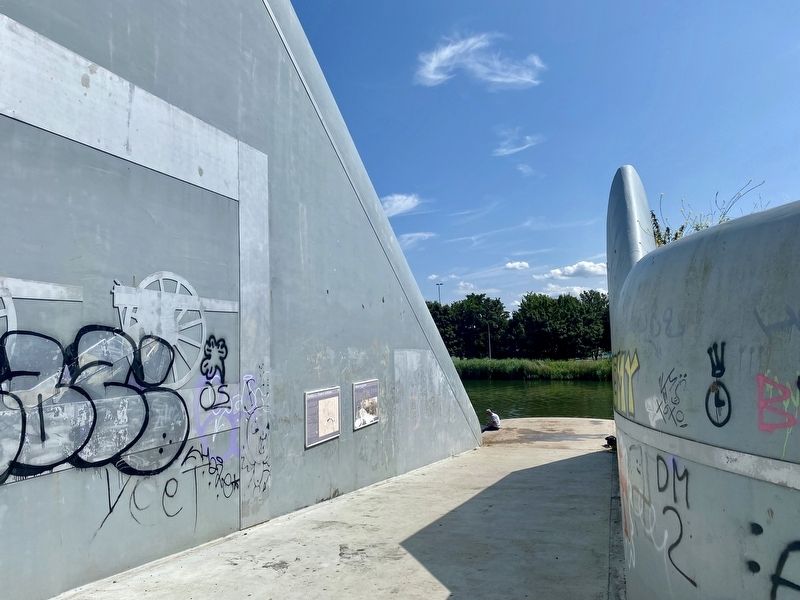
2. Soldaat en Geschut / Soldiers and Artillery Marker - wide view
Topics. This historical marker is listed in these topic lists: Forts and Castles • Military.
Location. 52° 18.425′ N, 5° 2.892′ E. Marker is in Weesp, Noord-Holland (North Holland), in Amsterdam. It can be reached from Ossenmarkt. Touch for map. Marker is in this post office area: Weesp, Noord-Holland 1381 HH, Netherlands. Touch for directions.

Regionally, it is in Europe, the European Union, Atlantic Europe, the Benelux Low Countries, the Schengen Area, Western Europe, and the Western World. Historically, it finds itself in what was once the Holy Roman Empire.
Other nearby markers. At least 8 other markers are within walking distance of this marker: Bastion de Nieuwe Achtkant (here, next to this marker); Fort aan de Ossenmarkt (about 150 meters away, measured in a direct line); Slachtoffers Weesp 1940-1945 / Weesp Victims of War 1940-1945 (about 180 meters away); Stadhuis / City Hall (approx. 0.4 kilometers away); St. Laurenskerk (approx. 0.4 kilometers away); Mouterij en Bierbrouwerij / Malthouse and Brewery (approx. 0.4 kilometers away); Weesp Jewish Deportation Memorial (approx. half a kilometer away); Philip Simon de Vries (approx. half a kilometer away). Touch for a list and map of all markers in Weesp.
More about this marker. To reach this marker, start at the parking lot at Ossenmarkt and simply follow the trail for about 3 minutes. The location does have a nice view of the Vecht River and there are even a couple of windmills in the distance.
Credits. This page was last revised on December 31, 2023. It was originally submitted on September 27, 2022, by Andrew Ruppenstein of Lamorinda, California. This page has been viewed 145 times since then and 8 times this year. Photos: 1, 2. submitted on September 27, 2022, by Andrew Ruppenstein of Lamorinda, California.
