Leavenworth in Crawford County, Indiana — The American Midwest (Great Lakes)
The Hoosier National Forest
Then and Now
Photographed by Duane and Tracy Marsteller, September 25, 2022
1. The Hoosier National Forest Marker
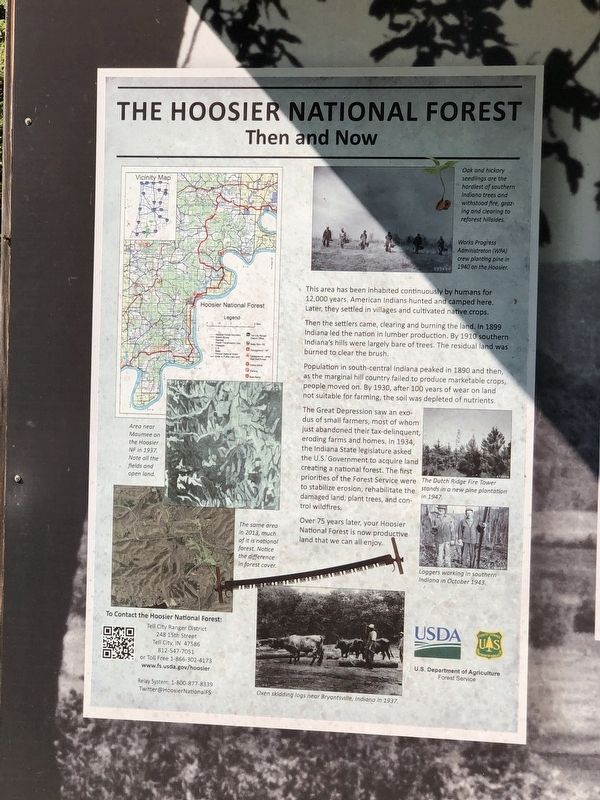
Then the settlers came, clearing and burning the land, In 1899 Indiana led the nation in lumber production. By 1910 southern Indiana's hills were largely bare of trees. The residual land was burned to clear the brush.
Population in south-central Indiana peaked in 1890 and then, as the marginal hill country failed to produce marketable crops, people moved on. By 1930, after 100 years of wear on land not suitable for farming, the soil was depleted of nutrients.
The Great Depression saw an exodus of small farmers, most of whom just abandoned their tax delinquent, eroding farms and homes. In 1934, the Indiana State legislature asked the U.S. Government to acquire land creating a national forest. The first priorities of the Forest Service were to stabilize erosion, rehabilitate the damaged land, plant trees, and control wildfires.
Over 75 years later, your Hoosier National Forest is now productive land that we can all enjoy.
Captions (clockwise from top right)
•
this page online
• Works Progress Administration (WPA) crew planting pine in 1940 on the Hosier.
• The Dutch Ridge Fire Tower stands in a new pine plantation in 1947.
• Loggers working in southern Indiana in October 1943.
• Oxen skidding logs near Bryantsville, Indiana in 1937.
• Area near Maumee on the Hoosier NF in 1937. Note all the fields and open land.
• The same area in 2013, much of it is national forest. Notice the difference in forest cover.
Erected by U.S. Forest Service.
Topics. This historical marker is listed in these topic lists: Horticulture & Forestry • Parks & Recreational Areas. A significant historical year for this entry is 1934.
Location. 38° 11.703′ N, 86° 20.123′ W. Marker is in Leavenworth, Indiana, in Crawford County. It is on Ohio River Scenic Byway (State Road 62) 0.2 miles west of East Hiawatha Heights, on the left when traveling west. Marker is in a kiosk at the Leavenworth Roadside Park. Touch for map. Marker is in this post office area: Leavenworth IN 47137, United States of
Photographed by Duane and Tracy Marsteller, September 25, 2022
2. The Hoosier National Forest Marker
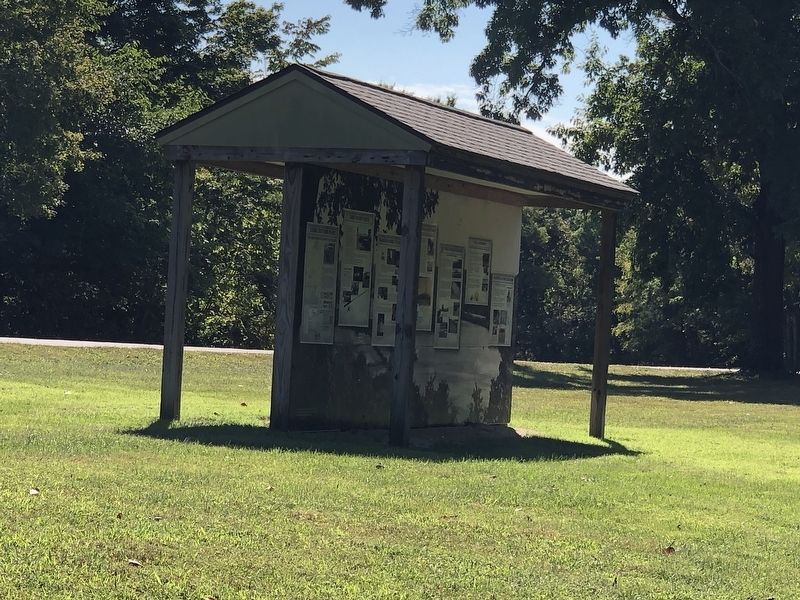
It is in this kiosk in Leavenworth Roadside Park.

Regionally, this marker is in Shawnee Hills and in Southern Indiana. It is also in the American Midwest, in the Ohio River Valley, and in the Corn Belt. Globally, it is in North America, the Western Hemisphere, the Western World, and the Anglosphere. Historically, it finds itself in what was once the territory of the Mississippian Culture and also the Northwest Territory.
Other nearby markers. At least 8 other markers are within 9 miles of this marker, measured as the crow flies: Leavenworth Skiffs (here, next to this marker); Where Did Buttons Come From (a few steps from this marker); Ohio River Lock and Dam No. 44 (a few steps from this marker); Captain Winfield Scott Paris (a few steps from this marker); Leavenworth (approx. 0.6 miles away); Welcome to Wyandotte and Siberts Cave! (approx. 3.2 miles away); Early Mining at Wyandotte Caves (approx. 3.2 miles away); Mt. Solomon Lutheran Church (approx. 8.9 miles away). Touch for a list and map of all markers in Leavenworth.
Credits. This page was last revised on October 3, 2022. It was originally submitted on October 2, 2022, by Duane and Tracy Marsteller of Murfreesboro, Tennessee. This page has been viewed 518 times since then and 43 times this year. Photos: 1, 2. submitted on October 2, 2022, by Duane and Tracy Marsteller of Murfreesboro, Tennessee.
