Leavenworth in Crawford County, Indiana — The American Midwest (Great Lakes)
Where Did Buttons Come From
Photographed by Duane and Tracy Marsteller, September 25, 2022
1. Where Did Buttons Come From Marker
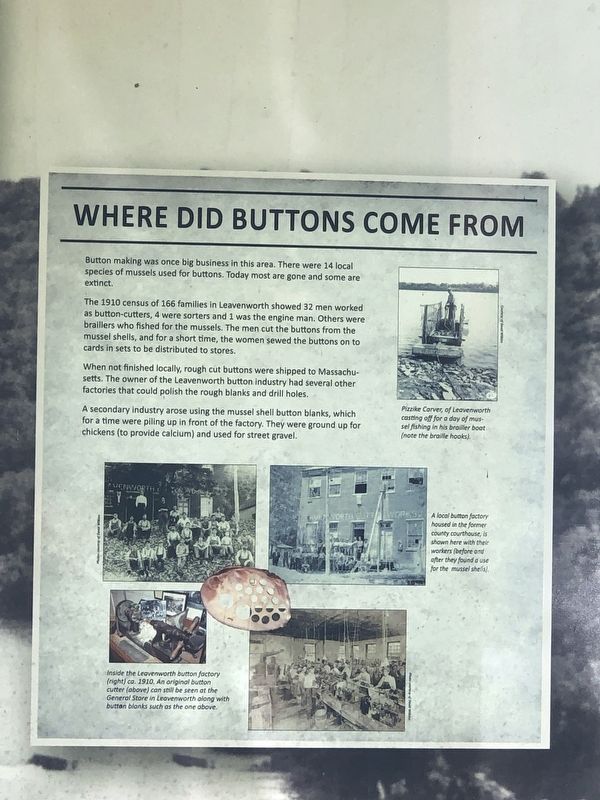
The 1910 Census of 166 families in Leavenworth showed 32 men worked as button-cutters, 4 were sorters and 1 was the engine man. Others were braillers who fished for the mussels. The men cut the buttons from the mussel shells, and for a short time, the women sewed the buttons on to cards in sets to be distributed to stores.
When not finished locally, rough cut buttons were shipped to Massachusetts. The owner of the Leavenworth button industry had several other factories that could polish the rough blanks and drill holes.
A secondary industry arose using the mussel shell button blanks, which for a time were piling up in front of the factory. They were ground up for chickens (to provide calcium) and used for street gravel.
Captions (clockwise from top right)
• Pizzike Carver of Leavenworth casting off for a day of mussel fishing in his brailler boat (note the braille hooks).
• A local button factory housed in the former county courthouse, is shown here with their workers
this page online
• Inside the Leavenworth button factory (right)ca. 1910. An original button cutter (above)can still be seen at the General Store in Leavenworth along with button blanks such as the one above.
Topics. This historical marker is listed in these topic lists: Industry & Commerce • Waterways & Vessels. A significant historical year for this entry is 1910.
Location. 38° 11.703′ N, 86° 20.129′ W. Marker is in Leavenworth, Indiana, in Crawford County. It can be reached from Ohio River Scenic Byway (State Road 62) 0.2 miles west of East Hiawatha Heights, on the left when traveling west. Marker is in a kiosk at Leavenworth Roadside Park. Touch for map. Marker is in this post office area: Leavenworth IN 47137, United States of America. Touch for directions.

Regionally, this marker is in Shawnee Hills and in Southern Indiana. It is also in the American Midwest, in the Ohio River Valley, and in the Corn Belt. Globally, it is in North America, the Western Hemisphere, the Western World, and the Anglosphere. Historically, it finds itself in what was once the territory of the
Photographed by Duane and Tracy Marsteller, September 25, 2022
2. Where Did Buttons Come From Marker
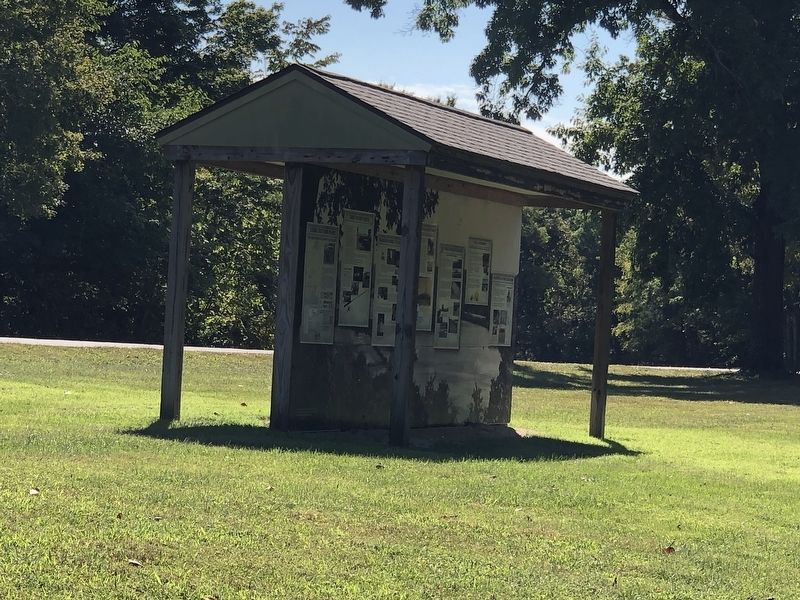
It is in this kiosk in Leavenworth Roadside Park.
Other nearby markers. At least 8 other markers are within 9 miles of this marker, measured as the crow flies: Ohio River Lock and Dam No. 44 (here, next to this marker); Captain Winfield Scott Paris (here, next to this marker); Leavenworth Skiffs (a few steps from this marker); The Hoosier National Forest (a few steps from this marker); Leavenworth (approx. 0.6 miles away); Welcome to Wyandotte and Siberts Cave! (approx. 3.2 miles away); Early Mining at Wyandotte Caves (approx. 3.3 miles away); Mt. Solomon Lutheran Church (approx. 8.9 miles away). Touch for a list and map of all markers in Leavenworth.
Also see . . . Indiana’s Pearl and Button Boom. The rush to find mussels and pearls in Indiana rivers at the turn of the 20th century at times resembled the gold-rush days. (Stephen Taylor, Indiana Historical Bureau Indiana History Blog, posted Jan. 5, 2022) (Submitted on October 3, 2022, by Duane and Tracy Marsteller of Murfreesboro, Tennessee.)
Credits. This page was last revised on October 3, 2022. It was originally submitted on October 3, 2022, by Duane and Tracy Marsteller of Murfreesboro, Tennessee. This page has been viewed 788 times since then and 104 times this year. Photos: 1, 2. submitted on October 3, 2022, by Duane and Tracy Marsteller of Murfreesboro, Tennessee.
