Stuttgart, Baden-Württemberg, Germany — Central Europe
Leonhardskirche

Photographed by Andrew Ruppenstein, September 2, 2022
1. Leonhardskirche Marker

(German:)
(English:)
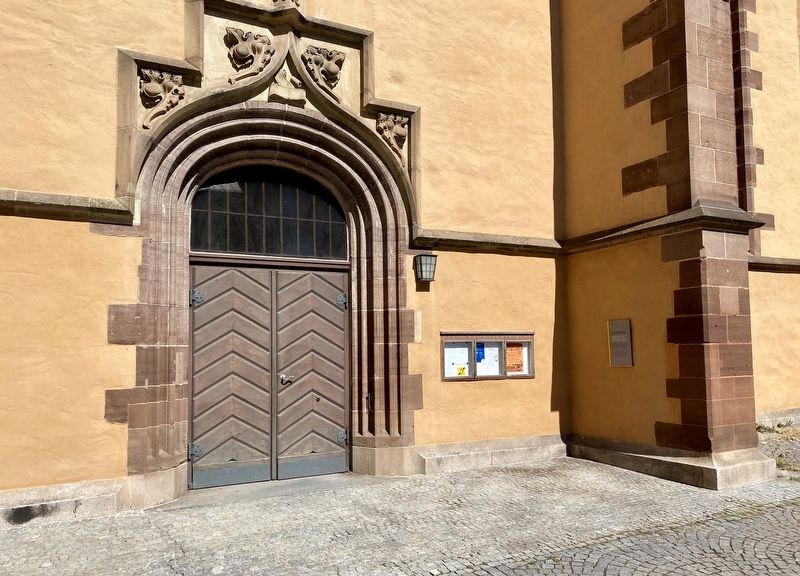
Second oldest church in city area. The Leonhard chapel built 1330 beyond the city wall was expanded in the 15th century. Burial place of Humanist, Johannes Reuchlin († 1522). Reconstructed 1949.
(French:)
Seconde église de la ville par son ancienneté. La chapelle St. Leonhard construite en 1330 hors des murs de la ville fut agrandie au 15e siècle. C'est ici que repose l'humaniste Johannes. Reuchlin († 1522). Reconstruction en 1949.
Erected by Stadt Stuttgart.
Topics. This historical marker is listed in this topic list: Religion & Religious Structures. A significant historical year for this entry is 1330.
Location. 48° 46.394′ N, 9° 10.819′ E. Marker is in Stuttgart, Baden-Württemberg. It is on Leonhardsplatz. Touch for map. Marker is in this post office area: Stuttgart BW 70182, Germany. Touch for directions.

Regionally, this marker is in German Swabia. Globally, it is in Europe, the European Union, Atlantic Europe, Central Europe, the Schengen Area, Western Europe, and the Western World. Historically, it finds itself in what was once the Roman Empire, the Holy Roman Empire, and the former West Germany.
Other nearby markers. At least 8 other markers are within walking distance of this marker: Rest eines Rundturms / Remains of a Round Tower (about 240 meters away, measured in a direct line); Robert Walser (approx. 0.3 kilometers away); Stuttgardia (approx. 0.3 kilometers away); Tritschler Building (approx. 0.3 kilometers away); Die Erste Evangelische Predigt / The First Protestant Service (approx. 0.4 kilometers away); Johann Heinrich Dannecker
this page online
Also see . . . Leonhardskirche (Stuttgart) (Wikipedia).
Excerpt (in translation): "Story: In 1337 a small chapel dedicated to Saint Leonhard was built on the site of today's church - in an open field about 500 meters in front of what was then the Esslinger Gate. The building probably initially served as a station for pilgrims on the Way of St. James pilgrimage route. From the end of the 14th century, outside the Esslinger Gate and with the chapel as the center, a suburb developed, optionally referred to as the Esslinger- or Leonhardsvorstadt after the gate or chapel. Before 1408 the first building was replaced by a single-nave church with a choir and a tower. With the abandonment of the cemetery of the collegiate church, in 1430 the Leonardskirch plaza became a cemetery for the citizens of Stuttgart. The importance of the church continued to grow, although it remained a subsidiary church until 1806....As early as 1463, an extension of the(Submitted on October 12, 2022.)church became necessary, which the master builder of the collegiate church, Aberlin Jörg, carried out until 1466. After this construction measure, the Leonhardskirche presented itself as a late Gothic three-aisled hall church with a slightly retracted choir and a tower standing on the side. The building remained almost unchanged in this form until the time of the Second World War. After the devastating bombardment of Stuttgart in 1944, the badly damaged church was rebuilt in a simplified way by Rudolf Lempp between 1948 and 1954."Photographed by Andrew Ruppenstein, September 2, 20222. Leonhardskirche Marker - wide viewThe marker is visible here mounted to the buttress just to the right of the entrance.
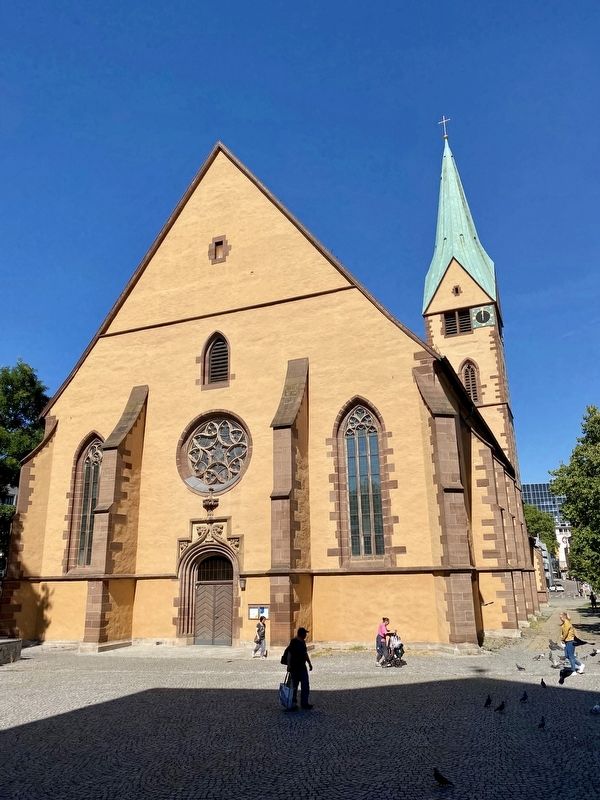
Photographed by Andrew Ruppenstein, September 2, 2022
3. Leonhardskirche, showing the south side of the church
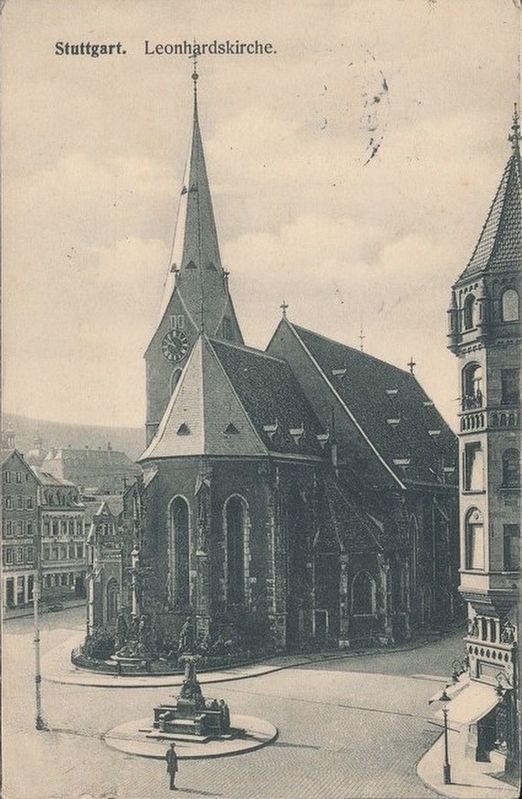
circa 1910
4. Leonhardskirche - view of the north side of the church
Credits. This page was last revised on October 12, 2022. It was originally submitted on October 12, 2022, by Andrew Ruppenstein of Lamorinda, California. This page has been viewed 270 times since then and 20 times this year. Photos: 1, 2, 3, 4. submitted on October 12, 2022, by Andrew Ruppenstein of Lamorinda, California.
