Artesia in San Antonio in Bexar County, Texas — The American South (West South Central)
Saint Philip's Episcopal Church

Photographed by James Hulse, October 9, 2022
1. Saint Philip's Episcopal Church Marker
Under the authority of Bishop James Steptoe Johnston, the first Episcopal Church for African Americans in the Diocese of West Texas was established in 1895. The first home of "St. Philip's Episcopal Church for Negroes" was an old German Methodist Church in downtown San Antonio later known as La Villita. In 1898, the church began a vocational school for African American young people which in 1923 became known as St. Philip's College.
After many years at La Villita, the congregation was forced to find other homes. Beginning in 1917, several locations served in turn as houses of worship for St. Philip's. A new church was erected on Pecan Valley Drive in 1963; it remained the only predominantly African American church in the diocese until 1964.
A full parish since 1967, St. Philip's provides support for many Episcopal programs and funds and is active in community outreach and fellowship.
Erected 1999 by Texas Historical Commission. (Marker Number 11749.)
Topics. This historical marker is listed in these topic lists: African Americans • Religion & Religious Structures. A significant historical year for this entry is 1877.
Location. 29° 24.128′ N, 98° 25.953′ W. Marker is in San Antonio, Texas, in Bexar County. It is in Artesia. It is at the intersection of Pecan Valley Drive and Sewanee Street, on the right when traveling north on Pecan Valley Drive. The marker is located in front of the church by the street. Touch for map. Marker is at or near this postal address: 1310 Pecan Valley
this page online

Regionally, this marker is in South Texas. It is also in the American South. Globally, it is in North America, a Gulf of Mexico state, the Western Hemisphere, the Western World, and the Anglosphere. Historically, it finds itself in what was once New Spain, the Republic of Texas, and one of the Confederate States of America.
Other nearby markers. At least 8 other markers are within 2 miles of this marker, measured as the crow flies: Site of the Camp of Stephen F. Austin (approx. half a mile away); "I Have A Dream Speech" (approx. 1.1 miles away); "I've Been to The Mountaintop" (approx. 1.1 miles away); "The Purpose of Education" (approx. 1.1 miles away); "Loving Your Enemies" (approx. 1.1 miles away); "Beyond Vietnam" (approx. 1.1 miles away); "The Drum Major Instinct" (approx. 1.1 miles away); "Remaining Awake Through A Great Revolution" (approx. 1.1 miles away). Touch for a list and map of all markers in San Antonio.
Also see . . . African-American Churches. Texas State Historical Association
African Americans who entered Texas from(Submitted on October 15, 2022, by James Hulse of Medina, Texas.)the 1820s through the Civil War years generally did so as slaves. In this country they developed a faith born from the union of African traditions and Christian evangelism. Through the eighteenth century slave traders delivered cargoes of men and women either recently enslaved in Africa or transported from plantation islands in the Caribbean. The former usually had had little contact with Christianity, though the Catholic Church had long maintained missions in sub-Saharan Africa. The latter had nurtured the concepts, rituals, and customs of Africa in the diaspora. The Europeans with whom slaves had contact on the plantations of Barbados and elsewhere in the Caribbean basin exerted scant influence on slave religion. By the time owners and traders began transporting slaves to Texas, however, distinctively African-American patterns of worship had evolved. Most slaves had some form of contact with organized Christian churches and merged the ideas they learned there with what they remembered individually or collectively from Africa.Photographed by James Hulse, October 9, 20222. The view of the Saint Philip's Episcopal Church and Marker from the street

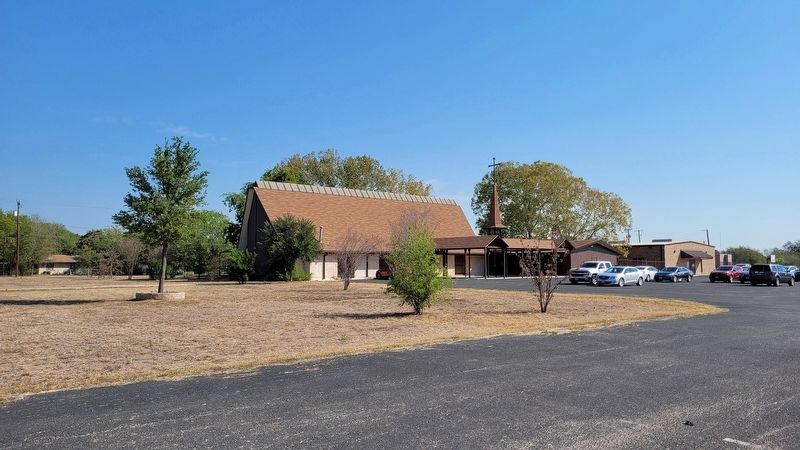
Photographed by James Hulse, October 9, 2022
3. The Saint Philip's Episcopal Church
Credits. This page was last revised on February 2, 2023. It was originally submitted on October 15, 2022, by James Hulse of Medina, Texas. This page has been viewed 590 times since then and 43 times this year. Photos: 1, 2, 3. submitted on October 15, 2022, by James Hulse of Medina, Texas.
