
Fayetteville in Lincoln County, Tennessee — The American South (East South Central)
William Hall
Photographed by Darren Jefferson Clay, October 15, 2022
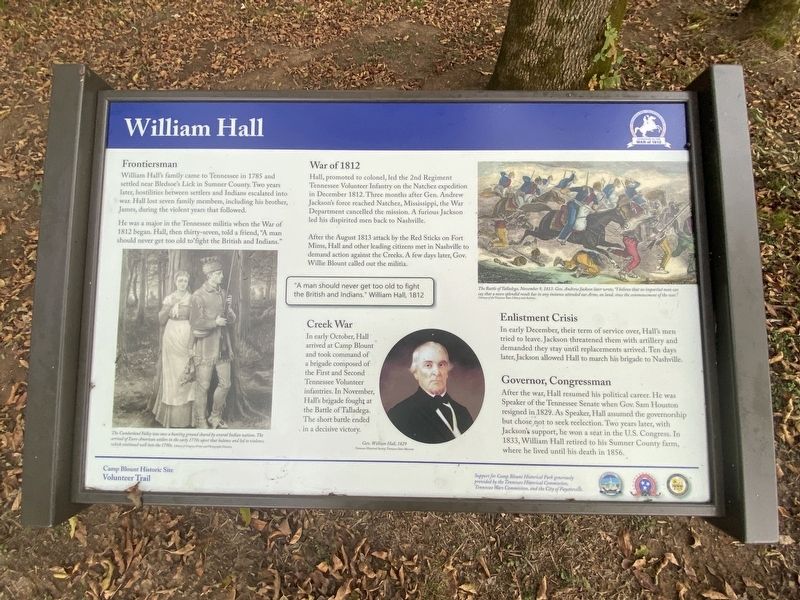
1. William Hall Marker
William Hall's family came to Tennessee in 1785 and settled near Bledsoe's Lick in Summer County. Two years later, hostilities between settlers and Indians escalated into war. Hall lost seven family members, including his brother, James, during the violent years that followed.
He was a major in the Tennessee militia when the War of 1812 began. Hall, then thirty-seven, told a friend, "A man should never get too old to fight the British and Indians."
War of 1812
Hall, promoted to colonel, Ind the 2nd Regiment Tennessee Volunteer Infantry on the Natchez expedition in December 1812. Three months after Gen. Andrew Jackson's force reached Natchez, Mississippi, the War Department cancelled the mission. A furious Jackson led his dispirited men back to Nashville.
After the August 1813 attack by the Red Sticks on Fort Mims, Hall and other leading citizens met in Nashville to demand action against the Creeks. A few days later, Gov. Wille Blount called out the militia.
Creek War
In early October, Hall arrived at Camp Blount and took command of a brigade composed of the First and Second Tennessee
this page online
Enlistment Crisis
In early December, their term of service over, Hall's men tried to leave. Jackson threatened them with artillery and demanded they stay until replacements arrived. Ten days later, Jackson allowed Hall to march his brigade to Nashville.
Governor, Congressman
After the war, Hall resumed his political career. He was Speaker of the Tennessee Senate when Gov. Sam Houston resigned in 1829. As Speaker, Hall assumed the governorship but chose not to seek reelection. Two years later, with Jackson's support, he won a seat in the U.S. Congress. In 1833, William Hall retired to his Sumner County farm where he lived until his death in 1856.
Inset text: "A man should never get too old to fight the British and Indians.” William Hall 1812
Topics. This historical marker is listed in these topic lists: War of 1812 • Wars, US Indian.
Location. 35° 8.537′ N, 86° 33.97′ W. Marker is in Fayetteville, Tennessee, in Lincoln County.
Photographed by Darren Jefferson Clay, October 15, 2022
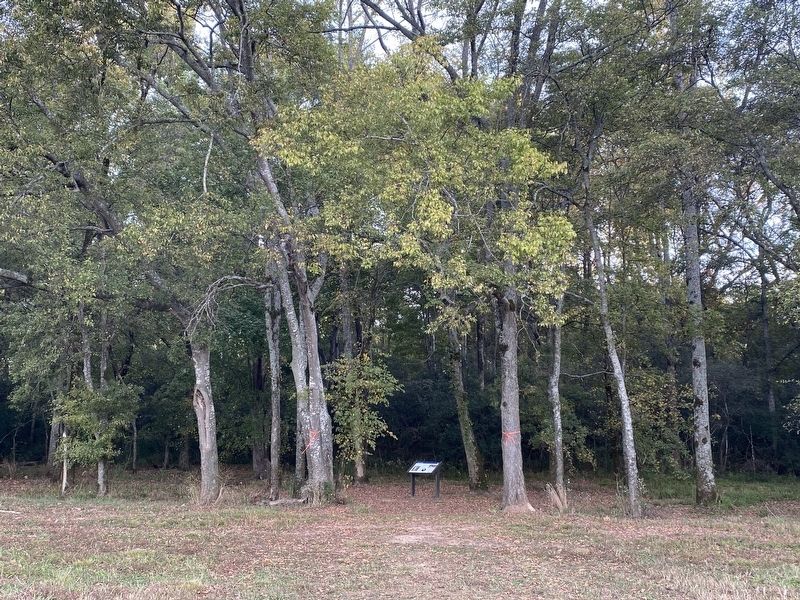
2. William Hall Marker

Regionally, this marker is in Middle Tennessee and in the Highland Rim. It is also in the American South and specifically in the Upper South. Globally, it is in North America, the Western Hemisphere, the Western World, and the Anglosphere. Historically, it finds itself in what was once the territory of the Mississippian Culture, one of the Confederate States of America, and the Antebellum South.
Other nearby markers. At least 8 other markers are within walking distance of this marker: David "Davy" Crockett (within shouting distance of this marker); Sam Houston (within shouting distance of this marker); Andrew Jackson (about 300 feet away, measured in a direct line); Tennessee Volunteers at Camp Blount (about 500 feet away); Carrying Fire and Sword (about 500 feet away); About the Sculpture / About the Artist (about 600 feet away); In the National Spotlight (about 600 feet away); Camp Blount & the "Tennessee Volunteers" (about 700 feet away). Touch for a list and map of all markers in Fayetteville.
Credits. This page was last revised on October 21, 2022. It was originally submitted on October 16, 2022, by Darren Jefferson Clay of Duluth, Georgia. This page has been viewed 583 times since then and 28 times this year. Photos: 1. submitted on October 16, 2022, by Darren Jefferson Clay of Duluth, Georgia. 2. submitted on October 17, 2022, by Darren Jefferson Clay of Duluth, Georgia. • Bill Pfingsten was the editor who published this page.
