Stuttgart, Baden-Württemberg, Germany — Central Europe
Friedrich E. Vogt
Photographed by Andrew Ruppenstein, September 2, 2022
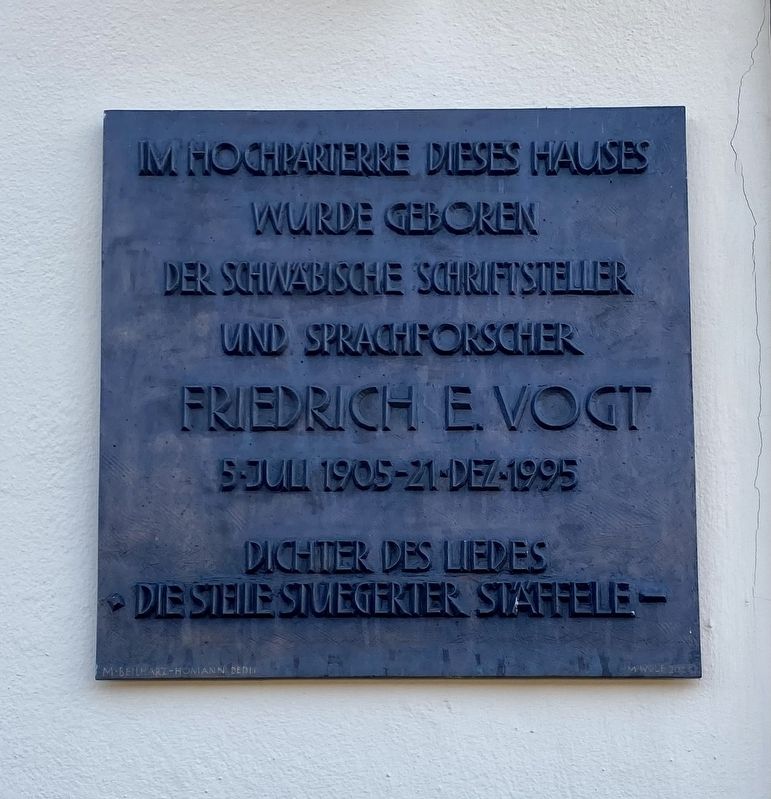
1. Friedrich E. Vogt Marker

wurde geboren
der Schwäbische Schriftsteller
und Sprachforscher
Friedrich E. Vogt
5. Juli 1905 - 21. Dez. 1995
Dichter des Liedes
«Die Steile Stuegekter Stäffele»
In the upper level of this house was born the Swabian author and linguistic researcher, Friedrich E. Vogt (July 5, 1905 - December 21, 1995), writer of the song "Die Steile Stuegekter Stäffele" (The Steep Stuttgart Staircases).
Topics. This historical marker is listed in these topic lists: Arts, Letters, Music • Science & Medicine. A significant historical year for this entry is 1905.
Location. 48° 46.218′ N, 9° 10.571′ E. Marker is in Stuttgart, Baden-Württemberg. It is on Hauptstätter Straße, on the right when traveling north. Touch for map. Marker is at or near this postal address: Hauptstätter Straße 61, Stuttgart BW 70178, Germany. Touch for directions.

Regionally, this marker is in German Swabia. Globally, it is in Europe, the European Union, Atlantic Europe, Central Europe, the Schengen Area, Western Europe, and the Western World. Historically, it finds itself in what
this page online
Other nearby markers. At least 8 other markers are within walking distance of this marker: Rest eines Rundturms / Remains of a Round Tower (about 210 meters away, measured in a direct line); Robert Walser (about 210 meters away); Leonhardskirche (approx. 0.4 kilometers away); Stuttgardia (approx. 0.6 kilometers away); Tritschler Building (approx. 0.6 kilometers away); Johann Heinrich Dannecker (approx. 0.7 kilometers away); Neue Kanzlei / New Chancellery (approx. 0.7 kilometers away); Die Erste Evangelische Predigt / The First Protestant Service (approx. 0.7 kilometers away). Touch for a list and map of all markers in Stuttgart.
Also see . . .
1. Oscar Müller - D' steile Stuagerter Stäffela (Youtube, 2 min.). Vogt's song, "The Steep Stuttgart Staircases", sung in the dialect of Stuttgart - Swabian. (Submitted on October 18, 2022.)
2. Stuttgarter Stäffele (Wikipedia, in German). Notes that in earlier times, Stuttgart's hills were covered in vineyards, with stone stairways leading up the hills. With urbanization, these stairways
Photographed by Andrew Ruppenstein, September 2, 2022
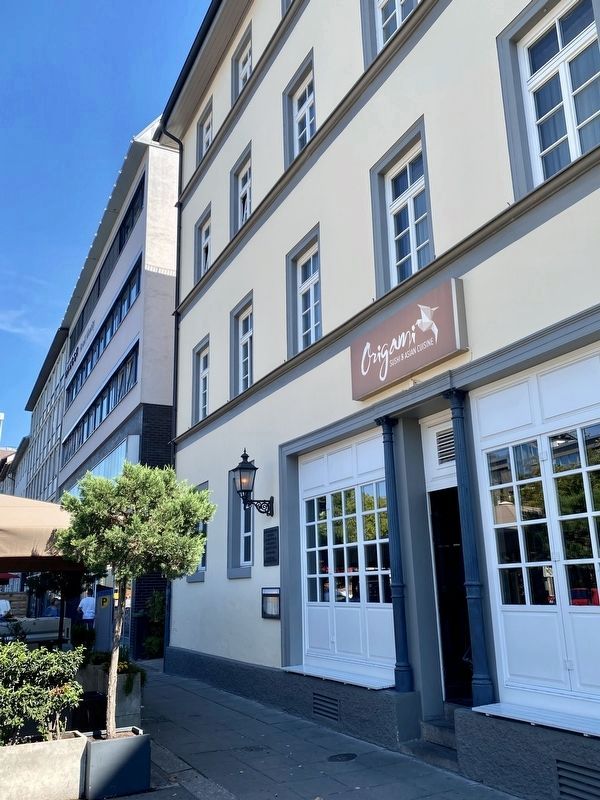
2. Friedrich E. Vogt Marker - wide view
The marker is visible here just below the lamplight.
On the cultural importance of the stairways (in translation): 'Various city walks, the so-called “Stäffelestouren”, have been offered on the Stäffele since the 1980s . In addition to the classic city tours, these are rather small hikes and are offered both by the city of Stuttgart and by numerous independent city guides. Stäffele in Stuttgart are not only used for locomotion, they are also used by citizens and guests as vantage points and meeting points. Literary and sporting events are becoming increasingly fashionable on the staircases, as are workouts and dating.'(Submitted on October 18, 2022.)
3. Friedrich E. Vogt (Wikipedia, in Allemanisch). Biography of Vogt in Allemanisch, which is the dialect (or group of dialects) to which Swabian, Vogt's native tongue and subject of study, belongs. It is spoken in the Stuttgart area. There doesn't seem to be anything on the internet on Vogt that would be more accessible. (Submitted on October 18, 2022.)
Credits. This page was last revised on October 18, 2022. It was originally submitted on October 18, 2022, by Andrew Ruppenstein of Lamorinda, California. This page has been viewed 231 times since then and 26 times this year. Photos: 1, 2. submitted on October 18, 2022, by Andrew Ruppenstein of Lamorinda, California.
