Latchford in Timiskaming District, Ontario — Central Canada (North America)
Founding of the Town of Latchford
⎯⎯⎯
Fondation de la Ville de Latchford
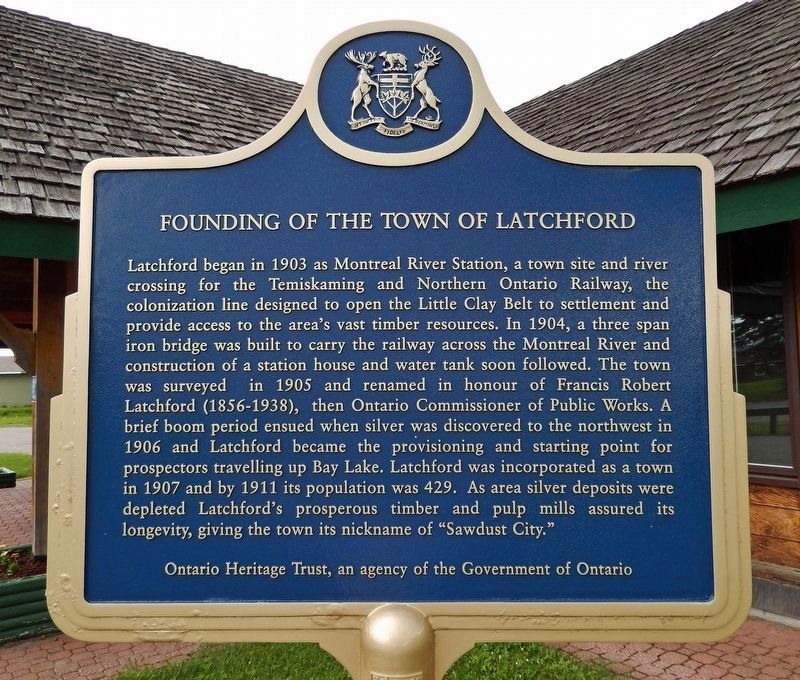
Photographed by Cosmos Mariner, June 1, 2022
1. Founding of the Town of Latchford
(marker west side)
(marker west side)

Latchford began in 1903 as Montreal River Station, a town site and river crossing for the Temiskaming and Northern Ontario Railway, the colonization line designed to open the Little Clay Belt to settlement and provide access to the area's vast timber resources. In 1904, a three span iron bridge was built to carry the railway across the Montreal River and construction of a station house and water tank soon followed. The town was surveyed in 1905 and renamed in honour of Francis Robert Latchford (1856-1938), then Ontario Commissioner of Public Works. A brief boom period ensued when silver was discovered to the northwest in 1906 and Latchford became the provisioning and starting point for prospectors travelling up Bay Lake. Latchford was incorporated as a town in 1907 and by 1911 its population was 429. As area silver deposits were depleted Latchford's prosperous timber and pulp mills assured its longevity, giving the town its nickname of "Sawdust City."
Latchford voit le jour en 1903 sous le nom de Montreal River Station. Elle est à a fois un site urbain et un lieu de franchissement de la rivière
this page online
Erected by Ontario Heritage Trust / Fiducie du patrimoine ontarien.
Topics and series.
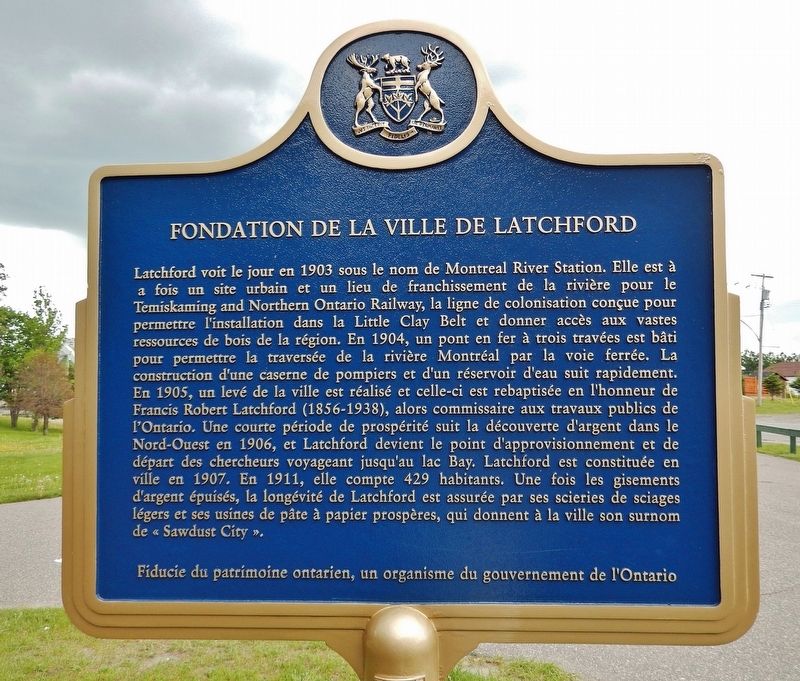
Photographed by Cosmos Mariner, June 1, 2022
2. Fondation de la Ville de Latchford
(marker east side)
(marker east side)
Location. 47° 19.464′ N, 79° 48.633′ W. Marker is in Latchford, Ontario, in Timiskaming District. It is on Main Street (Trans-Canada Highway) (Provincial Highway 11) 0.1 kilometers north of McLeod Avenue, on the right when traveling north. Marker is located in front of the Latchford Town Office. Touch for map. Marker is at or near this postal address: 10 Main Street, Latchford ON P0J 1N0, Canada. Touch for directions.

Regionally, this marker is in Northeastern Ontario and specifically in Northern Ontario. It is also in Central Canada. Globally, it is in North America, the Great North Woods, the Western Hemisphere, the Western World, and the Anglosphere. Historically, it finds itself in what was once a British colony, the Viceroyalty of New France, the Haudenosaunee (Iroquois) Confederacy, and Rupert’s Land.
Other nearby markers. At

Photographed by Cosmos Mariner, June 1, 2022
3. Marker is in front of the Latchford Town Office
Also see . . .
1. Latchford, Ontario.
Latchford was first settled in 1902 when the decision to build the Temiskaming and Northern Ontario Railway (now the Ontario Northland Railway) was struck. It was decided the railway would cross the Montreal River at the location of what is today Latchford, and a bridge was finished in 1904. Hence, the settlement was known first as Montreal River Station. A dam that provided hydroelectric power, as well as a vehicle crossing over the river, was built in 1910, and Ontario Highway 11 including a bridge(Submitted on October 22, 2022, by Cosmos Mariner of Cape Canaveral, Florida.)over the river was built finished through the town in 1927. Silver mining, forestry, and later tourism, drove Latchford’s economy throughout the 20th century.Photographed by Cosmos Mariner, June 1, 20224. Montreal River Railway Bridge (1904)(about 200 yards south of the marker)

2. Montreal River Railway Bridge.
The railroad bridge consists of three-span 38.1 m (125 ft) Pratt through truss spans. It was built in 1904 by the Dominion Bridge Company of Montreal for the Temiskaming and Northern Ontario Railway. The railway was renamed the Ontario Northland Railway in 1946. The portal bracing on this bridge has been replaced and altered.(Submitted on October 22, 2022, by Cosmos Mariner of Cape Canaveral, Florida.)
Credits. This page was last revised on October 22, 2022. It was originally submitted on October 22, 2022, by Cosmos Mariner of Cape Canaveral, Florida. This page has been viewed 631 times since then and 98 times this year. Photos: 1, 2, 3, 4. submitted on October 22, 2022, by Cosmos Mariner of Cape Canaveral, Florida.
