South Los Angeles in Los Angeles County, California — The American West (Pacific Coastal)
Los Angeles Memorial Coliseum
courtesy City of Los Angeles, October 22, 2022
1. Los Angeles Memorial Coliseum Marker
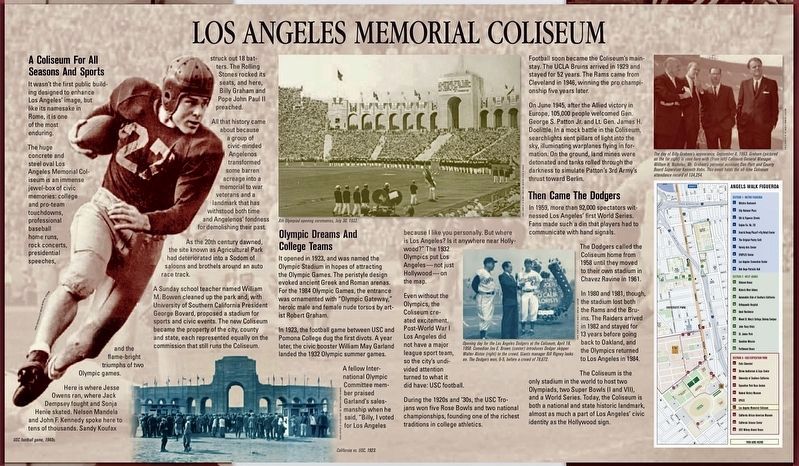
A Coliseum For All Seasons And Sports
It wasn't the first public building designed to enhance Los Angeles' image, but like its namesake in Rome, it is one of the most enduring.
The huge concrete and steel oval Los Angeles Memorial Coliseum is an immense jewel-box of civic memories: college and pro-team touchdowns, professional baseball home runs, rock concerts, presidential speeches, and the flame-bright triumphs of two Olympic games.
Here is where Jesse Owens ran, where Jack Dempsey fought and Sonja Henie skated. Nelson Mandela and John F. Kennedy spoke here to tens of thousands. Sandy Koufax struck out 18 batters. The Rolling Stones rocked its seats, and here, Billy Graham and Pope John Paul II preached.
All that history came about because a group of civic-minded Angelenos transformed some barren acreage into a memorial to war veterans and a landmark that has withstood both time and Angelenos' fondness for demolishing their past.
As the 20th century dawned, the site known as Agricultural Park had deteriorated into a Sodom of saloons and brothels around an auto race track.
A Sunday school teacher named William M. Bowen cleaned up the park and,
this page online
Olympic Dreams And College Teams
It opened in 1923, and was named the Olympic Stadium in hopes of attracting the Olympic Games. The peristyle design evoked ancient Greek and Roman arenas. For the 1984 Olympic Games, the entrance was ornamented with "Olympic Gateway," heroic male and female nude torsos by artist Robert Graham.
In 1923, the football game between USC and Pomona College dug the first divots. A year later, the civic booster William May Garland landed the 1932 Olympic summer games.
A fellow Inter-national Olympic Committee mem-ber praised Garland's sales-manship when he said, "Billy, I voted for Los Angeles because I like you personally. But where is Los Angeles? Is it anywhere near Hollywood?" The 1932 Olympics put Los Angeles — not just Hollywood — on the map.
Even without the Olympics, the Coliseum cre-ated excitement. Post-World War I Los Angeles did not have a major league sport team, so the city's
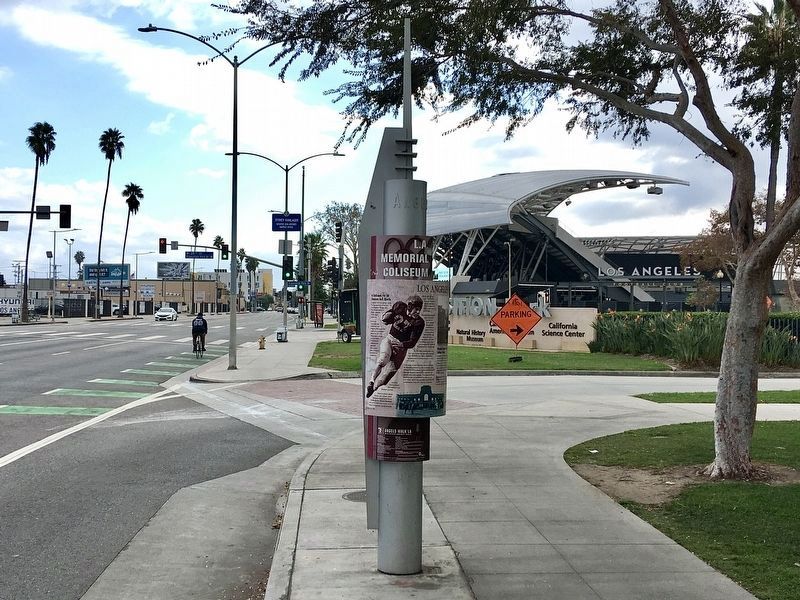
Photographed by Craig Baker, October 22, 2022
2. Los Angeles Memorial Coliseum Marker
During the 1920s and '30s, the USC Trojans won five Rose Bowls and two national championships, founding one of the richest traditions in college athletics.
Football soon became the Coliseum's main-stay. The UCLA Bruins arrived in 1929 and stayed for 52 years. The Rams came from Cleveland in 1946, winning the pro champi-onship five years later.
On June 1945, after the Allied victory in Europe, 105,000 people welcomed Gen. George S. Patton Jr. and Lt. Gen. James H. Doolittle. In a mock battle in the Coliseum, searchlights sent pillars of light into the sky, illuminating warplanes flying in formation. On the ground, land mines were detonated and tanks rolled through the darkness to simulate Patton's 3rd Army's thrust toward Berlin.
Then Came The Dodgers
In 1959, more than 92,000 spectators witnessed Los Angeles' first World Series. Fans made such a din that players had to communicate with hand signals.
The Dodgers called the Coliseum home from 1958 until they moved to their own stadium in Chavez Ravine in 1961.
In 1980 and 1981, though, the stadium lost both the Rams and the Bruins. The Raiders
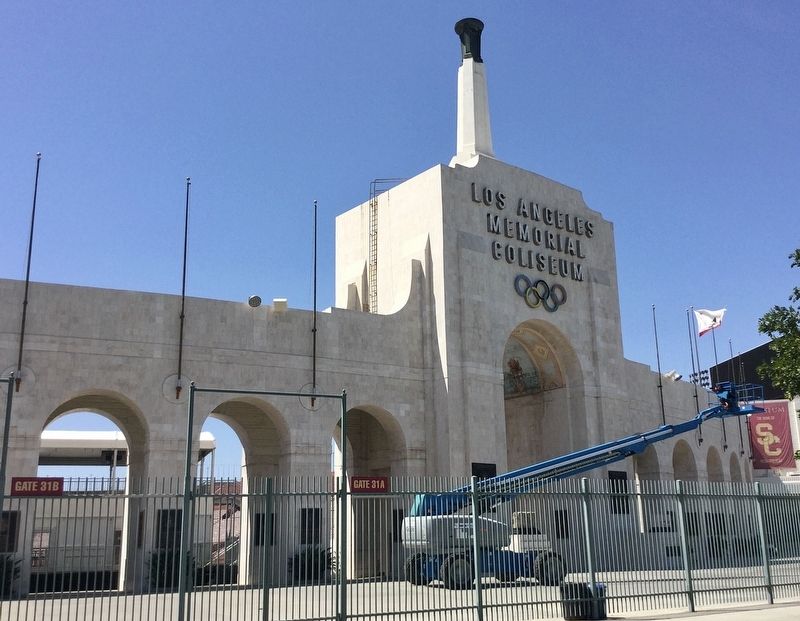
Photographed by Craig Baker, April 20, 2018
3. Los Angeles Memorial Coliseum
The Coliseum is the only stadium in the world to host two Olympiads, two Super Bowls (I and VII), and a World Series. Today, the Coliseum is both a national and state historic landmark, almost as much a part of Los Angeles' civic identity as the Hollywood sign.
Erected by City of Los Angeles.
Topics. This historical marker is listed in these topic lists: Architecture • Sports. A significant historical year for this entry is 1923.
Location. 34° 0.881′ N, 118° 16.98′ W. Marker is in Los Angeles, California, in Los Angeles County. It is in South Los Angeles. It is at the intersection of Figueroa Street and Exposition Park Drive, on the right when traveling south on Figueroa Street. Touch for map. Marker is in this post office area: Los Angeles CA 90037, United States of America. Touch for directions.

Regionally, this marker is in the Transverse Ranges. It is also on the American Pacific Coast. Globally, it is in North America, on the Ring of Fire, on the Pacific Rim, in the Western Hemisphere, in the Western World, and in the Anglosphere. Historically,
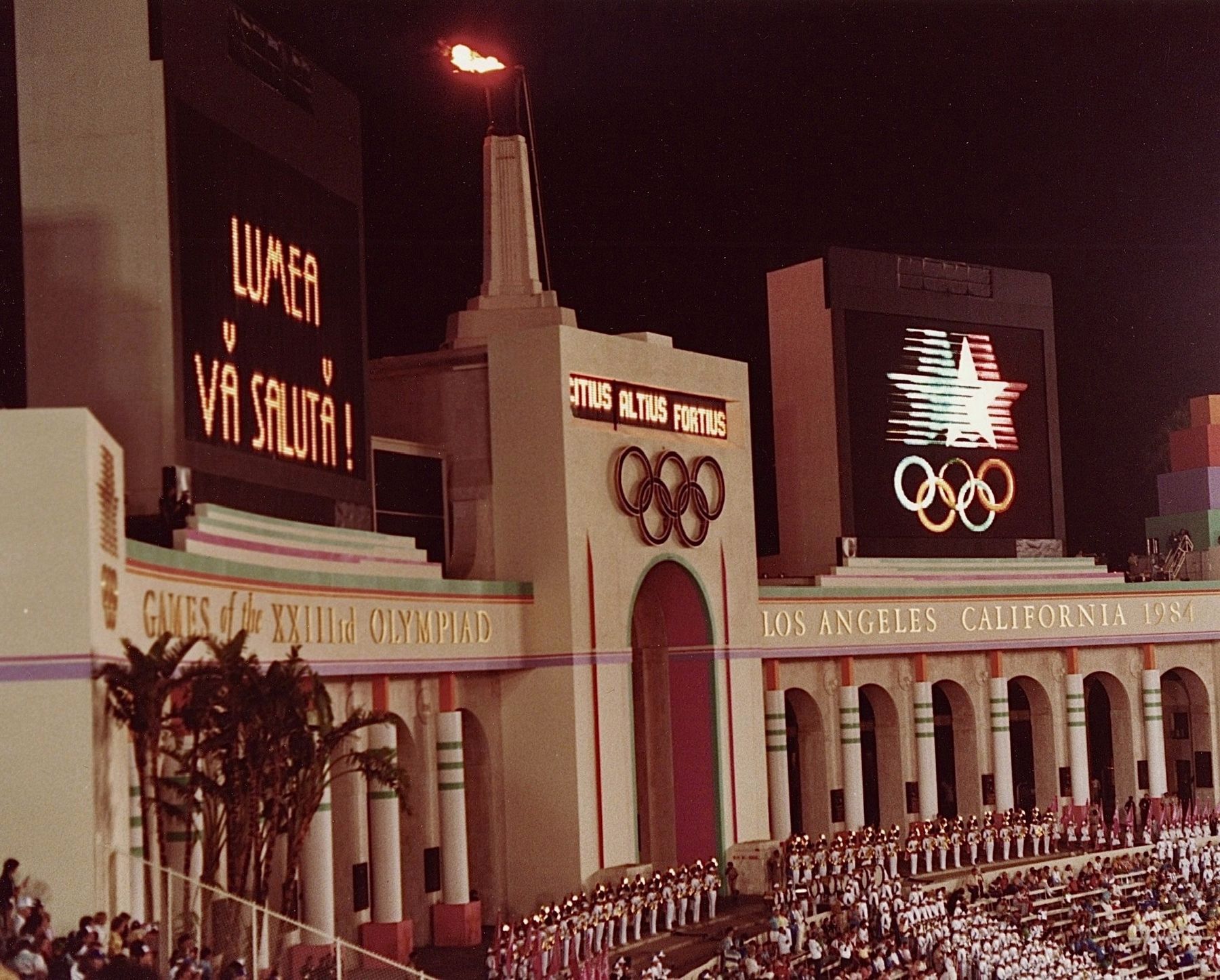
Photographed by Craig Baker, August 12, 1984
4. 1984 Olympics Closing Ceremony
Other nearby markers. At least 8 other markers are within walking distance of this marker: Historic Palm Tree (within shouting distance of this marker); Los Angeles Sports Arena (about 400 feet away, measured in a direct line); Spy in the Sky (about 500 feet away); a different marker also named Spy in the Sky (about 600 feet away); Zobelein Estate (about 600 feet away); Wishing on a Star, 2009 (about 600 feet away); California African American Museum (about 600 feet away); California Science Center (about 700 feet away). Touch for a list and map of all markers in Los Angeles.
Regarding Los Angeles Memorial Coliseum. The stadium will host a third Olympiad in 2028.
Also see . . . Angels Walk L.A. Self-guided walking tours of historic neighborhoods in Los Angeles. The Coliseum marker is part of the Figueroa walk. (Submitted on October 23, 2022.)
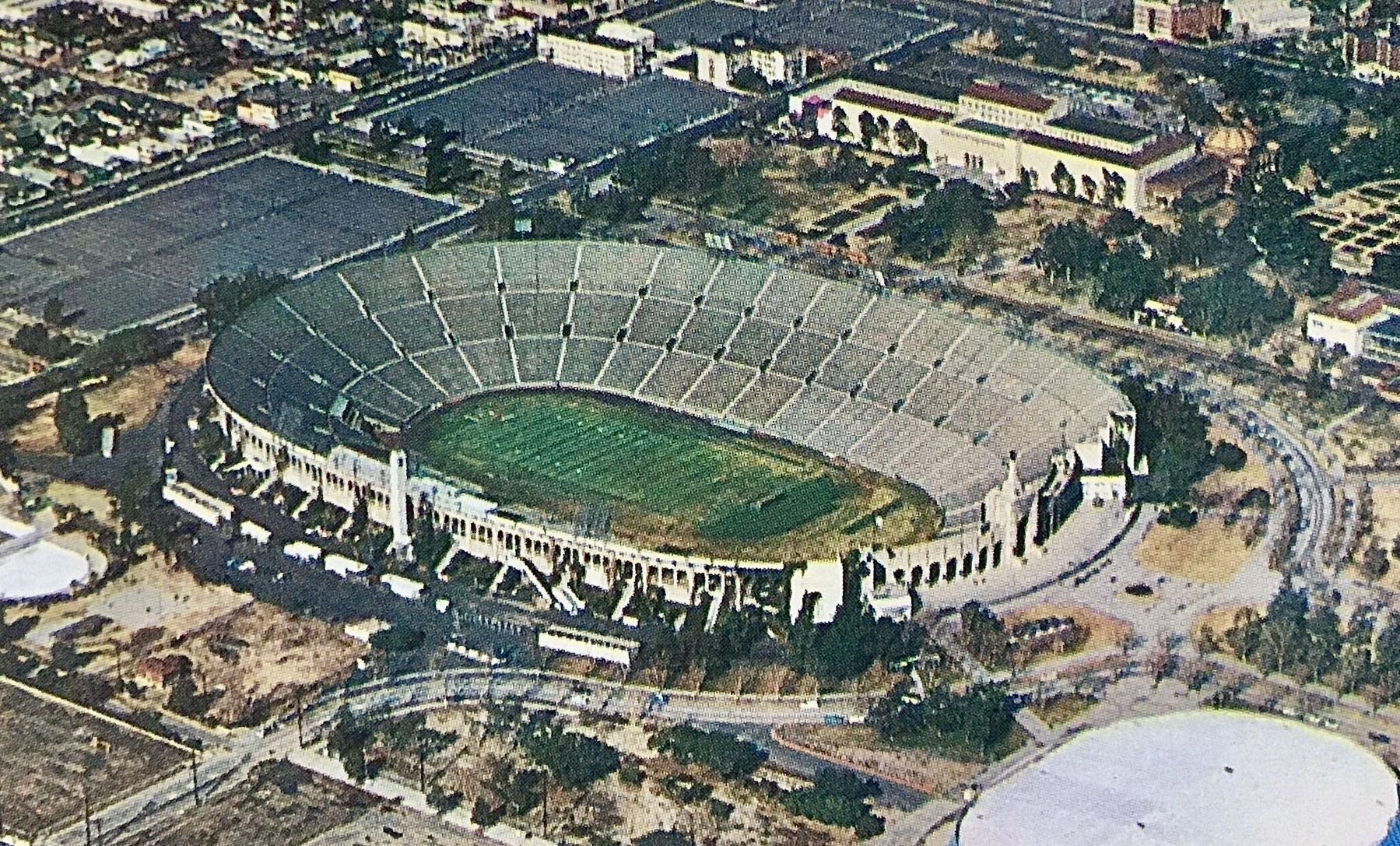
Public Domain, circa 1970
5. Postcard - circa 1970
Credits. This page was last revised on May 21, 2026. It was originally submitted on October 23, 2022, by Craig Baker of Sylmar, California. This page has been viewed 502 times since then and 49 times this year. Photos: 1, 2, 3, 4, 5. submitted on October 23, 2022, by Craig Baker of Sylmar, California.
