New Brunswick in Middlesex County, New Jersey — The American Northeast (Mid-Atlantic)
New Brunswick and the American Revolution
⎯⎯⎯
Crossroads of the American Revolution
Crossroads of the American Revolution National Heritage Area
Photographed by Devry Becker Jones (CC0), October 29, 2022
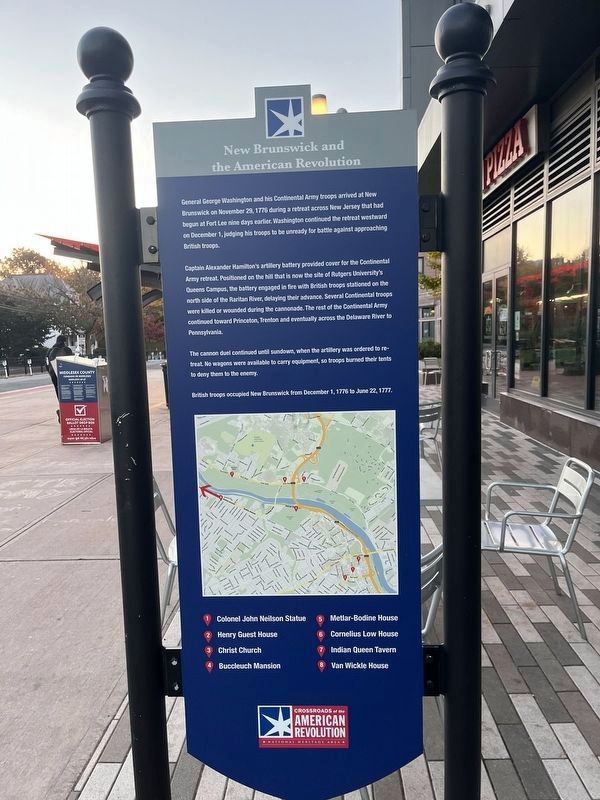
1. New Brunswick and the American Revolution side of the marker
New Brunswick and the American Revolution
General George Washington and his Continental Army troops arrived at New Brunswick on November 29, 1776 during a retreat across New Jersey that had begun at Fort Lee nine days earlier. Washington continued the retreat westward on December 1, judging his troops to be unready for battle against approaching British troops.
Captain Alexander Hamilton's artillery battery provided cover for the Continental Army retreat. Positioned on the hill that is now the site of Rutgers University's Queens Campus, the battery engaged in fire with British troops stationed on the north side of the Raritan River, delaying their advance. Several Continental troops were killed or wounded during the cannonade. The rest of the Continental Army continued toward Princeton, Trenton and eventually across the Delaware River to Pennsylvania.
The cannon duel continued until sundown, when the artillery was ordered to retreat. No wagons were available to carry equipment, so troops burned their tent to deny them to the enemy.
British troops occupied New Brunswick from December 1, 1776 to June 22, 1777.
Crossroads of the American Revolution
From
this page online
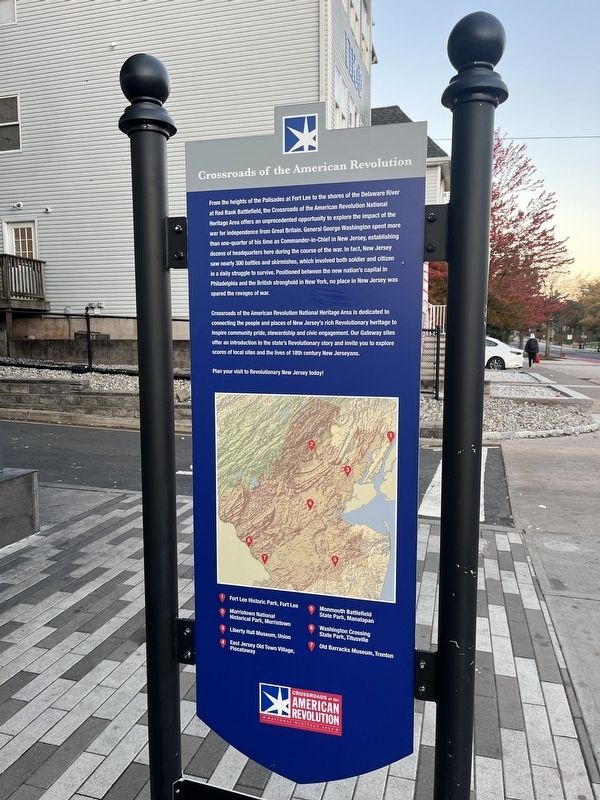
Crossroads of the American Revolution National Heritage Area is dedicated to connecting the people and places of New Jersey's rich Revolutionary heritage to inspire community pride, stewardship and civic engagement. Our Gateway sites offer an introduction to the state's Revolutionary story and invite you to explore scores of local sites and the lives of 18th century New Jerseyans.
Plan your visit to Revolutionary
Photographed by Devry Becker Jones (CC0), October 29, 2022
2. Crossroads of the American Revolution side of the marker
Topics. This historical marker is listed in this topic list: War, US Revolutionary. A significant historical date for this entry is June 22, 1777.
Location. 40° 29.982′ N, 74° 26.911′ W. Marker is in New Brunswick, New Jersey, in Middlesex County. It is on College Avenue 0.1 miles north of Hamilton Street, on the left when traveling north. Touch for map. Marker is at or near this postal address: 50 College Ave, New Brunswick NJ 08901, United States of America. Touch for directions.

Regionally, this marker is in Central Jersey, in Greater Princeton, and in the New York City Metropolitan Area. It is also in the American Northeast, in the Mid-Atlantic, and on the Eastern Seaboard. Globally, it is in the North Atlantic Region, North America, the Western Hemisphere, the Western World, and the Anglosphere. Historically, it finds itself in what was once New Netherland and also one of the original Thirteen Colonies.
Other nearby markers. At least 8 other markers are within walking distance of this marker: Gray Terrace (within shouting distance of this marker); Will’s Way (about 600 feet away, measured in a direct line);
Photographed by Devry Becker Jones (CC0), October 29, 2022
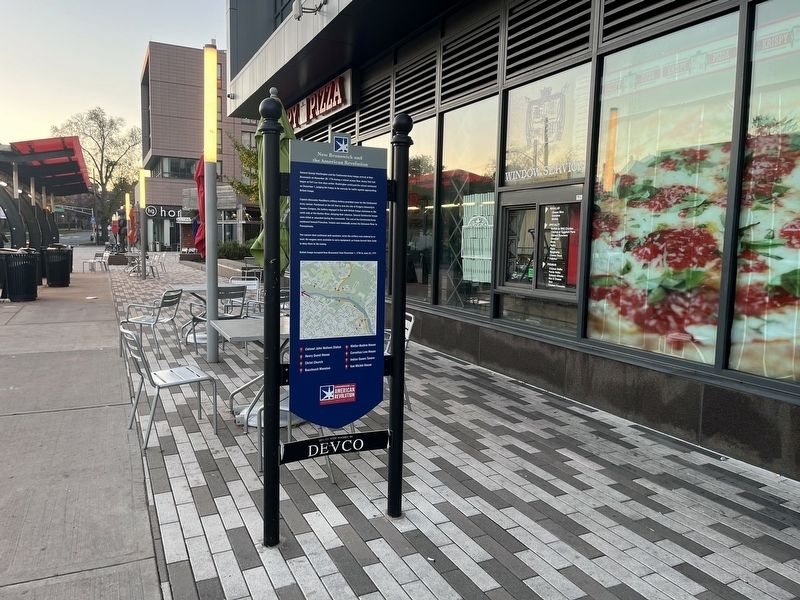
3. New Brunswick and the American Revolution / Crossroads of the American Revolution Marker
Credits. This page was last revised on October 30, 2022. It was originally submitted on October 30, 2022, by Devry Becker Jones of Washington, District of Columbia. This page has been viewed 1,662 times since then and 200 times this year. Photos: 1, 2, 3. submitted on October 30, 2022, by Devry Becker Jones of Washington, District of Columbia.
